You will see the line “Do not pray for an easy life; pray for the strength to endure a difficult one” stamped on shirts, mugs, and Templar memes — often as if a medieval knight had said it. Here is the honest answer up front: this is a modern saying, not a documented Templar quote, and it is most often attributed to the martial artist Bruce Lee in the twentieth century. So why does it fit the Knights Templar so well? Because the historical order really did build its entire way of life around strength through hardship. This post separates the modern motto from the medieval reality — and shows why the two speak so clearly to each other.
Where the Quote Actually Comes From
No medieval source supports this sentence. It appears in no chronicle, no surviving version of the Templar Rule, and no record of the order’s prayers. The phrasing is distinctly modern, and it is commonly credited to Bruce Lee, echoing older Stoic-flavored and self-improvement ideas about resilience.

Being clear about that is not a weakness — it is the difference between honoring history and inventing it. Treat the line as a modern attribution, not a medieval one. You can admire the sentiment and still refuse to put words in a dead knight’s mouth. The good news is that the real Templar story is more demanding, and more interesting, than any invented slogan.
It is worth contrasting the invented line with a phrase the order genuinely embraced. Templar tradition is strongly associated with the humble psalm verse “Non nobis, Domine, non nobis, sed nomini tuo da gloriam” — “Not to us, Lord, not to us, but to your name give the glory.” That prayer of self-effacement tells us far more about the brothers’ mindset than any modern slogan could, precisely because it belongs to their own devotional world rather than to ours.
Misattributions like this one spread easily online, where a striking sentence gets welded to a dramatic historical name and then repeated until it looks official. The Templars attract more than their share of this treatment, because their mystique seems to invite invented depth. Resisting that habit — asking “who actually said this, and when?” — is part of taking the history seriously rather than reducing it to a meme.
The Templars Really Did Live a Hard Life
The Rule endorsed at the Council of Troyes in 1129, under the influence of Bernard of Clairvaux, imposed a deliberately austere, monastic discipline on the brothers. On top of the vows of poverty, chastity, and obedience, daily life was ordered to be difficult on purpose:
- Poverty: no personal property; even clothing was issued and held in common.
- Fasting and plain food: regular fast days, with meat limited to only a few days each week.
- Silence and prayer: meals taken in silence while scripture was read aloud, the day framed by the canonical hours.
- Penance: breaches of the Rule met with real, sometimes harsh, discipline.
- Readiness to die: brothers were forbidden to flee in battle unless the odds passed a set threshold.
The texture of that discipline was concrete. Brothers commonly ate in pairs, sharing portions so that food was watched and waste avoided; the day was punctuated by the canonical hours, beginning with the night office of Matins in the dark. Rest was cut short by prayer, speech was limited, and even small comforts were rationed. It was, by deliberate design, a life with very little softness in it.
This was not hardship for its own sake but a system built to forge endurance. The rhythm of that life — rising for night offices, drilling, serving, praying — is laid out in our account of the hard daily discipline of a Knight Templar.
Do Not Pray for Easy Life
A modern statement of an old mindset — strength through hardship, worn on purpose.
🇺🇸 Fast US shipping · 🇪🇺 Ships across the EU · 🔒 Secure checkout
Strength Through Hardship: The Idea Behind It
The medieval frame for all this was not modern self-improvement but redemptive suffering. In the Christian thought that shaped the order, hardship was a spiritual discipline: a way to imitate Christ, purify the will, and turn a soldier into a servant of God. The warrior-monk embraced difficulty as a path rather than an obstacle, believing that endurance itself had value before God.
This is exactly where the modern motto genuinely rhymes with the medieval ethos. “Don’t ask for ease, ask for the strength to endure” is, in spirit, a fair summary of how the Templars actually lived — even though the words themselves belong to our century, not theirs.
The theology behind this was articulated by Bernard of Clairvaux himself, whose treatise In Praise of the New Knighthood (De laude novae militiae) defended the very idea of a warrior-monk. For Bernard, the Templar’s hard, disciplined life was not a contradiction of Christian devotion but an expression of it — a soldier’s endurance turned toward God. That framing, not a twentieth-century quote, is the true ancestor of any “strength through hardship” message we might attach to the order today.
Why the Modern Motto Still Fits
Used honestly, the saying works as a tribute rather than a forgery. It captures a real truth about the order: the Templars did not pray to have their trials removed. They trained, fasted, and disciplined themselves precisely so they could bear what came — heat, siege, wounds, and the constant threat of death in the field. The phrase resonates because the mindset behind it was lived out, in documented detail, for nearly two centuries.
The only rule is not to pretend a knight coined it. Say plainly that it is a modern line channeling an old spirit, and it becomes a legitimate, even powerful, way to connect with Templar history.
There is also a caution worth keeping. The Templars’ austerity aimed at humility and service, not self-image; the same Rule that demanded toughness also condemned pride and vanity. A modern motto honors that legacy best when it points outward — toward endurance and duty — rather than becoming a boast. Read that way, the phrase stays true to the spirit that produced it.
Wearing the Idea Today
People have always carried short phrases as reminders of how they want to live, and modern enthusiasts do the same — something we explore in our guide to wearing Templar mottos on modern dog-tag necklaces. The “Do Not Pray for Easy Life” shirt belongs to that tradition: a modern statement of an old mindset, worn on purpose.
Worn honestly, such a phrase is less a costume than a compass — a daily nudge toward patience and grit. The Templars would likely have distrusted any slogan worn for show, but they clearly understood the value of a short rule of life, repeated until it shaped behavior. That is the useful, non-mythical way to carry these words: not as a claim about the past, but as a discipline for the present.
So did a Templar say it? No — and we should not claim he did. But the idea it carries is faithful to a brotherhood that chose the harder road on principle. Wear the words if they steady you, and let them point back to the disciplined, demanding life that gave them their weight.
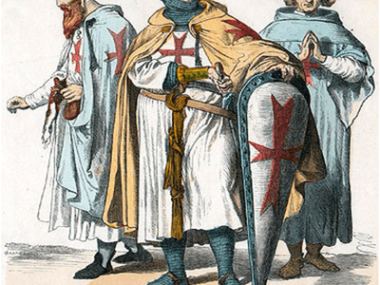
 Templar Uniform Editorial