“God wills it” in Latin is Deus vult — two words, and you do not need a third. Deus is “God”. Vult is “he wills”, the third-person singular of velle, to will or to wish. English insists on an object pronoun; Latin does not, so Deus vult already contains the “it”.
That is the whole answer, and it is the one most people are looking for. What follows is the part that trips people up: the medieval chroniclers who recorded the cry at Clermont in 1095 did not all spell it the same way, and a large share of people searching for “God’s will in Latin” actually want a completely different phrase.

Deus vult, word by word
Two words, two jobs:
- Deus — “God”, nominative singular. It is the subject doing the willing.
- vult — “wills”, third-person singular present active of the irregular verb volō, velle. The present tense runs volō, vīs, vult, volumus, vultis, volunt.
The common objection — where is the word for “it”? — has a simple answer. Latin routinely drops an object that context already supplies. A Roman reading Deus vult would not feel anything missing. If you want to be explicit, you can say Deus hoc vult, “God wills this”, or Deus id vult, “God wills that”. Neither is more correct; they are more pointed.
Deus vult, Deus lo vult, Deus hoc vult — which one is right?
All three circulate, and all three have medieval warrant. They are not competing spellings of one word so much as three different registers of Latin.
- Deus vult — clean classical grammar. Robert the Monk, writing his Historia Iherosolimitana in the early twelfth century, puts this in the mouths of the crowd at Clermont.
- Deus lo vult / Deus le volt — the forms that appear in the Gesta Francorum and accounts close to it. The lo or le is a Romance object pronoun, “it”. This is Latin as it was actually being spoken in northern France while it slid toward Old French, and the pronoun is the sound of that drift.
- Deus hoc vult — “God wills this”, with the demonstrative hoc doing the pointing. Perfectly classical, and a touch more emphatic.
One caution worth more than any of the three. Nobody at Clermont was taking dictation. Every surviving version of the cry was written down years afterwards, several by men reconstructing a speech from report rather than memory. What the sources preserve is roughly how the phrase sounded to people who had heard it talked about — not a transcript. If you want the full account of what happened in that field in November 1095, we cover it in the real story behind Deus vult.
In Hoc Signo Vinces – Christian Knight Tee
If you are going to wear Latin, wear it spelled right. Four words, clean type, no translation needed.
🇺🇸 Fast US shipping · 🇪🇺 Ships across the EU · 🔒 Secure checkout
“God’s will” is a different phrase: voluntas Dei
This is the distinction that sends most people away with the wrong Latin. Deus vult is a sentence — a subject and a verb, “God wills it”. “God’s will” is a noun phrase, and in Latin it is voluntas Dei: voluntas, will or intention, and Dei, “of God”, in the genitive.
The ones people most often actually want:
- God’s will / the will of God — voluntas Dei
- Thy will be done — fiat voluntas tua, from the Pater Noster in the Vulgate (Matthew 6:10)
- God willing — Deo volente, abbreviated D.V. in older English letters. It is an ablative absolute, literally “God being willing”.
- If God wills — si Deus vult
- According to God’s will — secundum voluntatem Dei
Pick by grammar, not by vibe. A tattoo or an engraving reading Deus vult says “God wills it”; one reading voluntas Dei says “the will of God”. They are not interchangeable, and a Latinist will notice.
How to pronounce it
Two defensible answers, depending on which Latin you mean.
- Ecclesiastical (Church) Latin: DAY-oos VOOLT. This is what you hear in choral settings and what almost everyone saying the phrase today uses.
- Reconstructed classical: DEH-oos WOOLT. Classical Latin v was sounded like an English w, which is also why Caesar’s veni, vidi, vici began life closer to weni, widi, wiki.
The u in vult is short — closer to the vowel in “pull” than the one in “pool”. Neither pronunciation is wrong; just do not mix them inside one phrase.
The spellings that go wrong
These turn up constantly, and a couple of them are more forgivable than they look.
- Deus volt — the most frequent. On its own it is a misspelling, and you should write vult. But volt is not invented: it is the vulgar form that travels with a pronoun, as in Deus lo volt. Dropping the pronoun and keeping the vulgar verb gives you a hybrid that belongs to no period.
- Dues vult — transposed letters. Dues is not a Latin word.
- Deus vuit / deus vlt — keyboard and scanning slips with no history behind them.
- Deus Vult with both words capitalised — not wrong, but Latin does not require it. Lowercase vult is the normal typesetting outside a title or a motto.
Where the phrase sits among Templar Latin
Worth being clear, because the association is so often assumed: Deus vult was not the Knights Templar motto. It belongs to the preaching of the First Crusade in 1095, four years before Jerusalem fell and more than twenty before Hugues de Payens founded the Order in 1119.
The Templars’ own motto was Non nobis, Domine, non nobis, sed nomini tuo da gloriam — “Not to us, Lord, not to us, but to your name give glory” — taken from Psalm 113:9 in the Vulgate numbering, 115:1 in most modern Bibles. The Order’s seal carried Sigillum Militum Xpisti, “seal of the soldiers of Christ”. And In hoc signo vinces — “in this sign you will conquer” — is Constantine’s, from 312, nearly eight centuries before any of this. All four phrases get worn together today, which is fine as long as you know which is which. The full set is laid out in our guide to every Knights Templar motto and what it meant.
Wearing the words
Latin on clothing lives or dies on two things: the spelling and the restraint. A phrase this short has nowhere to hide — one wrong letter and it reads as costume rather than conviction. That is the argument for the four-word motto over a crowded design: In hoc signo vinces set in heavy type, clean, no gloss underneath. It carries the same crusading register as Deus vult with a line of provenance you can actually defend if somebody asks you at the bar.
In short
“God wills it” in Latin is Deus vult. “God’s will” is voluntas Dei. Deus lo vult and Deus hoc vult are both historically attested variants rather than errors, and Deus volt standing alone is the one spelling genuinely worth avoiding.
Get those four straight and you are ahead of almost everyone using the phrase online.
Frequently asked questions
How do you say “God wills it” in Latin?
Deus vult. Deus is “God” in the nominative, and vult is “he/she/it wills” — the third-person singular of velle. Latin does not need a separate word for “it”, so the two words carry the full sense on their own.
Is it Deus vult or Deus lo vult?
Both are attested. Deus vult is the classical, grammatical form and the one you should write today. Deus lo vult (and Deus le volt) reflect spoken Latin in northern France sliding toward Old French, where lo or le supplies the object pronoun “it”.
What is “God’s will” in Latin?
Voluntas Dei — literally “the will of God”, with Dei in the genitive. That is a noun phrase and a different thing from Deus vult, which is a full sentence. “Thy will be done” is fiat voluntas tua, from the Lord’s Prayer in the Vulgate.
How is Deus vult pronounced?
In Church Latin, DAY-oos VOOLT. In reconstructed classical pronunciation it is closer to DEH-oos WOOLT, because classical Latin v was sounded like an English w. Most people saying the phrase today use the ecclesiastical version.
Is “Deus volt” a misspelling?
As a standalone phrase, yes — write Deus vult. The form volt is not stray noise, though: it comes from the vulgar Latin Deus lo volt recorded by medieval chroniclers, where it carries the object pronoun with it.
Was Deus vult the Knights Templar motto?
No. Deus vult was a crusading cry associated with the Council of Clermont in 1095, four years before the First Crusade took Jerusalem and more than twenty before the Templars were founded. The Order’s own motto was Non nobis, Domine, non nobis, sed nomini tuo da gloriam.
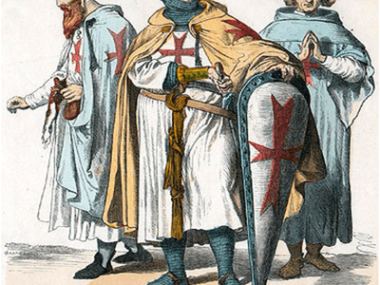
 Templar Uniform Editorial