In Hoc Signo Vinces — four Latin words that translate to “In this sign you shall conquer.” You will find them wrapped around Templar crosses, eagles, and shields, which is why so many people assume the line was a medieval Templar battle cry. The honest in hoc signo vinces meaning is richer and a little surprising: the words are far older than the Order, they belong first to a Roman emperor’s vision in the year 312, and their strong “Templar” branding is largely a modern development. Knowing where the phrase truly comes from makes it more compelling to wear, not less.
What “In Hoc Signo Vinces” Actually Means
Broken into parts, the Latin is straightforward. In hoc means “in this”; signo means “sign”; and vinces is “you shall conquer,” the future tense of the verb vincere, to conquer. Put together: “in this sign you shall conquer.” The pivotal word is sign. In the original story it points to a Christian symbol — usually understood as the cross, or the Chi-Rho, the monogram formed from the first two Greek letters of the name of Christ.

The phrase is a promise of victory, but a conditional one. Triumph comes through the sign — that is, through faith — and not through the strength of arms alone. That theological turn, crediting the win to God rather than the soldier, is exactly why the motto later meshed so neatly with Christian military imagery, the Templars very much included.
Constantine’s Vision at the Milvian Bridge
The origin lies with the Roman emperor Constantine the Great on the eve of the Battle of the Milvian Bridge in 312 AD, fought just outside Rome against his rival Maxentius. According to tradition, Constantine received a divine sign before the battle, marked it on his soldiers’ equipment, won a decisive victory, and set the empire on the road to Christianity.
The details, though, differ depending on which ancient source you trust — and honesty requires saying so:
- Eusebius of Caesarea, in his life of Constantine, describes the emperor seeing a cross of light in the sky above the sun, with Greek words meaning “by this, conquer,” later rendered in Latin as In Hoc Signo Vinces.
- Lactantius, writing earlier, tells it differently: Constantine was instructed in a dream to mark his soldiers’ shields with a heavenly sign — the Chi-Rho — with no sky-vision of those exact words.
Because the two accounts diverge, the famous Latin motto is best understood as a tradition distilled from these sources rather than a verbatim transcript of anything Constantine literally saw. What carried forward through history was the core image: a Christian sign adopted just before a decisive victory.
KNIGHT TEMPLAR – IN HOC SIGNO VINCES
Carry seventeen centuries of faith-before-force: the cross and the promise, In Hoc Signo Vinces, worn on your chest.
🇺🇸 Fast US shipping · 🇪🇺 Ships across the EU · 🔒 Secure checkout
From Roman Standard to Christian War Cry
After the Milvian Bridge, Constantine had the sign carried on the labarum, the imperial military standard. From there the motto seeped into more than a thousand years of Christian and martial symbolism. It surfaced on coins, banners, church art, and royal and regimental insignia, and eventually on the badges of countless orders and armies across Europe. Its appeal is obvious: it fuses faith and victory in three words. Any Christian fighting force could claim it — and many did — which is precisely why we should be cautious about assuming that any one group “owns” it.
Part of the phrase’s staying power is how compact and adaptable it is. Stripped to three words, it needs no explanation for a Christian audience and carries weight even to those who never studied Latin. Over the centuries it has been paired with eagles, crowns, swords, and crosses of every shape, taking on fresh colour from each setting while keeping its original promise intact. By the time it reached modern popular culture, it had become less any single institution’s property than a shared shorthand for conviction under a banner.
The Templar Connection — The Honest Version
So were the medieval Knights Templar marching under In Hoc Signo Vinces? The evidence says no — not as a documented Templar motto. The phrase is not recorded as their battle cry. Their attested war shout was “Beauséant!”, the name of their black-and-white banner, and their prayers leaned on Scripture, such as the humble Non nobis, Domine drawn from the Psalms.
The strong association between this motto and the Templars is largely modern. It reaches the popular imagination through two channels: the broad stream of Christian and Constantinian military symbolism that the Templars are folded into, and — importantly — the Masonic Knights Templar, a fraternal body that emerged from the 18th century onward and adopted a great deal of medieval-flavoured regalia. That organisation is not a continuation of the medieval Order suppressed in 1312; it is a later society that borrowed the name and imagery. A surprising share of what people file under “Templar mottos” actually arrives through these later routes, which is worth keeping in mind when you read about how the Order’s emblems carry their layered meanings.
It helps to recall who the medieval Templars actually were. The Order of the Poor Fellow-Soldiers of Christ and of the Temple of Solomon was founded around 1119 by Hugues de Payens, received its Latin Rule at the Council of Troyes in 1129, and was granted the right to wear the red cross pattée by Pope Eugenius III in 1147. Their identity was built on the cross and on Scripture — not on a Constantinian slogan. That is exactly why a cross-centred motto can feel so thoroughly Templar in spirit while still standing outside their documented record.
Why the Motto Still Fits the Templar Image
If it is not strictly medieval, why does In Hoc Signo Vinces feel so at home beside a Templar cross? Because it expresses something the historical Order genuinely believed: that victory belonged to God, and that the fight was undertaken under a sacred sign. The Templars really did march beneath the cross and really did credit their cause to heaven. The motto’s spirit is authentic even where its paper trail to the Order is not.
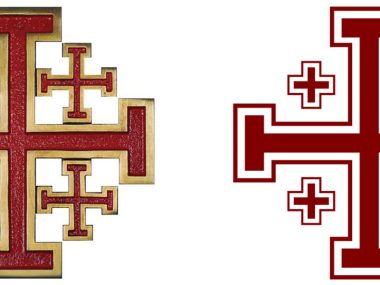
That “sign” also opens a door into the Order’s wider visual language. The cross was never a single fixed emblem — from the flared cross pattée onward there are several distinct forms of the Templar cross — and their seals carried their own encoded slogans, most famously the two-knights-on-one-horse device explored in the puzzle of the Sigillum Militum Xpisti. Read alongside those, In Hoc Signo Vinces becomes one more thread in a rich, sometimes reconstructed, tapestry of meaning.
There is also something honest in embracing a motto whose story you actually know. Wearing In Hoc Signo Vinces with an understanding of Constantine, the differing ancient accounts, and the later Templar revival is far richer than treating it as some ancient secret. You are not parroting a myth; you are joining a long, well-documented conversation about faith and courage that stretches back seventeen centuries.
Wearing the Sign
Worn today, In Hoc Signo Vinces is less a historical claim than a statement of conviction — a way of saying that you face your battles under a sign larger than yourself. A Knight Templar “In Hoc Signo Vinces” design puts that seventeen-centuries-old promise of faith before force right on your chest, together with the cross it was born from.
The motto and the cross together on one piece — the In Hoc Signo Vinces — Cross Pattée Tee, printed on demand and shipped to the US and EU.
The in hoc signo vinces meaning runs deeper than a slogan. It holds the memory of Constantine’s vision, the theology of victory given back to God, and centuries of Christian soldiers who took heart from three Latin words. It may not have been shouted by medieval Templars, but its message — conquer under the sign, and claim no glory of your own — is one the brotherhood would have understood completely.
 Templar Uniform Editorial