The Knights Templar and the Knights Hospitaller are constantly confused, and it is easy to see why: both were military-monastic orders born in the twelfth-century Holy Land, both wore crosses, and both fought in the Crusades. But they were genuinely different institutions with different origins, missions, insignia, and fates. The short version: the Templars began as protectors of pilgrims and wore a red cross pattée on white, while the Hospitallers began as carers for the sick and wore a white cross on a dark ground — and only one of the two survived past 1312. Here is how to tell them apart with confidence.
Two Orders Born of the Same Crusade
Both orders grew out of the aftermath of the First Crusade, which took Jerusalem in 1099, but they did not start at the same moment or for the same reason.

The Hospitallers are the older of the two. Their roots lie in a hospital in Jerusalem that cared for sick and poor pilgrims, run by a figure remembered as Blessed Gerard. The community received papal recognition in 1113 under Pope Paschal II, taking Saint John the Baptist as their patron — hence the formal name, the Order of St John.
The Templars came a few years later, around 1119 (sources vary), when Hugues de Payens and a small band of knights vowed to protect Christian pilgrims on the deadly roads to Jerusalem. King Baldwin II granted them quarters on the Temple Mount, and from that base — believed to be the site of Solomon’s Temple — they took their name. Both orders, in other words, answered the same crisis of pilgrim safety, but from opposite ends: one healed, the other guarded.
Different Missions: Carers Versus Warriors
The clearest difference is purpose, at least at the start. The Hospitallers existed to care for the sick and poor; their great hospital in Jerusalem was famous for treating pilgrims of many backgrounds, and charity remained central to their identity even as they took up arms. Militarisation came later, gradually, as the defence of the crusader states demanded fighting men.
The Templars, by contrast, were a fighting order from the beginning. Their reason to exist was armed protection, and they quickly became the shock cavalry of the crusader armies. Both, crucially, lived under monastic Rules — the same rhythm of prayer, poverty, and obedience that structured a brother’s whole day, much as this account of a day in the life of a Knight Templar describes. The difference lay in what that discipline was aimed at: the ward or the battlefield.
From the outside the two looked structurally alike. Each was headed by a Grand Master, divided into provinces run by regional commanders, and staffed by knights, sergeants, chaplains, and a broad base of servants and lay donors. Both answered directly to the pope rather than to local bishops or kings — an independence that made them formidable, and, in the Templars’ case, dangerously resented by the crown of France.
TEMPLAR SHIRTS – LIMITED EDITION
Fly the red cross pattée with pride — a limited-run tee for those who know the Templars from every other order.
🇺🇸 Fast US shipping · 🇪🇺 Ships across the EU · 🔒 Secure checkout
Telling Them Apart by Their Crosses
If you only remember one distinction, make it the insignia — it is the fastest way to identify an order in art, on effigies, and in modern reproductions.
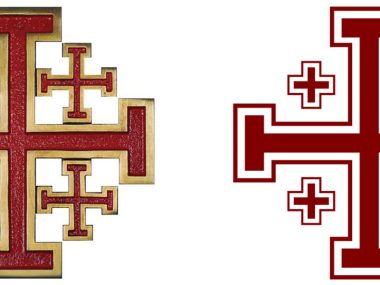
- Templars: a red cross pattée (arms narrow at the centre, flaring to broad flat ends) on a white mantle. The red cross was granted by Pope Eugene III in 1147; knights wore white, sergeants black or brown.
- Hospitallers: a white cross on a black or red ground. Their emblem developed into the eight-pointed Maltese cross, whose four arrowhead arms produce eight sharp points.
So the tells are colour and shape: Templar red-on-white with flared, flat-ended arms; Hospitaller white-on-dark with eight points. Confusing the two is one of the most common mistakes in Templar imagery, and it carries into architecture as well — both orders left distinctive buildings, a subject this piece on Knights Templar architecture brings to life. Get the cross right and you rarely go wrong.
One caution worth keeping in mind: the eight-pointed Maltese cross exactly as we picture it today crystallised over time and is bound most tightly to the order’s later home on Malta, so early Hospitaller images do not always show a textbook Maltese cross. The Templar marker, by contrast, stays reassuringly steady across the sources — a flared red cross on white.
Wealth, War, and Very Different Fates
Both orders grew rich and powerful, but their endings could hardly be more opposite — and this is where the confusion truly matters.
The Templars became medieval Europe’s most sophisticated bankers, managing deposits, credit, and estates across the West. That wealth helped doom them. On Friday 13 October 1307, King Philip IV of France ordered mass arrests; confessions were extracted under torture and are unreliable. Pope Clement V suppressed the Order at the Council of Vienne in 1312, and the last Grand Master, Jacques de Molay, was burned in Paris in 1314. The disappearance was so abrupt that it spawned centuries of legend, including the tangle of buried-treasure and relic stories surveyed in this look at Templar relics lost and found.
The Hospitallers did the opposite: they survived. In fact, much confiscated Templar property was transferred to them in 1312. Having already taken Rhodes around 1310, they later moved to Malta in 1530 — the source of the “Knights of Malta” name — and continue today as the Sovereign Military Order of Malta, still devoted to medical and humanitarian work. One order became a ghost story; the other became a living charity.
It is worth being honest about a less flattering truth as well: the two orders were rivals as much as allies. Chroniclers of the crusader states sometimes blamed their competition and pride for undercutting the Christian war effort, and they did not always coordinate on the battlefield. A shared Rule of prayer, it turns out, did not guarantee a shared strategy.
A Quick Side-by-Side (and a Third Order)
Here is the comparison boiled down for scanning:
The eight-pointed cross on its own piece — the Maltese Cross — Knights Hospitaller Tee, printed on demand and shipped to the US and EU.
- Origin: Templars c.1119 (pilgrim defence); Hospitallers, hospital roots recognised 1113.
- Core mission: Templars — warfare; Hospitallers — care for the sick, later warfare too.
- Insignia: Templars — red cross pattée on white; Hospitallers — white cross on dark, later the Maltese cross.
- Role: Templars — bankers and cavalry; Hospitallers — carers and cavalry.
- Fate: Templars — suppressed 1312; Hospitallers — survive to this day.
Worth a brief mention: there was a third great order, the Teutonic Knights, a largely German brotherhood that wore a black cross on white and turned its energies toward the Baltic. It is often mistaken for the Templars precisely because of that black cross. Formed during the Third Crusade and confirmed as a religious order around 1198, the Teutonic Knights eventually carved out their own state along the Baltic — a destiny unlike either the Templars or the Hospitallers. Three orders, three crosses, three fates, and no end of modern confusion between them.
So the difference comes down to five things — origin, mission, insignia, role, and fate. The Templars guarded and vanished; the Hospitallers healed and endured. If the red cross pattée is the badge you feel closest to, wearing it is a small way of keeping the distinction — and the memory of the Order that carried it — alive and correct.
 Templar Uniform Editorial