
Knights Templar symbols were never mere decoration: the red cross pattée, the black-and-white Beauséant banner, the seal of two knights on one horse, the white mantle, the Agnus Dei, and even the skull and crossbones each carried a precise meaning within the order. These emblems were visual declarations of the Templars’ vows, beliefs, and mission. This guide walks through every major symbol the Knights Templar actually used — plus the ones history wrongly pinned on them — and explains what each one meant.
The Red Cross Pattée: Emblem of Sacrifice and Crusade
Eagle & Symbol of Knights Templar Tee

Wear the order’s most iconic emblem — premium Templar apparel.
🇺🇸 Fast US shipping · 🇪🇺 Ships across the EU · 🔒 Secure checkout
The most universally recognized of all Knights Templar symbols is the red cross on a white field. Granted to the order by Pope Eugenius III in 1147, it adorned their tunics, shields, and banners, serving as both a rallying point for the knights and a terrifying sight for their adversaries.
The red cross symbolized the blood of Christ and the sacrifice of martyrdom, aligning perfectly with the Templars’ dual role as monks and warriors. Wearing it was a public declaration of their willingness to die defending Christendom. The form most associated with the order is the cross pattée — a cross whose arms broaden toward the ends — though early depictions also show simple Greek crosses. We break down the full history in our guide to the Templar cross meaning.
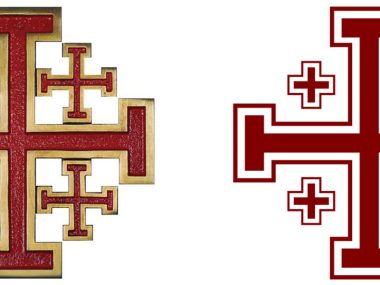
It is also worth separating the Templar cross from the five-fold Jerusalem cross, the emblem of the crusader Kingdom of Jerusalem. The two are constantly confused, but they belonged to different institutions and carried different meanings.

The Seal of Two Knights on One Horse: Humility and Brotherhood
The official seal of the order — the Sigillum Militum Xpisti, or “Seal of the Soldiers of Christ” — depicts two knights riding a single horse. Stamped on Templar documents for nearly two centuries, it is one of the most debated images the order left behind.
The primary interpretation points to the Templars’ founding vows of poverty and humility. In an era when a knight’s status was judged by his horse, two knights sharing one steed underscored their renunciation of personal wealth. Tradition holds that founders Hugues de Payens and Godfrey de Saint-Omer were at first so poor they owned a single horse between them.
Beyond poverty, the image symbolizes brotherhood: mutual support, shared burdens, and the collective spirit that made a Templar squadron more than the sum of its knights. Whatever its literal accuracy, its symbolic power as a statement of the order’s core values is undisputed.

The Beauséant: The Black-and-White Battle Banner
The Templar battle standard, the Beauséant, was divided horizontally into black and white. It was not merely a flag; it was a psychological weapon and a promise. As long as the banner flew, no Templar was permitted to leave the field.
The white section symbolized purity and grace toward friends of the order — the righteousness of their cause and the protection they offered pilgrims. The black section promised terror and death to their enemies. The banner encapsulated the Templar paradox: warrior-monks who were both devout and deadly.
The Beauséant had its own guard of knights in battle, and losing it was among the gravest disasters a squadron could suffer. The full story — including how the banner worked as a rallying system on crusade battlefields — is in our history of the Templar battle banner.

The White Mantle: Purity Worn as a Uniform
Before the red cross, there was the white mantle. Granted to full knights at the Council of Troyes in 1129, the white cloak marked its wearer as chaste, disciplined, and set apart from secular knighthood. Sergeants and lower ranks wore black or brown — the color line was a rank line.
The mantle was governed by strict rules: it could not be decorated, could not be given away, and was worn even at meals. When the red cross was added in 1147, the combination — blood-red cross on pure white wool — became the most recognizable uniform of the medieval world. Its modern descendants still follow the same visual code, as we show in our guide to the modern Knights Templar uniform.

The Agnus Dei: The Lamb of God
The Agnus Dei — a haloed lamb carrying a cross or banner over its shoulder — appears on Templar seals across Europe, most famously on the seal of the Master of the Temple in England. The lamb represents Christ as the sacrificial offering, an image of gentleness deliberately paired with an order built for war.
For the Templars the pairing was the point: they saw themselves as instruments of Christ’s sacrifice, meek before God and merciless in battle. The Agnus Dei reminded the brothers — and everyone who received a sealed Templar document — of the spiritual purpose beneath the armor.
The Skull and Crossbones: The Legend of Sidon
The skull and crossbones is the strangest entry in Templar iconography. It appears on some Templar-era tombstones as a memento mori — a reminder of death — and medieval legend attached it to the order through the macabre tale of the Skull of Sidon, in which a knight was said to have received a skull-and-bones talisman that protected him at sea.
Whether any Templar ever carried such an emblem is unprovable, but the association stuck. Later traditions — Masonic ritual and even the pirate flag — borrowed the image, which is why the symbol keeps circling back to the Templars in popular culture centuries after the order’s fall.
Baphomet and the Abraxas Seal: Accusation and Mystery
Not every symbol linked to the Templars was actually theirs. “Baphomet” — the idol the knights supposedly worshipped — comes entirely from confessions extracted under torture during the trials of 1307–1312. No Templar artifact bearing such an idol has ever been found; it was an accusation, not an emblem.
The Abraxas seal is a genuine mystery: at least one Templar official sealed documents with an ancient gnostic gem showing the rooster-headed Abraxas figure, inscribed “Templi Secretum” — the Secret of the Temple. It was almost certainly a reused antique gem, but it has fueled speculation about hidden Templar doctrines ever since.
Knights Templar Symbols at a Glance
| Symbol | What it is | Meaning |
|---|---|---|
| Red cross pattée | Red cross, arms widening outward | Martyrdom; willingness to die for the faith |
| Two knights on one horse | Official seal (Sigillum Militum Xpisti) | Poverty, humility, brotherhood |
| Beauséant | Black-and-white battle banner | Grace to allies, death to enemies; no retreat |
| White mantle | Knight’s cloak from 1129 | Purity, chastity, knightly rank |
| Agnus Dei | Haloed lamb with cross or banner | Christ’s sacrifice; spiritual purpose |
| Skull and crossbones | Tombstone motif; Sidon legend | Memento mori; later Masonic echo |
| Baphomet | Alleged idol from the trials | Accusation under torture — not a real Templar symbol |
Templar Symbols Today
Seven centuries after the order’s dissolution, its symbols are everywhere: in films and games, on jewelry and apparel, in Masonic tradition and military heraldry. The red cross pattée in particular has become shorthand for chivalry, conviction, and brotherhood.
Understanding the original meanings makes the modern uses richer — and helps separate genuine Templar heritage from Hollywood invention. For how these emblems live on in fashion, tattoos, and everyday symbolism, see our companion piece on Templar symbolism in modern life. If you are thinking about ink, what a Knights Templar tattoo means sorts the documented symbols from the myths before you commit.
Frequently Asked Questions
What is the most famous Knights Templar symbol?
The red cross pattée on a white field — granted by Pope Eugenius III in 1147 and worn on the mantle over the heart. It remains the emblem most people picture when they think of the order.
Fly the colours yourself: the Beauséant — The Templar War Banner Tee, printed on demand and shipped to the US and EU.
Did the Knights Templar really use the skull and crossbones?
It appears on some Templar-era graves as a memento mori, and legend ties it to the order through the Skull of Sidon tale — but there is no proof it was an official emblem. The Masonic and pirate uses came later.
What symbol did the Templars carry into battle?
The Beauséant, their black-and-white banner. As long as it flew, Templar knights were forbidden to retreat from the field.
So what was the actual Knights Templar logo?
There was none in the modern sense. The Order used three separate marks — the red cross on the mantle, the seal of two knights on one horse, and the Beauséant banner — each for a different purpose. Our guide to the Knights Templar emblem sets out what each one was for, and why the “Templar coat of arms” in heraldry books is a later attribution.
For the heraldry question specifically — shields, blazons, and which parts are modern invention — see the truth about the Templar coat of arms.
 Templar Uniform Editorial



12 comments