
There was never just one Templar cross. The Order and the wider crusading world used a whole family of cross forms — the pattée, the potent, the Jerusalem cross, the fitchée and more — and telling them apart is what this guide is for. This guide covers both halves of the question: what the Order’s red cross actually stood for, and how to tell every cross form apart at a glance.
The cross forms at a glance
Cross Pattée Tee

Found your cross? Wear it — premium Templar apparel, made on demand.
🇺🇸 Fast US shipping · 🇪🇺 Ships across the EU · 🔒 Secure checkout
Picture a Knight Templar. What comes to mind? For most, it is the striking image of a warrior in a white mantle, emblazoned with a bold, red cross over the heart. This symbol has become synonymous with the Order, an icon of medieval faith, wealth, and military prowess. But to truly understand the legend stitched into the Templar uniform, we must look closer. The cross worn by the Poor Fellow-Soldiers of Christ and of the Temple of Solomon was not a single, monolithic design. Its story is woven with variations, regional influences, and profound symbolism.

While the Cross Pattée is the most famous, other significant designs like the Cross Potent and the Jerusalem Cross were central to the world in which the Templars lived and fought. Each tells a different part of their story. This guide will delve into the most significant Templar cross types, exploring their origins, their powerful symbolism, and their place on the hallowed uniform of the Order. Join us as we decode the sacred geometry that defined these knights of Christ.
A mark of the crusader: why the cross was paramount
Before we dissect the specific designs, it’s crucial to understand the immense power of the cross in the medieval world. In 1095, when Pope Urban II called for the First Crusade, he urged the knights of Christendom to “take up the cross” and reclaim the Holy Land. This was not merely a turn of phrase. Crusaders literally stitched crosses of cloth onto their garments, marking them as soldiers of the church, pilgrims on a holy mission. The cross was a public vow, a symbol of piety, and a mark of divine protection.

As the Crusades evolved, this practice became more formalized. The cross transitioned from a simple pilgrim’s badge to a heraldic device. It became a way to distinguish between different military orders, noble houses, and kingdoms. For the Knights Templar, founded in Jerusalem around 1119, the cross was more than just a crusader’s mark; it was the very essence of their identity, granted by the highest authority in Christendom.
The Cross Pattée: the official emblem of the Order
When people speak of the “Knights Templar cross,” they are almost always referring to the Cross Pattée. Its elegant and powerful design is the quintessential symbol of the Order.
What does a Cross Pattée look like?

The term “pattée” comes from the French word for paw, and it describes the shape of the cross’s arms. A Cross Pattée features arms that are narrow at the center and flare outwards towards the ends. The ends themselves can be straight, forming a trapezoidal shape, or they can be curved, creating a more gentle, petal-like appearance. Both variations are historically associated with the Templars. This simple, yet visually striking design was easily recognizable on a chaotic battlefield.
A gift from the Pope: the history of the red cross
For the first few decades of their existence, the Templars wore a simple, unadorned white mantle. The white color was chosen to represent the purity and chastity required of the monks of the Order. The iconic red cross was a later addition, a mark of immense prestige granted by Pope Eugenius III. At the Council of Paris in 1147, as the Second Crusade was being launched, the Pope granted the Templars the right to wear a “red cross, single and straight” permanently on their habits.
This was a significant honor. The symbolism was profound:
- The white mantle: Represented the purity of their monastic vows and their new life, leaving behind worldly sin.
- The red cross: Symbolized the blood of Christ and their willingness to suffer martyrdom in the defense of the Holy Land. It was a constant reminder of the ultimate sacrifice.
The cross was typically worn on the left side of the mantle, directly over the heart. This placement was deliberate, signifying that their love for God and their commitment to the Order came from the very core of their being. It also appeared on their white surcoats worn over their armor and, most famously, on the upper canton of their fearsome black-and-white battle banner, the Beauchéant.
What the red cross meant
Color did the heavy lifting in medieval symbolism, and red was among the most charged of all. On a Templar’s mantle it spoke first of the blood of Christ, the sacrifice at the centre of the faith the knights had sworn to defend. Worn by men who had vowed to fight, it also signalled their own readiness to shed blood, and to bleed, in that cause.
This tied directly to the medieval ideal of martyrdom. A brother who fell in battle against the enemies of the faith was widely believed to die a martyr’s death, with the promise of salvation. The red cross was, in effect, a badge of that willingness — a public declaration that the wearer valued his faith above his own life.
It also fitted the wider language of the crusades. Those who took the cross, the crucesignati or “signed with the cross,” were promised spiritual rewards for their service, and the cloth cross was the visible sign of that vow. For the Templars the emblem was permanent rather than temporary: they had not merely taken the cross for a single campaign but bound their whole lives to it, calling themselves the milites Christi, the soldiers of Christ.
The cross on the battlefield
Worn into combat, the emblem did practical work. Each Templar squadron rode behind a banner carrying the cross, which served as a rallying point in the dust and confusion of a medieval engagement — a place to re-form when a charge broke up. The Order’s discipline was built around it: the Rule forbade a brother to abandon the field while the banner still flew.
The symbolism reinforced the discipline. A man who believed that death in that formation carried him straight to paradise had little reason to break ranks, and contemporaries on both sides remarked on how hard Templar units were to rout. The red cross was not decoration on a surcoat; it was the visible centre of how these men fought.
A symbol of identity and belonging
Beyond its theology, the cross did something intensely practical: it made the Templars a recognizable body of men. In an age before uniforms as we know them, the red cross on a white ground worked as one — on the mantle, on the surcoat over armor, on shields, and on the Order’s banners and seals. To see it was to know instantly whose men these were.
That shared mark reinforced the brotherhood. It reminded each knight that he had surrendered his private identity to something larger, and it told allies and enemies alike that behind the individual stood the whole disciplined Order. The cross was as much a statement of belonging as of belief. For the wider vocabulary of Templar imagery it sat within, our overview of Templar symbols and their enduring meanings makes a good companion read.
The Order’s own seals reinforce the point. The most famous shows two knights sharing a single horse, an image traditionally read as a sign of the founders’ poverty and brotherhood, while others carry the domed image of the Temple. On seals, shields, and banners alike, a shared set of signs told the world that these men acted as one body rather than as free-lancing individuals.
The Cross Potent: a symbol of the crusader kingdom
While the Pattée was the Templars’ unique identifier, it was not the only cross they would have encountered or used. The visual landscape of the Crusader States was rich with Christian heraldry, and among the most prominent was the Cross Potent.
Defining the Cross Potent
The Cross Potent is a cross with a perpendicular bar at the end of each arm. The name “potent” derives from an Old French word for a crutch, which the shape resembles. It’s a strong, angular, and architecturally solid-looking cross. Sometimes referred to as a “crutch cross,” its rigid form gave it a distinct heraldic identity separate from the more common Latin or Greek crosses.
A connection to Jerusalem’s first rulers
The Cross Potent is most famously associated with the coat of arms of the first ruler of the Crusader Kingdom of Jerusalem, Godfrey of Bouillon. Although he famously refused the title of king, his heraldry set a precedent. This makes the Cross Potent a foundational symbol of the very kingdom the Templars were established to protect. For the knights, this cross would have been a constant presence—seen on the shields of the kingdom’s knights, on coins, and on official seals. While not their personal emblem, it was the emblem of their home and their primary sphere of operation.
There is some debate among historians about whether the Templars themselves ever used the Cross Potent on their equipment. While no official statutes mandate it, it’s plausible that regional variations existed or that individual knights, particularly those with strong ties to the Kingdom’s nobility, may have incorporated it into personal designs. At the very least, it was an integral part of their world.
The Jerusalem Cross: emblem of the holy city
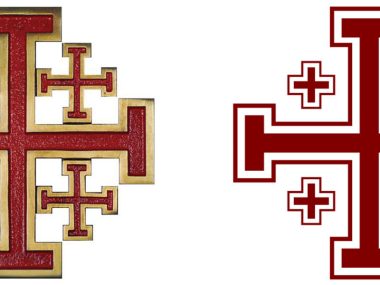
Perhaps the most complex and symbolically rich of all the crusader crosses is the Jerusalem Cross. It was not the cross of the Templar Order, but the cross of their mission’s ultimate objective: the Kingdom of Jerusalem itself.
The anatomy of a sacred symbol
The Jerusalem Cross, also known as the Crusader’s Cross, is a heraldic masterpiece. It consists of a large central cross—most often a Cross Potent—surrounded by four smaller Greek crosses (crosses with arms of equal length) in each of its four quadrants. The design is unique and immediately recognizable.
It famously breaks a primary rule of heraldry by placing a metal (gold, or or) on another metal (silver, or argent). This was a deliberate choice, intended to make the arms of the Kingdom of Jerusalem exceptional and to signify its supreme holiness.
Unpacking the profound symbolism
The meaning of the Jerusalem Cross has been interpreted in many ways, with each layer adding to its sacred power. The most common interpretations include:
- The Five Wounds of Christ: The large central cross represents the wound in Christ’s side from the spear, while the four smaller crosses represent the wounds in his hands and feet.
- Christ and the Four Evangelists: In this reading, the central cross is Christ, and the four smaller crosses are the authors of the four Gospels (Matthew, Mark, Luke, and John) who spread his message to the four corners of the world.
- The Crusader States: Some historians have suggested the five crosses represent the five primary Crusader polities: the Kingdom of Jerusalem, the Principality of Antioch, the County of Edessa, the County of Tripoli, and the Crusader state of Cyprus.
For a Knight Templar, the Jerusalem Cross was the symbol of what they were sworn to die for. They were the protectors of the Christian kingdom and the pilgrims who flocked to it. They would have fought alongside knights carrying this emblem on their shields and served kings who used it on their royal seal. It was the flag of their homeland and the visual representation of their sacred duty.
The enduring legacy of the Templar crosses
The Knights Templar were officially disbanded in the 14th century, but their symbols have shown remarkable resilience. The Cross Pattée, in particular, has lived on, forever associated with the mystery and legend of the Order.
Today, you can see these Templar cross types in numerous contexts:
- Modern Chivalric Orders: Many modern organizations inspired by the Templars, such as the Social Military Order of the Temple of Jerusalem (SMOTJ), use variations of the Cross Pattée or the Jerusalem Cross as their emblems.
- Historical Reenactment: Reenactment groups meticulously research and recreate Templar uniforms, ensuring the correct placement and style of the Cross Pattée on their mantles and surcoats.
- Popular Culture: From video games like Assassin’s Creed to films and novels, the red Cross Pattée is used as a powerful visual shorthand for the Knights Templar, instantly evoking their crusading legacy.
The cross after the Order — and the myths
When the Order was suppressed in 1312 and Grand Master Jacques de Molay was burned in 1314, the emblem did not vanish. It was absorbed into later heraldry, revived by chivalric and fraternal groups centuries afterward, and today appears everywhere from jewelry and jewellery counters to tattoos and brand logos.
That long afterlife has attracted a fog of invented meanings. You will find claims that the cross descends from the Hebrew letter tav, or from the “mark of Cain,” or that it encodes secret geometry and hidden esoteric doctrines. No evidence supports any of these readings. They are modern legend rather than medieval fact, and they all share the same flaw: the documented grant of the red cross in 1147 is an ordinary, well-recorded papal act, with no mystery left over for a secret origin to explain. The historical meaning is powerful enough on its own — faith, sacrifice, and brotherhood — without embroidery.
Modern confusion runs the other way as well. The cross pattée resembles later military decorations and other Christian crosses closely enough that people routinely mistake one for another, and the Templar version has been borrowed by everything from motorcycle clubs to fashion labels with no medieval connection at all. Recognizing the genuine history behind the emblem is the best guard against reading into it meanings that were never there.
It’s important to make a clear distinction here. While the modern International Red Cross and Red Crescent Movement uses a red cross as its symbol of neutrality and aid, its origin is officially different. The symbol was adopted in 1864 to honor the Swiss founder, Henry Dunant, by reversing the colors of the Swiss flag (a white cross on a red field). However, the underlying cultural power of a cross as a symbol of aid and sanctuary undoubtedly shares deep roots in Christian symbolism, a tradition the Templars helped to cement.
A story in every symbol
The red cross on a white field is far more than a simple logo. It is a key that unlocks a deeper understanding of the Knights Templar. The Cross Pattée was their identity, a Papal seal of approval that marked them as an elite fighting force in the service of God. The Cross Potent was the symbol of their environment, the mark of the early Crusader nobility in the Holy Land. And the Jerusalem Cross was their purpose, the complex and sacred emblem of the kingdom they were sworn to defend with their lives.
The eight-pointed cross on its own piece — the Maltese Cross — Knights Hospitaller Tee, printed on demand and shipped to the US and EU.
By understanding these different Templar cross types, we can more clearly read the story woven into the very fabric of their uniform. It is a legend of faith, sacrifice, and an unshakeable duty to protect the holy places of Christendom—a legend still powerful today.
 Templar Uniform Editorial



11 comments