Search “how the Knights Templar invented modern banking” and you’ll find a dramatic story — but an honest answer needs some nuance. Between roughly 1150 and 1300, the Order built one of medieval Europe’s most sophisticated financial networks, so a pilgrim could deposit coin in London and later draw its value in the Holy Land. That was genuinely innovative. Even so, “invented modern banking” is popular shorthand, and we’ll examine it critically: the Templars were pioneers working at unusual scale, not the sole inventors. Here’s what they actually did, how their letters of credit functioned, and why their vast wealth ended up destroying them.
Did the Templars Really “Invent” Banking?
The short answer is: not exactly. The idea that the Knights Templar invented modern banking makes a fine headline, but it overstates the case. Most of the tools we associate with them — safekeeping deposits, transferring value at a distance, extending credit against future income — had older roots and were being refined at the same time by other groups.

Italian merchant-bankers, and later celebrated houses such as the Medici of Florence, developed comparable instruments and arguably shaped the banking industry more directly and lastingly. Jewish and Lombard moneylenders financed much of medieval Europe as well. It is fairer to say the Templars were among the first to operate a pan-European financial institution at scale — a coordinated network rather than a single counting house.
It also helps to remember that “banking” is an old idea. Temples in the ancient world guarded deposits, and money-changing is nearly as old as coinage itself. What changed in the Templars’ era was the scale and coordination of these services under one trusted, disciplined organization.
One caveat deserves to be stated plainly: the Templars did not mint their own coin. They stored, moved, guarded, and lent money, but they never issued currency the way a modern central bank does. Keep that in mind whenever you meet the “first bank in history” claim.
A Financial Network Built on Preceptories
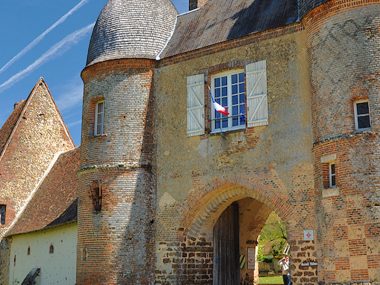
The Order’s real advantage was infrastructure. Its preceptories — also called commanderies — formed a chain of fortified houses stretching from the Holy Land through Iberia, France, and England. Each was a working agricultural estate, a religious community, and, crucially, a strongbox.
Because these buildings were defended, disciplined, and answerable to the same order, they made ideal treasuries. You can read that purpose in their masonry: solid, functional, and built to endure. Our guide to Templar architecture, combining practicality and praise, shows how these structures doubled as secure vaults for coin and valuables.
Geography made the system powerful. A traveler could hand funds to the Order in one kingdom and expect recognition of that transaction hundreds of miles away, because it was the same institution from end to end — a genuinely rare thing in a politically fragmented medieval Europe.
TEMPLAR SHIRTS – LIMITED EDITION
Carry the same discipline and trust that once moved fortunes safely across Christendom — our limited-edition Templar shirt wears the Order’s legendary reliability on your chest.
🇺🇸 Fast US shipping · 🇪🇺 Ships across the EU · 🔒 Secure checkout
The Letter of Credit: A Medieval Traveler’s Cheque
The Templars’ most famous service solved a deadly problem: carrying gold along bandit-ridden roads to Jerusalem. Instead, a pilgrim or crusader could deposit money at one Templar house and receive a coded letter of credit, then withdraw the equivalent value at a distant house on arrival.
This acted as an early analogue of the modern traveler’s cheque and the bill of exchange. The document and the trust behind it travelled in place of the cash, so robbers waiting on the route found little worth taking. Historians debate the exact mechanics — how the codes and accounting worked in detail is not fully documented — but the principle is well attested.
It is easy to underestimate how much everyday risk this removed. For a feel of the routine, discipline, and dangers that Templars juggled, see our account of a day in the life of a Knight Templar. Their banking work was quiet and clerical, yet every bit as important as the fighting on the frontier.
Vaults, Loans, and Royal Treasuries
Transfers were only one part of the business. The Order offered a broad menu of financial services that any modern client would recognize:
- Safekeeping of treasure, jewelry, charters, and important documents inside their fortified houses.
- Estate and revenue management on behalf of nobles and monarchs.
- Ransom handling for captives taken during war in the Holy Land.
- Lending to kings, lords, bishops, and ordinary pilgrims.
The Paris Temple and the London Temple grew into major financial centers. For a time, the French royal treasury was actually housed at the Paris Temple — a striking sign of how far the Crown trusted the Order’s competence and security.
So how did they profit when canon law forbade usury, the charging of interest on loans? They worked within the rules. Rather than explicit interest, arrangements were structured through rents, service fees, and favorable exchange rates. The lender’s return was real; it simply wasn’t recorded as interest, which kept the practice acceptable to the Church.
How Royal Debt Helped Destroy the Order
Wealth made the Templars indispensable — and dangerous to owe money to. King Philip IV of France was heavily in debt to the Order, and his chronically empty treasury gave him a strong motive to move against it and erase what he owed.
On Friday, 13 October 1307, Philip ordered the mass arrest of Templars across France on charges of heresy and blasphemy, most of which were extracted under torture. Seizing the Order’s assets was, for a cash-strapped king, a very convenient result. Under royal pressure the Order was formally suppressed by Pope Clement V in 1312, and the last Grand Master, Jacques de Molay, was burned at the stake in 1314.
Debt was not the only factor — Philip had already clashed with the papacy and may have believed the charges, or simply found them useful. But it is telling that a monarch who owed the Order so much was the one who tore it down. The lesson historians often draw is sobering: a lender that finances kings wields real power, but also paints a target on its own back. If the human side of this story pulls at you, you may enjoy our guide to tracing possible Templar ancestors in your family.
Wear a Piece of the Legacy
The Templar financial legacy is really a story of trust, discipline, and building something larger than any single person — ideals worth carrying with you. A well-made Templar shirt is a quiet nod to that heritage: the same red-and-white identity that once signaled reliability from London to Jerusalem, whether you spell it honor or honour.
Whether you are a history buff, a reenactor, or simply drawn to the Order’s story, wearing the cross keeps the conversation going and the memory alive.
So did the Knights Templar invent modern banking? Not single-handedly — that headline clearly overstates it. But they did build one of the first truly pan-European financial networks and pioneered credit instruments that made medieval travel and trade far safer. Their achievements were real, their reach was remarkable, and their downfall is a lasting reminder that money and power have always been risky companions.
 Templar Uniform Editorial