Type “Templar Rose Cross” into any search bar and you will meet a striking claim: that the Knights Templar carried a secret emblem of a rose blooming at the heart of a cross. It is worth stating the honest answer straight away. There is no reliable evidence that the medieval Templars ever used the Rose Cross. The symbol belongs to a mystical movement born in the early seventeenth century, roughly three hundred years after the Order was suppressed in 1312, and it reached the Templars only through much later legend. Untangling the two stories is far more rewarding than blurring them, so let us take them in turn.
What the Rose Cross actually is
The Rose Cross, or Rosy Cross, is precisely what the name describes: a cross with a single rose set at the intersection of its arms. As a mystical emblem it is read on several layers at once. The cross stands for the material world, the body, and the redemptive suffering of Christ; the rose represents the soul, spiritual unfolding, silence and secrecy, and — in older Christian imagery — the blood and love of Christ.

Placed together, the two suggest a marriage of matter and spirit, of pain and beauty, of the earthly and the divine. Colour often carries meaning too, with a red rose read for sacrifice and passion, a white rose for purity, and a golden centre for illumination. It is a genuinely thoughtful and beautiful device, which is a large part of why so many stories have attached themselves to it. But the power of an emblem to inspire later mystics is not the same thing as a documented link to a medieval order — and that is exactly the seam where popular writing tends to tear.
Rosicrucianism: the symbol’s real birth
The Rose Cross rose to fame with Rosicrucianism, a movement announced in a short burst of anonymous German texts in the early 1600s. Three documents did the work: the Fama Fraternitatis (1614), the Confessio Fraternitatis (1615), and the allegorical Chymical Wedding of Christian Rosenkreuz (1616). Together they described a hidden brotherhood, founded by a legendary sage named Christian Rosenkreuz, devoted to secret wisdom, to healing the sick without payment, and to a coming reform of religion and learning.
Did Rosenkreuz exist? Almost certainly not; most historians read him as a deliberate allegory, and the manifestos themselves may have begun as a learned literary game. What is not in doubt is the date. Rosicrucianism is a creature of the seventeenth century, tangled up with the intellectual ferment that also produced early modern science and Protestant reform. The Rose Cross is its badge — not the Order’s. When a modern source presents it as a Templar sign smuggled through the centuries, that is the moment to reach for a calendar.
Eagle and Symbol of Knights Templar
Choose the emblems the Order truly carried, not a later mystical badge.
🇺🇸 Fast US shipping · 🇪🇺 Ships across the EU · 🔒 Secure checkout
How the Templars got tangled in
If three centuries separate the two, why are they so often welded together? The answer lies in the eighteenth and nineteenth centuries, when a wave of fraternal and esoteric societies mined the medieval past for prestige. Secrecy, chivalry, and a hint of persecution made the Templars irresistible raw material, and more than one new order claimed spiritual descent from them whether or not any real link existed.
Freemasonry did much of the joining. The Scottish Rite includes a Christian-themed degree, the Knight of the Rose Croix — its eighteenth degree — which fuses chivalric and Rosicrucian imagery. Because Masonic tradition also developed its own commemorative Knights Templar bodies, the Rose Cross and the medieval Order ended up sharing the same shelf in the popular imagination. Add a century of romantic novels, occult-revival societies such as the Hermetic Order of the Golden Dawn (founded 1888), and a modern appetite for hidden history, and the confusion became self-sustaining.
Nineteenth-century writers then hardened the association into supposed fact. Occult authors and popular historians recast the Templars as guardians of a secret wisdom later carried by the Rosicrucians, a narrative with plenty of atmosphere but no archive behind it. Printed often enough, the link simply began to feel true — which is precisely how a great deal of pseudo-history is manufactured and then passed off as suppressed knowledge.
The emblems the Templars really used
The documented iconography of the Order simply does not include the Rose Cross. What the Templars actually wore and sealed is well attested: the red cross pattée on a white ground, granted by Pope Eugenius III in 1147 and worn on the mantle; the black-and-white war banner called the Beauséant; the Agnus Dei, or Lamb of God; and their seals, most famously the image of two knights sharing a single horse. You can walk through the whole set in our overview of Templar symbols and their meanings.
These devices were public, legal, and heraldic — stamped on charters, flown in battle, and recognised across Christendom. A hidden rose emblem would sit oddly beside an order whose entire identity rested on a visible cross. There is no charter, seal, or reliable chronicle showing the brothers adopting the Rose Cross as their own, and responsible history has to say so plainly rather than leave the door open to wishful thinking.
Did the rose mean anything to medieval Christians?
Here the honest answer gains some nuance. The rose was everywhere in medieval Christian culture — it simply was not a Templar badge. It was above all a symbol of the Virgin Mary, hailed as the rosa sine spina, the “rose without thorns,” and celebrated in hymns and litanies. The great rose windows of Gothic cathedrals such as Chartres and Notre-Dame de Paris turned the flower into architecture and coloured light.
The word rosary itself carries the image, meaning a “garland of roses” of prayers offered to Mary. So a medieval knight would certainly have known the rose as a sacred sign. But that devotional culture belonged to all of Latin Christendom, not to one military order. Sharing in a Marian flower is not the same as wearing a Rosicrucian emblem that would not be designed for another three hundred years. The distinction matters if you care about getting the history right rather than merely getting a good story.
There is even a genuine Marian thread running through Templar life, though it has nothing to do with the Rose Cross. The Order was strongly devoted to Our Lady: many of its churches were dedicated to the Virgin, its statutes framed daily prayers in her honour, and the spirituality championed by Bernard of Clairvaux — whose influence helped shape the Templar Rule at the Council of Troyes in 1129 — was steeped in Marian devotion. If you are hunting for a “rose” in real Templar history, that veneration of the rosa mystica is the one to find. It lived in prayer and dedication, not in a secret badge.
Rose Cross versus Rose Croix: untangling the names
Part of the muddle is linguistic. “Rose Cross,” “Rosy Cross,” “Rose Croix,” and “Rosicrucian” all circle the same imagery but point to different things — a mystical philosophy, a Masonic degree, and a whole family of later orders. None of them points back to Hugues de Payens and the founding brothers of 1119.
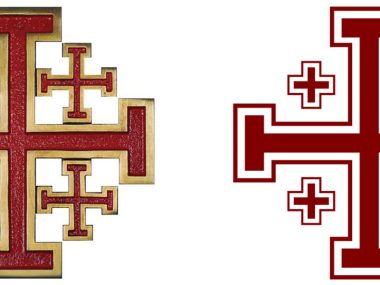
The clearest way to keep your footing is to anchor yourself in the emblems that are actually documented. If you are drawn to the Templars specifically, learn the crosses they genuinely used — there are more of them than most people expect, as our guide to the Templar cross types explains, alongside the closely related Jerusalem cross of the crusader kingdom. Master those, and the Rose Cross will never trip you up again.
Wearing symbols you can defend
None of this diminishes the Rose Cross. It is a rich and moving emblem — it simply belongs to a different and later story than the one usually sold to us. Treating it as a hidden Templar sign does a disservice to both traditions: it rewrites the Order’s real heraldry, and it hides the genuine seventeenth-century roots of Rosicrucianism.
If you want Templar imagery you can defend with the facts, choose the emblems the Order truly carried. Our Eagle and Symbol of Knights Templar design draws on that authentic heraldic world rather than a later mystical badge, so what you wear matches the real record. Keep the two histories distinct and you gain two fascinating stories instead of one muddled myth — and you honour the truth of each.
 Templar Uniform Editorial