
The Templar cross meaning comes down to three ideas: sacrifice, purity, and brotherhood. The Order’s famous red cross pattée stood for a willingness to die for the Christian faith, the blood of Christ and the blood of the martyr worn openly over the heart. It marked the wearer as a soldier of Christ, bound the brothers together as one identifiable brotherhood, and proclaimed the purity of life their Rule demanded. Like most powerful symbols, it carried several layers of meaning at once, and those layers are worth unpacking one at a time.
How the Templars got their cross
The red cross was not there at the founding. When the Order took shape around 1119 under Hugues de Payens, the brothers were known for their white mantles, a colour their Rule linked to chastity and purity of life. For nearly three decades the habit carried no coloured emblem at all.

That changed in 1147, when Pope Eugenius III granted the Templars the right to wear a red cross on their mantles. According to the traditional account, the pope wished the brothers to bear a sign of martyrdom that would set them apart as they rode into battle. From that point the pairing of white cloth and red cross became the Order’s instantly recognisable signature.
The two colours worked as a pair. White had long stood in monastic thought for innocence and the washing-away of sin, which is why the knights wore it on their mantles; the red cross laid over that white ground added the promise of sacrifice on top of purity. The non-knightly brothers, the sergeants and servants, wore the same red cross on black or brown cloth, so the emblem itself, rather than the colour of the garment, became the true mark of a Templar.
What the colour red meant
Colour did the heavy lifting in medieval symbolism, and red was among the most charged of all. On a Templar’s mantle it spoke first of the blood of Christ, the sacrifice at the centre of the faith the knights had sworn to defend. Worn by men who had vowed to fight, it also signalled their own readiness to shed blood, and to bleed, in that cause.
This tied directly to the medieval ideal of martyrdom. A brother who fell in battle against the enemies of the faith was widely believed to die a martyr’s death, with the promise of salvation. The red cross was, in effect, a badge of that willingness, a public declaration that the wearer valued his faith above his own life.
It also fitted the wider language of the crusades. Those who took the cross, the crucesignati or “signed with the cross,” were promised spiritual rewards for their service, and the cloth cross was the visible sign of that vow. For the Templars the emblem was permanent rather than temporary: they had not merely taken the cross for a single campaign but bound their whole lives to it, calling themselves the milites Christi, the soldiers of Christ.
Cross Pattée Tee
Carry the Order’s own cross every day with the Cross Pattée tee — the exact shape worn on the white mantle, nine centuries of meaning in one bold design.
🇺🇸 Fast US shipping · 🇪🇺 Ships across the EU · 🔒 Secure checkout
The shape: understanding the cross pattée
Just as important as the colour is the form. The classic Templar emblem is a cross pattée, a cross whose arms are narrow at the centre and flare outward to broad, flat ends. It is not the long-stemmed Latin crucifix, nor the equal-armed Greek cross, though the Order in fact used several cross forms across its history and on different objects.
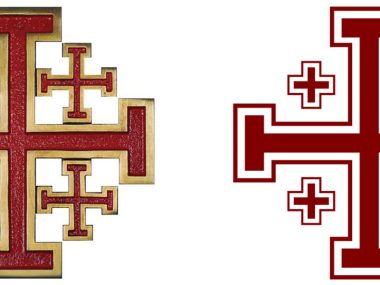
That variety causes real confusion today, because “the Templar cross” is often used loosely. If you want to tell the forms apart with confidence, our guide to the different Templar cross types lays them out clearly, and our explainer on the Jerusalem cross and the crusader’s cross shows how the Templar emblem relates to the other great crusading symbols of the age.
In heraldry the cross pattée became a widely copied device, and its flared, tapering arms are still what most people picture as a “Templar cross.” Museum seals and manuscripts, though, show the Order using plainer Greek and Latin crosses as well, which is why hunting for one single “official” version can mislead. The pattée is the popular emblem; it was never the only one the brothers used.
A symbol of identity and belonging
Beyond its theology, the cross did something intensely practical: it made the Templars a recognisable body of men. In an age before uniforms as we know them, the red cross on a white ground worked as one, on the mantle, on the surcoat over armour, on shields, and on the Order’s banners and seals. To see it was to know instantly whose men these were.
That shared mark reinforced the brotherhood. It reminded each knight that he had surrendered his private identity to something larger, and it told allies and enemies alike that behind the individual stood the whole disciplined Order. The cross was as much a statement of belonging as of belief. For the wider vocabulary of Templar imagery it sat within, our overview of Templar symbols and their enduring meanings makes a good companion read.
The Order’s own seals reinforce the point. The most famous shows two knights sharing a single horse, an image traditionally read as a sign of the founders’ poverty and brotherhood, while others carry the domed image of the Temple. On seals, shields, and banners alike, a shared set of signs told the world that these men acted as one body rather than as free-lancing individuals.
The cross after the Order, and the myths
When the Order was suppressed in 1312 and Grand Master Jacques de Molay was burned in 1314, the emblem did not vanish. It was absorbed into later heraldry, revived by chivalric and fraternal groups centuries afterward, and today appears everywhere from jewellery to tattoos to brand logos.
That long afterlife has attracted a fog of invented meanings. You will find claims that the cross encodes secret geometry or hidden esoteric doctrines, but no evidence confirms these readings; they belong to modern legend rather than medieval fact. The historical meaning is powerful enough on its own, faith, sacrifice, and brotherhood, without embroidery.
Modern confusion runs the other way as well. The cross pattée resembles later military decorations and other Christian crosses closely enough that people routinely mistake one for another, and the Templar version has been borrowed by everything from motorcycle clubs to fashion labels with no medieval connection at all. Recognising the genuine history behind the emblem is the best guard against reading into it meanings that were never there.
Wearing the symbol today
The red cross still resonates because what it stood for is easy to admire: conviction, courage, and loyalty to something greater than the self. Our Eagle and Symbol of Knights Templar tee brings that emblem into a bold modern design, letting you carry nine centuries of meaning in an everyday piece.
Worn thoughtfully, it is less a fashion statement than a small history lesson you carry with you, one that invites the question every good symbol should provoke: what does that mean? Knowing the real answer, sacrifice, purity, and belonging, is what turns an emblem into a story worth telling.
Understand the cross and you understand the Order in miniature. Red for sacrifice, flared arms for its unmistakable form, white behind it for purity, and one shared sign to bind the brotherhood together, a small emblem that still says a great deal.
 knighttemplar


1 comment