Some of the best-documented facts about the Knights Templar sound like they belong in a thriller: a warrior order that answered only to the Pope, ran an international bank, and was wiped out in a single dawn of arrests. Here are 25 Knights Templar facts that are genuinely true, drawn from medieval records rather than conspiracy lore. Each one is short, dated where it matters, and we have flagged the single "fact" most people get wrong. If you love this period, you will not run out of dinner-table material.
Origins and Identity (Facts 1–5)
The order grew out of a very specific moment: the decades after the First Crusade, when Jerusalem was in Christian hands but the roads to it were deadly for unarmed pilgrims. Everything about the early Templars, from their vows to their name, flows from that single problem.

- They were founded around 1119. A small band of knights under Hugues de Payens formed to protect pilgrims traveling to Jerusalem, taking monastic vows while keeping their swords.
- Their name comes from a building. They were housed on Jerusalem’s Temple Mount, in the Al-Aqsa complex that crusaders called the "Temple of Solomon," which is exactly how they became the "Knights of the Temple."
- Their Rule was endorsed at the Council of Troyes in 1129. This church council gave the young order official standing and a written code of life that governed everything from prayer to meals.
- A saint wrote their case. Bernard of Clairvaux composed De laude novae militiae ("In Praise of the New Knighthood"), arguing that a monk could also be a soldier without contradiction.
- They answered only to the Pope. The bull Omne Datum Optimum (1139) exempted them from kings and local bishops alike and let them keep the spoils of war, an extraordinary privilege for the age.
The Rule: Dress and Discipline (Facts 6–11)
Templar life was governed by a detailed Rule that read more like a monastery’s than an army’s. It dictated dress, grooming, and even how a brother could behave in battle.
- Knights wore white mantles. The white cloak marked a full knight and symbolized purity; sergeants and lower ranks wore black or brown.
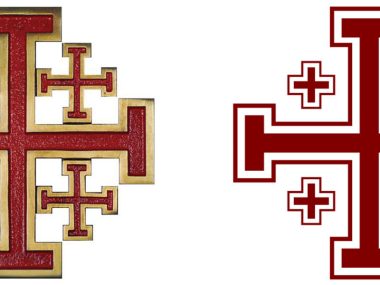
- The red cross came later. It was granted in 1147, roughly two decades after the founding, so the very earliest Templars did not wear it at all.
- Their seal showed two knights on one horse. The famous image is usually read as a badge of poverty and brotherhood, two men sharing a single mount and, by extension, the order’s vow of shared property.
- Vanity was banned. The Rule forbade fashionable pointed shoes and all fur except plain lambskin, cutting off the status displays of ordinary knighthood.
- Beards were required. Brothers kept beards and short hair, standing apart from the clean-shaven fashion favored at many courts.
- Retreat was tightly controlled. A brother could not flee a battle unless the enemy outnumbered his force by more than three to one, which helped forge their fearsome reputation for standing firm.
TEMPLAR SHIRTS – LIMITED EDITION
For the friend who repeats these facts at every gathering, a limited-edition tee stamped with the order’s own cross.
🇺🇸 Fast US shipping · 🇪🇺 Ships across the EU · 🔒 Secure checkout
Organization, Money, and Reach (Facts 12–17)
Behind the front-line knights sat a sprawling international organization. This is where the Templars start to look surprisingly modern, running estates, ships, and finance across two continents.
- Most Templars never fought. The famous armored knights were a minority; sergeants, chaplains, farmers, and clerks kept the machine running, and their daily rhythm looked more like a monastery than a barracks, as our day in the life of a Templar shows.
- They ran an early bank. A pilgrim could deposit money at one house and withdraw it elsewhere with a letter of credit, a genuine forerunner of modern banking that also kept his cash safe from bandits.
- They owned a fleet. Their ships carried pilgrims, money, and supplies between Europe and the Holy Land, giving the order reach that few rivals could match.
- They held land across Europe. A vast network of farms, mills, and commanderies generated the income that funded the war effort in the East.
- They built formidable castles. Fortresses such as Atlit, also called Château Pèlerin, could hold thousands and were among the strongest in the crusader states, showing off the engineering skill you can explore in our look at Templar architecture.
- Their war banner had a name. The black-and-white Beauséant served as both a rallying point on the field and a proud symbol of the order.
The Fall and the Myths (Facts 18–25)
The order’s downfall was as dramatic as its rise, and it is the part later legend has embroidered most heavily. Here is what the documents actually say, ending with the one claim you should treat with caution.
- Acre fell in 1291. The loss of the great port effectively ended the crusader foothold the Templars had defended for generations, and left the order searching for a new purpose.
- The arrests came on Friday, 13 October 1307. King Philip IV of France, deep in debt, had Templars across the kingdom seized in a single coordinated operation at dawn.
- Confessions were extracted under torture. Many of the lurid admissions used against the order were produced under duress and later retracted by the men who made them, which is why historians treat this testimony with great caution.
- A parchment records papal doubt. The Chinon Parchment (1308), rediscovered in the Vatican archives and published in 2007, shows that Pope Clement V absolved the leaders of heresy.
- The order was dissolved in 1312. Clement V suppressed it at the Council of Vienne administratively, notably without a formal verdict of guilt against the order as a whole, which is why the case still divides historians today.
- Their wealth changed hands. Most assets were transferred to the Hospitallers, and in Portugal the new Order of Christ inherited Templar holdings; some of what survived is traced in our guide to Templar relics, lost and found.
- Jacques de Molay was burned in 1314. The last Grand Master went to the stake in Paris, reportedly protesting the order’s innocence to the very end.
- The "Friday the 13th" curse is a modern myth. The popular claim that the date is unlucky because of the 1307 arrests has no medieval evidence; the superstition was tied to the Templars only in modern times, so treat it as folklore, not history.
Why These Stories Look Good on You
Facts this vivid deserve better than being buried in a footnote. Wearing the order’s cross is a low-key way to keep the real history in circulation, and it tends to draw exactly the kind of questions you now have accurate answers for. It beats reciting a debunked superstition, and it looks a great deal sharper too.
The truth about the Templars is stranger and more satisfying than the legends stacked on top of them. Notice how many of these facts point back to the same qualities: discipline, poverty, reach, and a spectacular fall. Keep the dates honest, flag the myths, and the story holds up entirely on its own. That is the version worth wearing, and the version worth repeating.
 Templar Uniform Editorial