
When we picture a Knight Templar, the image is immediate and powerful. It’s not just the sword or the shield that captures our imagination, but the stark white mantle, emblazoned with its potent crimson cross, flowing behind him. This garment was more than a piece of clothing to ward off the chill; it was a declaration. It was a second skin of purpose, a wearable vow of poverty, chastity, and obedience. It was the physical embodiment of a sacred oath, recognized on the battlefield and in the halls of power across Christendom. But in our modern world of fast fashion and fleeting trends, what can this ancient piece of outerwear teach us? The answer is, surprisingly, everything. The principles woven into the very fabric of the Templar mantle—symbolism, function, and identity—are as relevant today as they were in the 12th century. It’s time we reimagined the power of our own outerwear, looking to the past to understand the story our coats and jackets tell about us today.
The mantle as a sacred symbol: beyond mere fabric
To understand the Knights Templar, one must first understand their uniform, and the mantle was its soul. Prescribed by the Latin Rule, the code of conduct for the order, the mantle was a non-negotiable part of a knight’s identity. For the knights, it was to be pure white, a constant, visible reminder of their vow to cast off a life of sin for one of service and purity. This wasn’t a fashion choice; it was a spiritual discipline worn for all to see. The white fabric spoke of a life cleansed, a commitment to fight for Christ with a pure heart. It set them apart from secular knights, whose colorful surcoats often boasted of personal lineage and vanity. The Templar mantle, in its stark simplicity, erased individual ego in favor of collective, holy purpose.

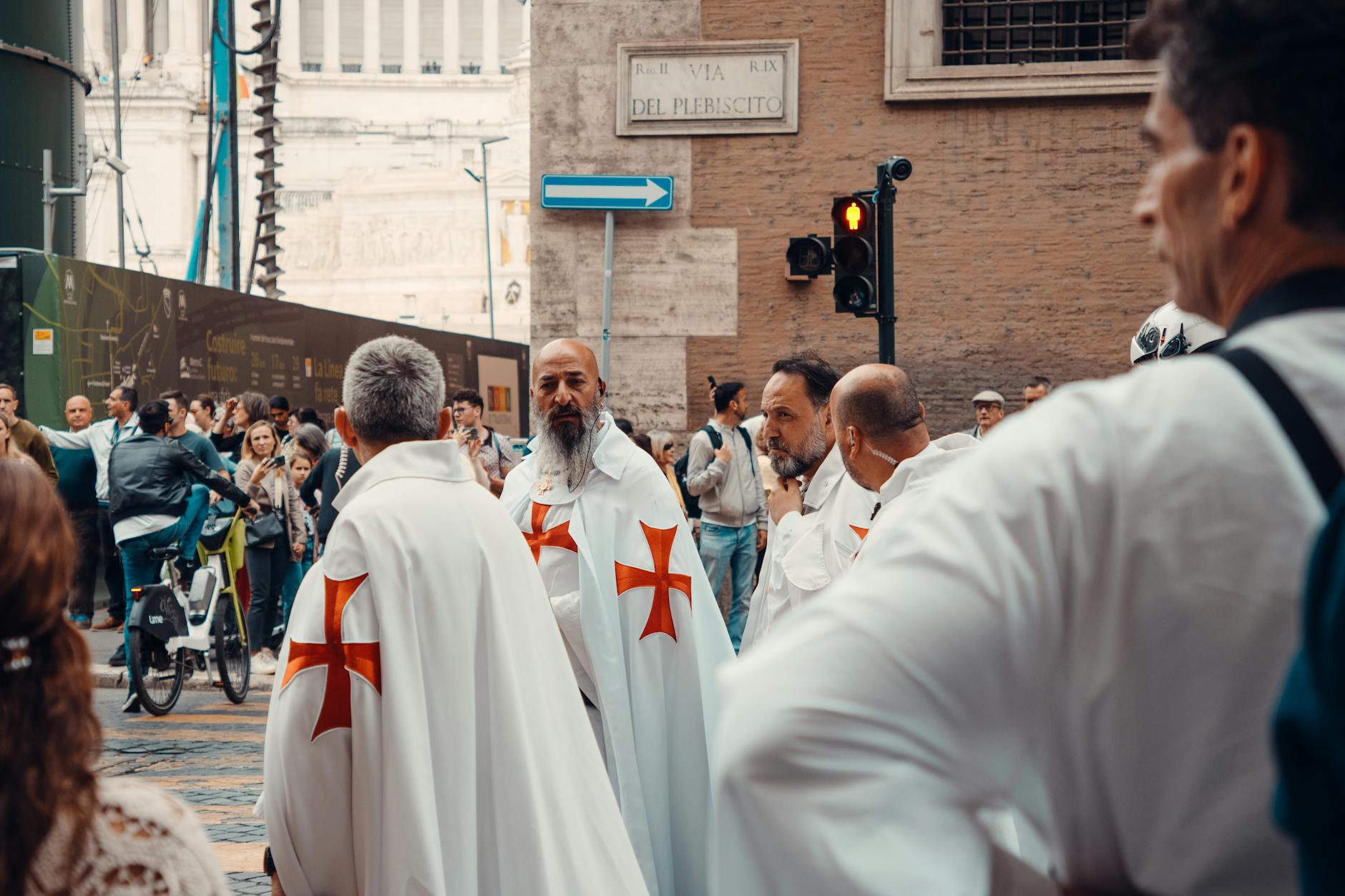
Upon this canvas of purity was the famous red cross, the croix pattée. Granted by Pope Eugenius III around 1147, this symbol was profoundly significant. Red, the color of blood, signified their willingness to face martyrdom in the defense of the Holy Land. It was a promise to God and their brethren that they would not flee from battle, that their life was forfeit for their cause. Every time a knight donned his mantle, he was reaffirming this ultimate vow. Imagine the psychological impact—on both the wearer and the enemy. To see a line of Templars, a sea of white and red, was to witness a force that had already made peace with death. Their outerwear was their banner, their creed, and their armor of faith all in one.
This deep symbolic resonance challenges us to look at our own clothing choices. We often select outerwear based on aesthetics or brand names, but what if we chose it based on our values? The Templar mantle shows us that a garment can be a powerful, non-verbal communicator of one’s core beliefs. It forces us to ask: what does my favorite jacket say about me? Does it speak of a commitment to durability and sustainability, a modern form of stewardship? Does its style align with a personal code of conduct or a community I belong to? The Templars knew that what you wear on the outside reflects the convictions you hold on the inside. The mantle was not a costume; it was the outward manifestation of an inward transformation, a principle we can still aspire to in our own chivalrous apparel.
The fortress of fabric: outerwear as protection and purpose
While the symbolism of the Templar mantle was paramount, the order was nothing if not pragmatic. Their apparel had to be brutally functional, capable of withstanding the harsh realities of a life spent in the saddle and on the battlefield. The mantle, typically made of thick, heavy wool, was a masterclass in purposeful design. In the scorching heat of the Outremer, the white color helped reflect the sun’s rays, providing a surprising degree of cooling for the knight and his horse. Worn over steel armor, it prevented the metal from becoming a searing oven under the desert sun.

Conversely, during the frigid, damp nights in the Levant or back in the commanderies of Europe, that same heavy wool mantle served as a warm blanket. It was a portable shelter, a shield against wind, rain, and cold. This duality of purpose was essential for a warrior monk who might be riding across a desert one week and standing guard on a castle wall in a winter storm the next. The garment was a tool, as vital to a knight’s survival and operational effectiveness as his sword. A soldier suffering from sunstroke or hypothermia is a liability, and the Templars, as an elite fighting force, could not afford such weaknesses. Their outerwear was their first line of defense against the elements, ensuring they were always ready for the real battle.
This ethos of function-first design is a powerful lesson. Today, we are surrounded by technical fabrics and specialized gear that serve the same fundamental purpose. The modern adventurer choosing a GORE-TEX shell to protect against a downpour is channeling the same spirit as the Templar relying on his wool mantle. We select our outerwear to enable our own missions, whether it’s commuting to work in a storm, hiking a mountain trail, or simply navigating the urban landscape. The materials have evolved from wool and linen to synthetics and smart textiles, but the core principle remains unchanged: our outermost layer is a functional fortress. It’s what allows us to face the world, whatever it may throw at us. The Templar mantle reminds us that the best apparel is not just about looking the part; it’s about being equipped for the challenges ahead.
Reimagining chivalry in modern outerwear: from mantle to metropolis
How do we translate the sacred, functional, and identity-defining power of the Templar mantle into our 21st-century lives? We begin by recognizing that our outerwear is already performing these roles, whether we are conscious of it or not. The act of choosing a coat is an act of defining ourselves to the world. A sharply tailored wool overcoat projects an image of professionalism and classic taste. A rugged, well-worn leather jacket speaks of rebellion, independence, and a life of experience. A brightly colored technical parka suggests an adventurous spirit and a connection to the outdoors. Each choice is a piece of our personal heraldry, a symbol that communicates our tribe, our values, and our story without a single word.

Furthermore, the idea of the mantle creating a unified brotherhood has powerful modern parallels. Think of the leather vests of a motorcycle club, the matching team jackets of an athletic squad, or even the subtle brand loyalty that connects strangers wearing the same label. These are all forms of modern uniforms that foster a sense of belonging and shared identity. They are the symbols of secular orders, communities bound by common passions and pursuits. By choosing to wear a particular piece of outerwear, we are often, consciously or unconsciously, aligning ourselves with a group and the values it represents.
The final, and perhaps most important, step in this reimagining is to become more intentional. We can elevate the act of putting on a coat from a mundane necessity to a meaningful ritual. Before you step out the door, take a moment to consider the garment you’ve chosen. What are you preparing to face? What version of yourself are you presenting to the world? Let your jacket be your modern mantle—a symbol of your personal code, a tool that empowers you, and a statement of your identity. Choose pieces that are not only stylish but also durable and ethically made, reflecting a respect for resources that the Templars, with their vow of poverty, would have understood. In a world of disposability, choosing to invest in and care for a quality piece of outerwear is a chivalrous act in itself. The legend of the Templars is not just in ancient history; it’s in the very stitches of the clothes we wear, if we only choose to see it.

 Templar Uniform Editorial


