
A black cross does not have one meaning — it has several, and which one applies depends entirely on who put it there. The most famous black cross of the Middle Ages belonged to the Teutonic Knights, not the Templars: the Templars wore a red cross pattee on white wool. In heraldry, black is the tincture sable. In Christian practice, black is the colour of mourning and requiem. And on a modern shirt or pendant, a blacked-out cross is usually a style decision rather than a historical one. Here is what each black cross actually stands for, and how to tell them apart at a glance.
The medieval black cross that really existed: the Teutonic Knights
If you have seen a white mantle carrying a plain black cross, you have seen the Teutonic Order. The brotherhood began around 1190 as a field hospital serving German-speaking crusaders during the long siege of Acre, and was recognised as a full military order in 1198. Its brothers took the same white mantle the Templars wore, but marked it with a black cross instead of a red one.

That was not an accident of dyeing. By the end of the twelfth century the three great military orders in the Holy Land were telling themselves apart by colour on the battlefield: red cross on white for the Temple, white cross for the Hospital, black cross on white for the Teutonic brothers. A commander scanning a line of men could read allegiance from a distance. The black cross meant German, and it meant Teutonic — nothing else.
So the short answer to “did the Templars have a black cross?” is no. The order that did is a different order, founded seventy years later, with its own rule, its own grand masters and eventually its own state on the Baltic.
Why the Templars never wore a black cross — but did wear black
Here is the detail that trips most people up, and it is the reason the phrase “black Templar” is not entirely wrong. The Rule drawn up at the Council of Troyes in 1129 reserved the white mantle for knight-brothers only. The order’s sergeants, squires and serving brothers — who vastly outnumbered the knights — wore black or brown. Pope Eugenius III granted the order its red cross in 1147, and that cross was then worn by everyone.
Which means a genuine Templar sergeant walked around in a black robe with a red cross on it. The black in Templar dress is the cloth, not the cross. If you are recreating a kit, that distinction decides whether you are dressed as a knight or as the far more common rank below him — and it is covered in more depth in our guide to what the Templar red cross really stood for.
Eagle & Symbol of Knights Templar
The cross pattee rendered the way the Order actually used it — symbol first, on a shirt built for daily wear.
🇺🇸 Fast US shipping · 🇪🇺 Ships across the EU · 🔒 Secure checkout
What a black cross means in heraldry
In heraldry the colour black is called sable, and a cross drawn in sable is described by its shape first: a plain cross, a cross pattee (also spelled formee) if the arms flare outward at the ends, a cross potent if they end in crossbars. This is the answer to a question we get often: the flared Templar-style cross has no separate name when it is black. It is simply a cross pattee in sable.
You will also find lists claiming sable “means” constancy, prudence or grief. Treat those with care. Tincture symbolism of that kind comes from later heraldic writers systematising the craft centuries after coats of arms were first granted; medieval armigers generally chose colours for contrast and recognisability, not for a coded message. The one rule that genuinely governed the choice was the rule of tincture — keep a dark colour off another dark colour so the design stays readable at a hundred paces.
One practical legacy survives in engraving: when a black-and-white print needed to show tinctures, sable was marked by crosshatching horizontal and vertical lines. It is why old woodcuts of arms look the way they do. For the wider family of cross forms and how each one was used, see our guide to the Templar cross types.
The black cross of mourning and remembrance
Away from heraldry entirely, the most common everyday meaning of a black cross is grief. Black has been the liturgical colour of mourning in the Western church for centuries — used for requiem Masses and for Good Friday. Since the liturgical reforms of 1969 many parishes use violet or white at funerals instead, but black remains permitted and is still chosen deliberately.
That association spread well beyond church walls. Death notices in much of continental Europe are printed with a black cross at the head. Roadside memorials, war-grave markers and remembrance pins use the same shorthand. When someone posts a plain black cross with no other context, mourning is almost always what is meant.
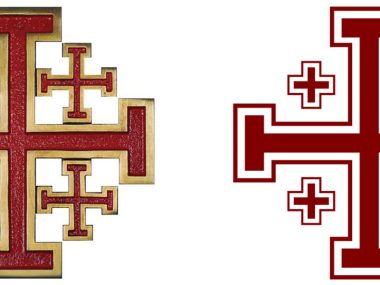
It is worth separating this from the crusader crosses people often search alongside it. A Jerusalem cross is a statement about pilgrimage and the Holy Land; a black cross on a funeral card is a statement about loss. Same geometry, unrelated messages.
The Iron Cross confusion — and the fictional one
The Teutonic black cross had a long afterlife. In 1813 Frederick William III of Prussia instituted a military decoration in the same flared black shape, the design usually credited to the architect Karl Friedrich Schinkel: the Iron Cross. A version of that emblem still marks German military aircraft and vehicles today. It descends from the Teutonic Order’s cross, not from the Temple — a different brotherhood, six centuries earlier, with no institutional link to the Templars at all.
Because that pair gets confused constantly, we compared them side by side: Templar cross vs. Iron Cross covers the shared pattée shape, the five visual tells that separate them, and where the modern sensitivities actually lie.
And because it comes up constantly: the “Black Templars” who dominate a lot of search results are a fictional chapter from the Warhammer 40,000 tabletop setting. The name borrows medieval flavour; the history is invented. If you arrived here from that direction, our piece on the black Templar cross and why it is not red untangles the modern version of the symbol in detail.
Wearing a black cross today
None of this makes a black cross pattee historically “wrong” to wear — it makes it modern, and that is a different thing. Blacked-out insignia is a contemporary aesthetic: the emblem rendered tonally, so it reads as texture up close and as shape from across a room. It is the same instinct that produced subdued unit patches and monochrome heraldry on kit that is meant to be worn rather than displayed.
The honest way to wear one is to know which story you are carrying. A red cross pattee on black cloth is the sergeant’s colours and genuinely medieval. A black cross on white is Teutonic. A black cross on black is a styling choice of the last twenty years, and there is nothing wrong with saying so. What does not hold up is claiming a blackout cross as an authentic Templar emblem — the Order’s own colour was red, and it was granted by a pope who wanted it seen.
The short version
Black cross on white: Teutonic Knights. Red cross on black: a Templar sergeant. Sable cross in a coat of arms: a heraldic tincture, not a coded message. Black cross on a death notice: mourning. Black cross on a modern shirt: style, worn best by someone who knows the difference.
Pick the symbol that matches the story you actually want to tell — and then wear it properly, in a piece built to last rather than a novelty print. That is the whole difference between costume and colours.
 knighttemplar


3 comments