
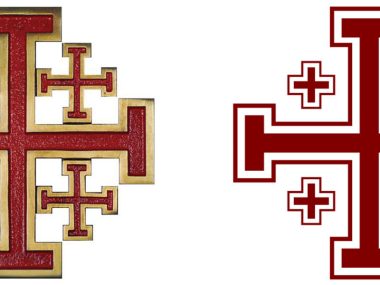
Crusader cross and Jerusalem cross are not two rival designs — they are two different kinds of word. “Jerusalem cross” names one exact emblem: a large cross potent with four small crosses in its quadrants, five in total, the arms of the Crusader Kingdom of Jerusalem. “Crusader cross” names no single design at all; it is a loose modern umbrella for any cross worn by crusaders, and today it most often points at the Jerusalem cross. So when someone says crusader cross, they usually mean the Jerusalem cross — but the Templar, Maltese and Teutonic crosses all sit under the same umbrella, which is exactly why the question keeps coming up.
The short answer: a category versus a design
Hold the two terms side by side and the confusion dissolves.

- Jerusalem cross — a specific emblem. Five crosses: one large cross potent (its arms ending in short crossbars) with four Greek crosslets tucked into the corners. Rendered in gold on silver. It stood for the Kingdom of Jerusalem, founded 1099.
- Crusader cross — a category. No fixed shape, no fixed color, and no medieval technical meaning. Modern usage applies it to the Jerusalem cross most of the time, to the Templar cross often, and to almost any crusading emblem occasionally.
Put plainly: every Jerusalem cross is a crusader cross; not every crusader cross is a Jerusalem cross. If you need to be understood precisely — on a tattoo brief, a product listing, a piece of writing — name the design, not the category.
Why “crusader cross” never named one design
The men who went on crusade were the crucesignati, “those signed with the cross.” Taking the vow meant having a cloth cross sewn onto your garment, and the cross itself was a badge of the vow rather than a coat of arms. Its shape was whatever the tailor cut, and its color identified where you came from.
The clearest illustration comes from the meeting at Gisors in 1188, when the kings of France and England took the cross together for the Third Crusade. Rather than share an emblem, the chroniclers record that the contingents divided the palette between them: red for the French, white for the English, green for the Flemings. Three different crosses, one crusade — and not one of them the Jerusalem cross.
That is the heart of the matter. There was never a standard-issue crusader cross to compare against the Jerusalem cross, because the crusades produced dozens of crosses. The umbrella term is a modern convenience, and it flattens a genuinely varied history.
EAGLE – TEMPLAR SHIRT
One cross, nine centuries of meaning — the Eagle Templar tee carries the Order’s emblem in a bold modern design.
🇺🇸 Fast US shipping · 🇪🇺 Ships across the EU · 🔒 Secure checkout
The Jerusalem cross: the one design that is exact
When the First Crusade took Jerusalem in 1099, the victors established a Christian kingdom in the city, and tradition attributes its five-fold cross to Godfrey of Bouillon, the knight who declined a royal crown and called himself Advocate of the Holy Sepulchre instead. Over the following century the emblem hardened into the formal arms of the kingdom.
Two details make it unmistakable. The first is the count: five crosses, always. The central cross is a cross potent, its four arms capped with short crossbars, and a small Greek cross sits in each quadrant. The second is the tincture: gold on silver, metal laid on metal, which breaks heraldry’s own rule that a metal must be set against a color. Whether that breach was deliberate or simply older than the rule, medieval heralds treated it as a mark of the kingdom’s singular status — the one coat of arms on earth entitled to break the law of arms.
Its meaning is read two ways, and both are old: the five crosses as the five wounds of Christ, or the central cross as Christ with the four evangelists carrying the gospel to the four corners of the world. Pilgrims who reached the Holy Land brought the emblem home, and it still reads as a badge of pilgrimage rather than of conquest. Our full guide to the crusader cross meaning follows that story in depth.
The other crosses under the umbrella
These are the designs most often called crusader crosses when the Jerusalem cross is not what is meant.
The Templar cross — a single red cross pattée, arms flaring outward to broad flat ends, red on white. Pope Eugene III granted the Knights Templar the red cross in 1147, and it marked the men of the Order of the Temple until their suppression in 1312. One cross, not five; a brotherhood, not a kingdom. If that is the pair you are weighing, we cover it directly in Jerusalem cross vs Templar cross.
The Hospitaller and Maltese cross — the Knights Hospitaller, the Templars’ great rivals, wore a plain white cross, on black and later on red. The famous eight-pointed Maltese form — four arrowhead arms meeting at the center, its eight points read as the eight Beatitudes — became the order’s signature later, after Malta. Sharp points rather than flat flares or crossbars mean you are looking at the Hospitallers.
The Teutonic black cross — a plain black cross on white, worn by the Teutonic Order, the third of the great crusading brotherhoods. Straight arms, no flare, no crossbars. This is the design that eventually gave the world the Iron Cross in 1813 — a lineage that has nothing to do with the Templars, however similar the silhouette looks at a glance.
The cross of Lorraine — a two-barred cross carried by the dukes of Lorraine, Godfrey of Bouillon’s own house, and long associated with the crusades and with relics of the True Cross. Count the horizontal bars: two means Lorraine.
Telling them apart in three seconds
A field guide short enough to use while looking at a pendant:
- Five crosses, gold on white → Jerusalem cross.
- One red cross with flared arms → Templar (cross pattée).
- Eight sharp points → Maltese, the Hospitallers.
- Plain black straight arms → Teutonic — the Iron Cross family.
- Two horizontal bars → cross of Lorraine.
- Any of the above, described vaguely → someone said “crusader cross.”
Color is the fastest tiebreaker when the shape is too small to read. Gold on white is Jerusalem; red on white is Templar; black on white is Teutonic. For the wider family of crusading emblems — banners, seals and mottos as well as crosses — see our guide to crusader symbols and meanings.
How the Jerusalem cross outlived the crusades
The Kingdom of Jerusalem fell in 1291, but its cross did not go with it. Custody of the Christian holy places passed in the following century to the Franciscans, who took the five-fold cross as the emblem of that custody and carry it still — which is why the design turns up on church walls and pilgrim badges far from any battlefield.
The other survival is stranger and more personal. Pilgrims who reached Jerusalem marked the journey on their own skin, and the practice never stopped: a single family of tattooists in the Old City has been inking the Jerusalem cross on arriving pilgrims for roughly five centuries, using stamps handed down through generations. A crusader emblem became a souvenir of having walked to the place, then a keepsake, then a tattoo people ask for without knowing any of that history.
This is the long reason the two terms drifted together. “Crusader cross” carries the sound of armies; the Jerusalem cross has spent most of its life on pilgrims, friars and pendants. Using the umbrella term for it tells the smaller and louder half of the story.
Which one do you actually want to wear?
If a design is going on your chest or your skin, the umbrella term will not serve you — the specific cross will. The Jerusalem cross says pilgrimage: faith bound to a place and carried home, five wounds counted in gold. The Templar cross says brotherhood: discipline, vow, and a red cross worn by men who expected to die under it. Both are crusader crosses. They say markedly different things.
Carry the cross this piece is about — the Jerusalem Cross — Bold Crusader Tee, printed on demand and shipped to the US and EU.
Choose the one whose story is yours, and know it well enough to answer the question when someone asks — because with these two, someone always asks. If you are thinking in ink rather than cloth, our guide to the crusader cross tattoo meaning sorts out which design carries which meaning on skin.
 Templar Uniform Editorial


3 comments