
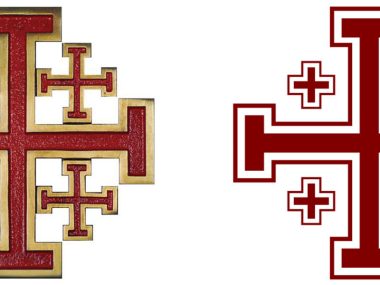
There was never one crusader flag. The banner most people mean when they use the phrase is the arms of the Crusader Kingdom of Jerusalem — a large gold cross potent with four small crosses in its quadrants, set on silver-white — and its meaning is territorial before it is anything else: it was the flag of a kingdom, not a uniform issued to an army. The crusades ran for nearly two centuries and fielded dozens of banners, each meaning something different: a vow, a homeland, a military order, a pope’s blessing. Knowing which banner is in front of you is the whole answer.
The short answer: three flags carry the name
Almost every search for a crusader flag lands on one of three designs, and they do not mean the same thing.

- The Jerusalem cross banner — gold, five crosses, on white. The arms of the Kingdom of Jerusalem after 1099. Meaning: this territory is held by the Christian kingdom.
- The Beauséant — the Knights Templar’s black-and-white war banner. Meaning: the Order is on this field, and it has not yielded.
- A plain colored cross — red, white or green on a field. Meaning: these men are from this contingent, nothing more.
If you want to be understood precisely, name the banner rather than the category. “Crusader flag” is a modern umbrella term with no medieval equivalent, in the same way that crusader cross is an umbrella while Jerusalem cross names one exact design.
Why crusaders wore crosses before they flew flags
The men who went on crusade were the crucesignati — “those signed with the cross.” Taking the vow meant having a cloth cross sewn onto your outer garment, and that stitched cross, not any banner, was the primary crusading emblem. It marked a personal obligation: you had promised to go, and the cross on your shoulder said so to everyone who saw you.
Because the cross was a badge of a vow rather than a coat of arms, it had no fixed shape. What it did acquire was color as a national marker. The clearest case is the meeting at Gisors in 1188, when the kings of France and England took the cross together for the Third Crusade. Rather than adopt one emblem, the chroniclers record that the contingents divided the palette: red for the French, white for the English, green for the men of Flanders.
That is the historical heart of the question. Three crosses, one crusade, and not one of them the Jerusalem cross — because there was never a standard-issue crusader flag to begin with.
Eagle & Symbol of Knights Templar
Nine centuries of meaning in one emblem — the Order’s symbol, cut bold and clean for modern wear.
🇺🇸 Fast US shipping · 🇪🇺 Ships across the EU · 🔒 Secure checkout
The Jerusalem cross banner: the closest thing to a crusader flag
When the First Crusade took Jerusalem in 1099, the victors founded a Christian kingdom in the city, and tradition attributes its five-fold cross to Godfrey of Bouillon — the knight who refused a royal crown and styled himself Advocate of the Holy Sepulchre instead. Over the following century the emblem hardened into the formal arms of the kingdom, and it is the design that modern usage has settled on as the crusader flag.
Two details make the banner unmistakable. The first is the count: five crosses, always — a central cross potent, its arms capped with short crossbars, with a small Greek cross in each quadrant. The second is the tincture: gold laid on silver, metal on metal, which breaks heraldry’s own rule that a metal must be set against a colour. Medieval heralds treated the breach as a mark of the kingdom’s singular status rather than an error.
As for what the five crosses mean, the honest answer is that the medieval sources do not tell us. The familiar readings — the five wounds of Christ, or Christ with the four evangelists — are later interpretations rather than recorded intent. Both are worth knowing; neither should be presented as the documented original. The fuller account sits in our guide to the Jerusalem cross and its meaning.
The Beauséant: the Templars’ own banner
The Knights Templar did not fight under the Jerusalem cross. They fought under the Beauséant — a banner divided black above and white below, sometimes shown with the Order’s red cross added. The name comes from Old French bauçant, a piebald black-and-white horse, and the division was read as the Order’s two faces: black toward its enemies, white toward its friends.
Its meaning was operational, not decorative. The Rule bound a brother to the banner while it flew: a Templar could not quit the field as long as the Beauséant was still raised. Only if it fell might he rally to another Christian banner, and only if every Christian banner was down could he honourably leave. A flag that determines whether a man may walk away is a flag with a job — which is why it reads so differently from the kingdom’s heraldic arms. We cover it in depth in our guide to the Beauséant, the Templar battle banner.
The other banners on a crusade field
A crusading army was a coalition, and its sky was crowded. Alongside the kingdom’s arms and the Templar Beauséant you would have seen:
- The papal banner — the vexillum sancti Petri, granted by the pope to sanction an expedition. It meant the campaign carried Rome’s authority.
- The oriflamme — the red-gold banner kept at Saint-Denis and carried by the kings of France. A dynastic flag, not a crusading one, brought along on crusade.
- The Hospitallers — a white cross on red. The rival order’s field sign, and deliberately the inverse of nobody: simply theirs.
- The Teutonic Knights — a black cross on white, the design that would travel north into the Baltic and long outlive the crusades.
- St George’s cross — red on white, adopted by English forces and eventually by England itself.
One caution worth stating plainly: no authentic crusader battle flag survives. Twelfth-century textiles almost never do. Everything we reconstruct comes from manuscript illumination, seals, coins and later heraldic record — which is exactly why so many confidently drawn “crusader flags” online are modern artwork, not artefacts.
What the crusader flag means today
The Jerusalem cross never went out of use. It remains the emblem of the Franciscan Custody of the Holy Land, and pilgrims still receive it as the Jerusalem Pilgrim’s Cross — an unbroken devotional line from the kingdom to the present. The modern flag of Georgia carries a comparable five-cross arrangement, though its crosses come from Georgian tradition rather than from the crusader kingdom.
It is also true that crusader imagery has been picked up by modern political movements the historical Order would not recognise. That does not change what the banner meant in 1099, but it is a fair reason to know your own symbol well enough to explain it. Precision is the best answer to appropriation: the Jerusalem cross is the arms of a kingdom, the Beauséant is a fighting order’s rallying point, and a coloured cross was a contingent marker. None of the three was a slogan.
Wear the emblem, know the story
A cross on a shirt invites the same question a banner did: what does it stand for? The difference is that you get to answer. Our Eagle & Symbol of Knights Templar tee carries the Order’s emblem in a clean modern cut, for wearers who would rather explain a symbol than merely display it.
So: there is no single crusader flag, and the phrase is doing the work of at least three different banners. Learn the count of crosses, the colour pairing and the shape of the arms, and you can name any of them at a glance — and say what it actually meant to the men who carried it. For the designs themselves rather than the banners, continue with our guide to the Templar cross types.
The words shouted under these banners are unpacked in Deus vult: the real story of “God wills it”.
 Templar Uniform Editorial


3 comments