The honest answer first: you cannot join the Knights Templar. The Order founded in 1119 was dissolved by Pope Clement V in 1312, its properties transferred, its members absorbed, pensioned or scattered. There is no unbroken line of succession from it to anything operating today, and every group claiming one is making a claim no historian accepts.
That said, several real, long-established organisations carry the Templar name, do genuine work, and accept members. They are worth knowing apart from each other — and from the groups that will happily sell you a knighthood.

Why there is no surviving Order
The suppression was thorough in a specifically legal way. At the Council of Vienne in 1312, the bull Vox in excelso dissolved the Order by administrative act. Clement V deliberately did not condemn it as heretical — the evidence had not convinced him — but he abolished it anyway, on the grounds that its reputation was damaged beyond repair.
A second bull transferred the Templar properties to the Knights Hospitaller. Individual brothers were not executed as a class; most were pensioned, absorbed into other orders, or released. Only the leadership who recanted were burned.
This matters for the succession question. The Order was not driven underground — it was wound up, its assets inventoried and its people reassigned, in public, over several years. A secret continuation would have had to survive with no property, no income, no recruitment and no recorded trace for roughly four and a half centuries before the first such claims appear in the 1700s. For the one documented exception, see what actually happened in Portugal and Scotland.
The real organisations you can actually join
Three families of organisation have a genuine institutional history. None claims medieval descent that stands up, but all are real bodies with real requirements.
1. OSMTH / SMOTJ — the ecumenical chivalric orders. The Sovereign Military Order of the Temple of Jerusalem, and its American branch the Sovereign Military Order of the Temple of Jerusalem (SMOTJ), trace their organisational history to the nineteenth and twentieth centuries. OSMTH holds consultative status with the United Nations Economic and Social Council, which is a meaningful institutional marker. The work is charitable — supporting Christians in the Middle East, humanitarian funding, heritage preservation. Entry is normally by invitation and sponsorship by an existing member, after a period of acquaintance, with a Christian profession of faith expected.
2. Masonic Knights Templar. In the American York Rite, the Knights Templar is the final order of the Commandery. You cannot approach it directly: you must first be a Master Mason in good standing, then progress through the Chapter (Royal Arch) and Council degrees. Unlike most of Freemasonry, this body requires a profession of Christian faith. In England and Wales the equivalent is the Masonic Knights Templar under its own Great Priory. This is the largest and most accessible route by far, and it is open about being a Masonic order inspired by the Templars rather than descended from them — see what the modern Masonic order actually is.
3. The Order of Christ. The Portuguese successor created in 1319, which took over the Templar properties and much of the personnel, still exists — but as a state honour conferred by the President of Portugal, not a membership society. There is also a papal Order of Christ, the Holy See’s highest order, conferred very rarely. Neither accepts applications.
KNIGHTS TEMPLAR T-SHIRT
Not a title you buy — a tradition you carry.
🇺🇸 Fast US shipping · 🇪🇺 Ships across the EU · 🔒 Secure checkout
How to spot a fake order
Templar revivalism attracts a steady supply of invented organisations. The tells are consistent:
- It claims unbroken descent from 1118/1119. No credible body claims this, because it cannot be documented. Watch for the phrase “secret succession” or a lineage running through Scotland.
- You can pay to be knighted. If a fee produces a title, a certificate and a sash with no sponsorship, no probation and no vetting, you are buying costume jewellery. The historical Order treated paying for entry — simony — as one of its gravest expulsion offences, which is a pointed irony.
- It sells ranks upward. Grand Commander, Grand Prior and Knight Grand Cross available at ascending prices is a product catalogue, not a hierarchy.
- It claims sovereignty, diplomatic status or chivalric recognition. Real recognition is checkable — through a national honours system, the Holy See, or ECOSOC. Unverifiable claims are the point of the exercise.
- It has no charitable output you can examine. Real orders publish what they fund.
What membership actually involves
People are often surprised by how undramatic the genuine article is. There is no armour. A modern investiture involves a mantle and a ceremony, after which you are a volunteer with obligations: regular meetings, dues, charitable fundraising, and committee work. The commitment is real but it is the commitment of a service organisation, not a military one.
That is not a criticism. The medieval Order’s own daily reality was closer to administration than to battle — most brothers never saw the Holy Land and spent their lives managing farms, mills and accounts so that the few who fought could be paid for. A modern member raising funds for a hospital in the Levant is doing something a thirteenth-century preceptor would have recognised immediately.
If you just want the identity, not the institution
Worth saying plainly, because a great many people searching this question are not looking for an organisation at all. They have connected with what the Order represented — discipline, brotherhood, faith held under pressure — and want to carry it. That requires no membership and no permission.
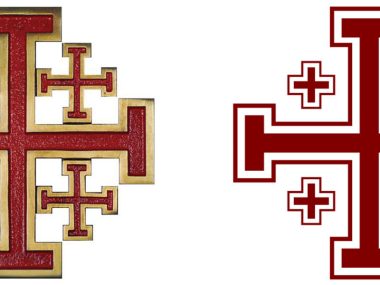
The symbols are not restricted. The red cross, the Beauséant and the mottoes belong to history, and wearing them is a statement about what you value, not a claim to an office. The only thing worth avoiding is the opposite move: buying a title from an online “priory” and then representing it as something it is not. Carrying the cross honestly beats carrying a certificate dishonestly. For the symbols themselves, start with what the Order actually bore.
The medieval Order had more than one kind of member
One more piece of history is worth knowing, because it is the closest medieval equivalent to what most modern enquirers actually want.
Full brothers — knights in white mantles, sergeants in black or brown — were only part of the Order’s membership. Alongside them stood the confratres and donats: lay associates who supported the Order financially or by grant of property, received a share in its prayers and privileges, and sometimes the right to be buried in a Templar cemetery, without taking the full vows or living in a house.
Some served for fixed terms. Some were married men who arranged to enter fully as brothers only at the end of their lives, a common medieval practice. Women could be associated with the Order in this supporting role too, even though they could not be received as brothers — the Rule is explicit in excluding them from the fighting membership.
The arrangement was financially vital. A transnational order with permanent war costs ran on exactly this kind of lay affiliation, and the Templars built a large network of it across Europe. It is also the historical shape that modern charitable orders have returned to, more or less by accident: supporters who fund the work and share the identity without pretending to be medieval knights.
The short answer
The medieval Order ended in 1312 and nobody can join it. The real options today are OSMTH/SMOTJ (invitation, sponsorship, Christian profession, charitable work), the Masonic Knights Templar (Master Mason first, then York Rite progression), or the Order of Christ (a state honour, not open). Anything that sells you a knighthood outright is selling you a costume.
 Templar Uniform Editorial