The Masonic Knights Templar is a modern fraternal order inside Freemasonry — not a surviving branch of the medieval Order of the Temple. In the United States it is the Commandery, the final body of the York Rite, and a candidate must already be a Master Mason before he can petition it. It borrows the medieval Order’s cross, its battle cry and its imagery, and it has done so since the eighteenth century. What it does not have is a documented line of descent from the knights who were arrested in 1307. Understanding that distinction is the whole point of this guide.
What Is the Masonic Knights Templar?
Short answer: The Masonic Knights Templar is a Christian chivalric order inside Freemasonry, not a survival of the medieval Order. In the United States it is the Commandery, the final body of the York Rite, open only to men who are already Master Masons. Britain calls the equivalent unit a Preceptory.

In American Freemasonry the York Rite is a ladder of three bodies. A Master Mason first joins a Chapter of Royal Arch Masons, then a Council of Cryptic Masons, and finally a Commandery of Knights Templar. The Commandery confers three orders rather than degrees: the Illustrious Order of the Red Cross, the Order of Malta, and the Order of the Temple. A man who completes them is styled a Sir Knight.
The governing body in the United States is the Grand Encampment of Knights Templar, formed in 1816. In England and Wales the equivalent is the Great Priory, and the local unit is a Preceptory rather than a Commandery. The vocabulary shifts between countries, but the shape is the same: a chivalric, ceremonial order layered on top of ordinary Craft Masonry.
One feature sets the Commandery apart from almost everything else in Freemasonry. Most Masonic bodies ask only that a candidate profess belief in a Supreme Being, leaving the specifics alone. The Order of the Temple has historically required a Christian profession — a candidate is asked to defend the Christian faith. That requirement is why the Commandery, uniquely, is explicitly Christian in character.
Where the Masonic Order Came From
The Masonic Templar story begins in the eighteenth century, not the twelfth. The usual starting point is an oration delivered in Paris in 1736 by Andrew Michael Ramsay, a Scottish Jacobite, who told his listeners that Freemasonry had been carried home from the Holy Land by crusading knights. Ramsay actually named the Hospitallers, not the Templars — a detail that is almost always dropped in the retelling — but the idea of a crusading pedigree was irresistible, and within a generation Templar degrees were circulating in France and Germany.
By the 1760s a Templar degree is documented in Scotland and Ireland, and the Baldwyn Encampment at Bristol claims an older working still. The German Rite of Strict Observance, built in the same period, went further and asserted an unbroken secret succession from the medieval Order. It collapsed in 1782 at the Convent of Wilhelmsbad, when its own members concluded the evidence did not exist.
Freemason — Knights Templar Tee
Cross and crown, worn plainly. For Sir Knights and for anyone who respects the symbolism.
🇺🇸 Fast US shipping · 🇪🇺 Ships across the EU · 🔒 Secure checkout
Is There a Real Link to the Medieval Templars?
Short answer: No. No surviving document connects the Masonic order to the Templars suppressed in 1312. The best-known claimed proof, the Charter of Larmenius, is regarded as an eighteenth-century forgery. Most Grand Encampments describe their own order as commemorative rather than descended.
No surviving document connects the Commandery to the Order dissolved by Pope Clement V in 1312. The best-known attempt to supply one is the Charter of Larmenius, a parchment that purports to record the transfer of the Grand Mastership from Jacques de Molay to a successor in 1324. Historians have regarded it as an eighteenth-century fabrication for well over a century, and it is treated as such by most Masonic scholars too.
Legends of Templar survival in Scotland — fugitive knights turning the tide at Bannockburn in 1314 — make a good story and have no contemporary source behind them. The honest position, and the one most Grand Encampments take in their own literature, is that the Masonic order is a commemorative one. It keeps the memory and the symbolism of the medieval knights alive without claiming to be them.
That is less romantic than a secret chain of succession, and it is also more defensible. The medieval Order was a religious military community of warrior monks founded around 1119; the Commandery is a fraternal body of modern men. Both wear the cross. Only one of them rode to Hattin.
The Symbols: Cross and Crown, Beauceant, Chapeau
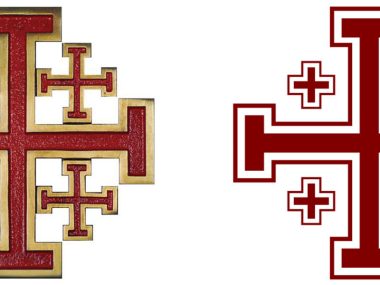
Masonic Templar regalia is its own visual language, overlapping with the medieval Order’s but not identical to it. The central emblem is the cross and crown, usually a red Passion cross inside a crown, carrying the motto In Hoc Signo Vinces — “In this sign you will conquer,” the phrase associated with Constantine’s vision in 312. You will also meet the Maltese cross, borrowed from the Order of Malta degree, which is why Commandery jewellery often mixes cross forms that the medieval Templars never used together. Our guide to the different Templar cross types is useful here, because the distinctions matter once you start buying regalia.
The Beauceant — the black-and-white banner of the medieval Order — survives in Commandery use, and the ladies’ auxiliary in the United States takes its name from it. Officers wear a chapeau, a plumed cocked hat whose plume colour marks rank, and carry a sword. None of that is medieval. The chapeau is a nineteenth-century American military affectation, and the medieval Templars wore a white mantle and a coif, not a feathered hat.
If you want the older symbol set on its own terms, start with the real Templar emblem, seal and crest and then with the wider vocabulary of Templar symbols. Knowing which symbols belong to which order is the quickest way to avoid buying something that mixes six centuries into one design.
How Do You Join a Commandery?
Short answer: You must first be raised a Master Mason, then join a Royal Arch Chapter and, where required, a Cryptic Council, before petitioning a Commandery. Membership is by petition and ballot at every stage, and the Order of the Temple has historically required a Christian profession.
The path is fixed and there are no shortcuts. A man must first be raised a Master Mason in a Craft lodge, which in most jurisdictions means petitioning, being investigated, and working through three degrees over several months. He then joins a Royal Arch Chapter, a Cryptic Council where one is required, and finally petitions a Commandery. Membership is by petition and ballot throughout; no one is recruited.
American Commanderies are also known for the Knights Templar Eye Foundation, which has funded ophthalmic care and research since 1956. For many Sir Knights that charitable work, rather than the costume, is the reason they stay.
Wearing the Cross Outside the Lodge Room
Regalia stays in the asylum, but the symbolism does not have to. Plenty of Sir Knights want something they can wear on a Saturday without explaining a chapeau to anyone — and plenty of people who will never join a Commandery still respond to the same imagery. A plain cross-and-crown or red cross pattée on a shirt does the job: it reads as conviction rather than costume, and it does not pretend to a rank the wearer has not earned. Choose colour honestly — a deep red cross on bone or black is the historic pairing, and gold-heavy “Templar” merchandise is almost always a modern invention.
The Masonic Knights Templar is best understood on its own merits: a Christian chivalric order inside Freemasonry, roughly 260 years old, that chose the Templars as its model and has kept faith with that choice. It is not a survival, and it has never needed to be one. Read it as commemoration and the symbols make sense; read it as secret descent and you will spend years chasing documents that were forged to be chased.
Related: how to join a modern Templar order today.
 Templar Uniform Editorial