
When we picture a Knight Templar, the image is immediate and powerful: the iconic white mantle, emblazoned with the stark red cross, billowing over a warrior of unwavering faith. This surcoat is a symbol of purity and martyrdom, a legend in its own right. But beneath this famous cloth lay the true secret to the Templar’s battlefield resilience—a sophisticated, multi-layered system of defense where every stitch and every link was a calculated component of survival. The gleaming chainmail, or maille, was its heart, but its effectiveness was not merely in the strength of its iron rings. It was in the forgotten art of tailoring, the meticulous layering, and the foundational garments that turned a simple mesh of metal into a formidable second skin. To truly understand the Templar uniform, we must look past the mantle and delve into the science of why chainmail layers and their expert tailoring truly mattered.
The unsung hero: the gambeson as the foundation of defense
Before a single metal link was donned, the Templar knight’s protection began with a thick, padded garment known as a gambeson or aketon. This crucial piece of attire, often overlooked in popular depictions, was arguably as important as the chainmail itself. It was the unsung hero of medieval armor, the foundation upon which the entire defensive system was built. Made from multiple layers of durable fabric like linen or canvas and stuffed with padding such as raw wool, horsehair, or cloth scraps, the gambeson was meticulously quilted to keep its filling evenly distributed.

Its primary function was shock absorption. While chainmail is exceptionally effective at stopping the cutting edge of a sword or the point of a spear, it does little to mitigate the sheer kinetic force of the impact. A blow from a mace, warhammer, or even a powerful sword strike could break bones and cause massive internal bruising right through the maille. The gambeson acted like a primitive form of trauma pad, compressing upon impact to dissipate the concussive force across a wider area of the body. This alone could mean the difference between a debilitating injury and a mere bruise, allowing a knight to remain in the fight.
Beyond protecting from blunt force, the gambeson served several other vital purposes. It provided a comfortable barrier between the wearer’s body and the heavy, abrasive chainmail, preventing chafing and sores during long marches and grueling campaigns. In the sweltering heat of the Holy Land, a properly made linen gambeson could also help manage sweat, wicking it away from the skin. Furthermore, it was the structural base for attaching other pieces of armor. As armor evolved, pieces of plate like couters (elbow guards) and poleyns (knee guards) could be tied directly onto the reinforced points of the gambeson, keeping them securely in place.
For the Knights Templar, an order known for its discipline and battlefield prowess, this foundational layer was non-negotiable. It transformed their chainmail from a simple anti-cutting defense into a comprehensive system capable of withstanding the diverse and brutal array of weapons they faced, ensuring that the soldier of Christ could endure the harshest blows and continue his sacred duty.
A perfect fit for a holy war: tailoring the maille hauberk
With the padded foundation in place, the next layer was the maille itself. A full-length shirt of maille, known as a hauberk, often included integrated mittens (muffs) and an attached maille hood, or coif. This was the centerpiece of Templar protection, a flexible curtain of iron that could turn aside a blade with ease. However, not all maille is created equal. Historically, the Templars would have worn riveted mail. Each tiny ring was interlinked with four others and then secured with a minuscule rivet, creating an incredibly strong and resilient mesh. This stands in stark contrast to the cheaper, modern “butted” mail, where rings are simply bent closed and can be easily pried open by a determined thrust.
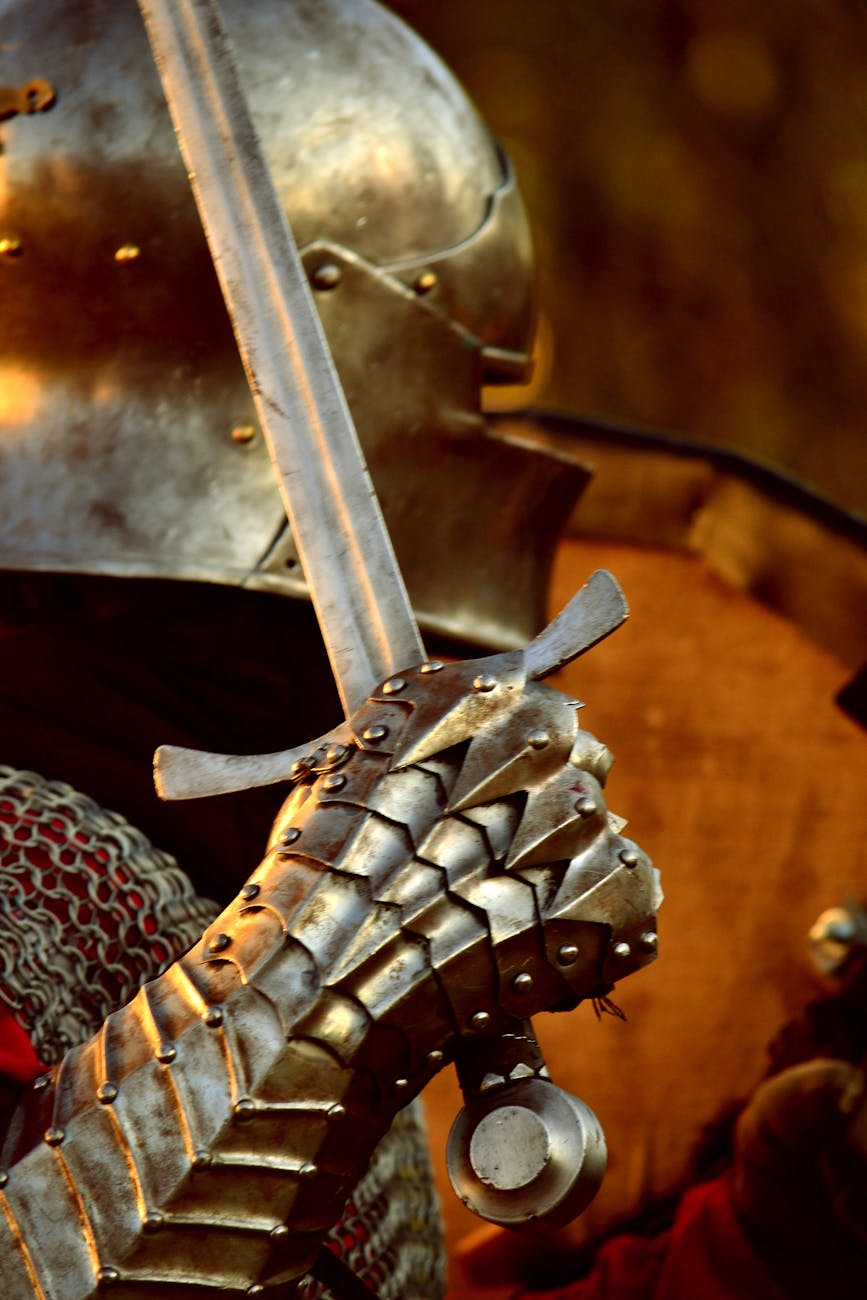
More importantly, a hauberk was not a one-size-fits-all sack of metal. The art of tailoring chainmail was essential for both endurance and effectiveness. A poorly fitted hauberk, weighing anywhere from 25 to 40 pounds, would hang entirely from the shoulders. This immense, localized weight would cause extreme fatigue in a very short amount of time, rendering a knight less effective in a prolonged battle. A master armorer, however, would tailor the hauberk to the knight’s body. By cinching the hauberk at the waist with a sturdy leather belt, a significant portion of the weight was transferred to the hips. This simple act of weight distribution allowed the knight to bear the load for hours on end, preserving his stamina for when it mattered most.
Tailoring also directly impacted mobility. A well-crafted hauberk was tapered in the arms and torso to provide a closer fit, reducing unnecessary bulk and weight. Armorers would skillfully add triangular sections of maille, called gores, into the skirt of the hauberk to allow it to flare out, granting the knight unrestricted leg movement for fighting on foot or mounting a horse. Square sections, known as gussets, were often added in the armpits. This crucial detail prevented the maille from binding or tearing when the knight raised his arms to strike a blow. Every element was designed to create a balance between maximum coverage and maximum freedom of movement. For a Templar knight, whose martial arts were honed through relentless training, the ability to move without restriction was paramount. The expert tailoring of his maille ensured that his armor was a second skin, not a metal prison.
The complete system: from linen undergarments to the sacred surcoat
The true genius of Templar attire lies in viewing it not as individual pieces, but as a complete, integrated system where each layer serves a specific purpose and enhances the others. The process of arming a knight was a ritual of layering, starting with the most basic garments and building outwards into a fortress of fabric and steel.

It began with simple linen undergarments (braies and a shirt) for comfort and hygiene. Over these went padded leggings, or chausses, which performed the same shock-absorbing function for the legs as the gambeson did for the torso. Next came the maille chausses, laced securely to a belt. Then, the knight would pull on his gambeson, the foundational garment. The maille hauberk was hoisted over his head, its weight immediately settled and distributed by the waist belt. The maille coif was pulled up over a padded arming cap, which cushioned blows to the head. A helmet was then placed over the coif, completing the head protection. Finally, the iconic white surcoat was worn over everything.
This final layer, while symbolic, was also intensely practical, especially in the Crusader States. The brilliant white fabric reflected the harsh Middle Eastern sun, preventing the chainmail from heating up to dangerous temperatures and effectively “cooking” the knight inside. It also kept dust, mud, and rain off the maille, which was susceptible to rust. Rust not only weakened the rings but could also seize them up, reducing the armor’s flexibility. The surcoat, therefore, was a crucial piece of maintenance equipment as well as a symbol of identity. It proclaimed the knight’s allegiance to all, striking fear into his enemies and inspiring his allies. When this entire system was assembled, the Templar was transformed. He was a walking testament to the era’s most advanced military technology—a synergy of padded textiles, tailored maille, and practical outerwear that made him one of the most formidable heavy cavalrymen in history. The legend of the Templars was forged in faith and fire, but it was stitched together, layer by careful layer, with thread and iron.

 Templar Uniform Editorial


