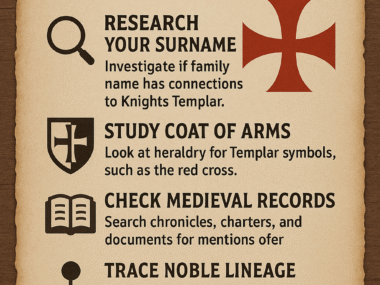
When we picture a Knight Templar, the image is immediate and iconic: the stark white mantle, the bold red cross, the stoic warrior of faith. It’s a uniform that speaks of history, legend, and an unwavering sense of purpose. But beneath the layers of linen and chainmail lies something far more enduring than any physical garment. It is the invisible uniform of brotherhood, a code of conduct and a set of traditions that bound these men together with a strength that has echoed through centuries. In a world that often feels fragmented and isolating, these ancient principles of unity, discipline, and service offer a powerful blueprint for strengthening our connections and communities today. The legend is not just in the stitch of the mantle, but in the spirit of the men who wore it. This is an exploration of that spirit—the traditions of the Templar brotherhood and how we can weave them into the fabric of our modern lives.
The foundation of the order: faith, charity, and duty
The Poor Fellow-Soldiers of Christ and of the Temple of Solomon, as they were originally known, were founded on a triumvirate of powerful ideals: faith, charity, and duty. These were not abstract concepts but the very pillars upon which their entire existence was built. To understand how to apply their traditions, we must first understand the bedrock from which they grew. This foundation was so strong that it supported a multinational organization for nearly two hundred years, and its principles remain as relevant today as they were in the 12th century.

First and foremost was faith. While rooted in their devout Christianity, this faith extended beyond religious doctrine. It was a profound belief in their mission—to protect pilgrims on the dangerous roads to the Holy Land. This shared purpose was the glue that held the order together. It gave every action, from prayer to training to standing guard, a deep and resonant meaning. In our contemporary lives, this translates to the power of a shared mission. Whether it’s within a family, a company, a sports team, or a volunteer group, a common goal galvanizes individuals into a cohesive unit. It transforms a group of people into a brotherhood or sisterhood. Finding or creating that shared purpose is the first step in building a modern order of your own. It requires asking the big questions: What do we stand for? What is the ‘pilgrim’ we are trying to protect? What is the ‘Holy Land’ we are striving to reach? This could be raising a family with strong values, building a business that operates ethically, or creating a community project that improves your neighborhood. This shared faith in a goal gives us a reason to support one another when times are tough.
Next came charity, a principle embodied in their very name, the “Poor Fellow-Soldiers.” Their initial mission was an act of profound charity: protecting the vulnerable without expectation of reward. This service-oriented mindset is a powerful antidote to the self-centeredness that can permeate modern culture. The Templar concept of charity was active and protective. It wasn’t just about giving alms; it was about offering a shield to those who could not defend themselves. We can practice this today by becoming guardians in our own communities. This can mean mentoring a young person, volunteering for a local cause, checking in on an elderly neighbor, or simply standing up against injustice when we see it. It is about using our strength, whatever it may be, in the service of others. This active charity builds powerful bonds, as it fosters trust and mutual respect, showing others that they are not alone and that someone is watching their back.
Finally, there was an unshakeable sense of duty. A Templar’s vow was a sacred, lifelong commitment. It was a promise to the order, to God, and to his brothers. This dedication to one’s word and responsibilities is a cornerstone of any strong relationship. In an age of fleeting commitments and digital anonymity, the concept of unwavering duty feels almost revolutionary. To embody this tradition means to cultivate personal integrity. It means that your word is your bond. When you say you will do something, you do it. It means being reliable, accountable, and present for the people who depend on you. This steadfastness builds a foundation of trust that is essential for any true brotherhood. It is the quiet, consistent work of showing up, day in and day out, that forges the strongest connections, creating a shield wall of mutual support that can withstand any challenge.
The code of conduct: discipline, humility, and mutual support
If faith, charity, and duty were the foundation, then the order’s strict code of conduct—largely derived from the Latin Rule—was the framework that gave it structure and strength. This code governed every aspect of a knight’s life, from his dress to his diet to his interactions with his brothers. It was designed to strip away individual ego and forge a unified, disciplined fighting force. These internal traditions of discipline, humility, and mutual support are perhaps the most potent lessons for building resilience in modern life.

Discipline was paramount. The Templar lifestyle was austere and rigorous. They ate simple meals, often in silence, and owned no personal property. Their uniform, while iconic, was a symbol of their collective identity, not individual vanity. It was a rejection of materialism in favor of a higher purpose. This principle offers a powerful counter-narrative to our consumer-driven world. Practicing Templar discipline today doesn’t mean we must live as monks, but it does encourage us to be more intentional about our lives. It’s about cultivating self-control, whether that’s with our finances, our health, or our use of technology. It’s about choosing substance over surface, focusing on developing skills and character rather than just accumulating possessions or chasing social media validation. It is the discipline to turn off distractions and be present with the people in front of you, to train your mind and body, and to prioritize the long-term health of your community over short-term personal gratification. This shared discipline creates a culture of excellence and mutual respect.
Hand-in-hand with discipline was humility. The famous Templar seal, depicting two knights sharing a single horse, is a timeless symbol of this value. It represented their initial poverty but also their commitment to brotherhood and the suppression of personal pride. In an era that celebrates self-promotion and personal branding, humility is a radical act. To practice it is to recognize that our individual success is often built on the support of others. It means listening more than we speak, admitting when we are wrong, and being willing to learn from anyone, regardless of their status. In a group setting, it means celebrating the team’s victory over individual accolades and being willing to do the unglamorous work that needs to be done. Humility is the mortar that holds the bricks of brotherhood together. It diffuses conflict, encourages collaboration, and reminds us that we are all part of something larger than ourselves.
From this foundation of discipline and humility grew the ultimate expression of the Templar brotherhood: absolute mutual support. In battle, a Templar was forbidden from retreating unless the odds were insurmountable or the order was given. They stood shoulder-to-shoulder, forming a shield wall where each knight’s life depended on the man next to him. This was not just a battlefield tactic; it was a life philosophy. They lived together, ate together, and prayed together. This constant proximity forged an unbreakable bond. We can recreate this in our own lives by being intentional about building and maintaining our ‘shield wall.’ It means creating networks of support where people can be vulnerable without fear of judgment. It’s about being the friend who shows up at 2 a.m., no questions asked. It’s about creating a family or a team where everyone knows their role and trusts that their comrades will fulfill theirs. This level of support requires active participation. It means checking in, offering help before it’s asked for, and sharing not only in the triumphs but also in the struggles. It is in this crucible of shared experience that casual friendships are forged into true brotherhood.
Forging modern knighthood: ritual, mentorship, and community building
The Templar traditions were not just a set of abstract ideals; they were put into practice through tangible structures that fostered community and passed knowledge from one generation to the next. By examining their methods of ritual, mentorship, and community building, we can find a practical guide for creating our own modern orders—groups bound by shared values and a commitment to mutual growth and service.

Humans are creatures of ritual. From a simple handshake to a formal ceremony, rituals give our lives structure, meaning, and a sense of shared identity. The Knights Templar understood this profoundly. Their lives were filled with rituals, from daily prayers and chapter meetings to the solemn initiation ceremony for new recruits. These repeated, symbolic actions reinforced the order’s values and strengthened the bonds between brothers. We can harness this power in our own lives by creating meaningful rituals. This could be a weekly family dinner with no phones allowed, an annual camping trip with a close group of friends, a formal quarterly meeting for a business team to reaffirm its mission, or even a simple daily practice of gratitude. These rituals become sacred spaces in time, predictable anchors in a chaotic world where we can reconnect with our purpose and with each other. The Templar uniform itself was a part of this ritual—donning the mantle was a physical act that signified a mental and spiritual shift from individual to brother, from man to Templar.
Another key to the order’s longevity was its effective system of mentorship. Experienced knights were responsible for training squires and new members, passing down not only martial skills but also the order’s code of conduct and unwritten traditions. This master-apprentice model ensured that the core values of the brotherhood were preserved and transmitted through the generations. In today’s world, the need for mentorship is greater than ever. We can honor this Templar tradition by actively seeking out mentors in our own lives and, just as importantly, by offering our guidance to those who are on a similar path but a few steps behind us. This relationship is a two-way street; the mentor gains the satisfaction of passing on their wisdom, and the mentee gains a guide to help them navigate challenges. In a professional, personal, or community context, a strong mentorship culture creates a cycle of growth and support, ensuring that knowledge and values are not lost but are instead strengthened with each new generation.
Ultimately, the Templars were master community builders. Their network of preceptories and commanderies across Europe were more than just military outposts; they were centers of agriculture, finance, and local governance. They created infrastructure and provided stability, becoming integral parts of the communities they inhabited. This is perhaps the grandest lesson of all: a true brotherhood does not exist in a vacuum. It strengthens itself by serving and building the wider community around it. We can embody this principle by shifting our focus from individual achievement to collective well-being. This could mean starting a neighborhood watch, organizing a local charity drive, supporting local businesses, or creating a club or organization dedicated to a shared passion. It is about building spaces—both physical and virtual—where people can connect, collaborate, and support one another. By becoming architects of our communities, we not only create a better world for others but also forge a deeper sense of purpose and a more powerful bond within our own ‘order’. The legacy of the Templars teaches us that the strongest brotherhoods are those that build something that will outlast them.
The white mantle and red cross may be relics of history, but the spirit they represent—the unwavering commitment to a higher purpose, to one’s brothers, and to the community—is timeless. By embracing the core Templar traditions of faith in a shared mission, active charity, unwavering duty, self-discipline, profound humility, and absolute mutual support, we can begin to forge our own modern knighthood. The uniform of this new order is not woven from linen, but from integrity, loyalty, and service. It is worn not on the body, but in the heart. The true Templar legend lives on, not in ancient castles or buried treasure, but in the everyday actions of those who choose to build a better, more connected world, one brother at a time.

 Templar Uniform Editorial