The fall of the Knights Templar was neither sudden nor simple. Between 1307 and 1314 the wealthiest military order in Christendom was arrested, interrogated under torture, formally dissolved, and finally erased when its last Grand Master died at the stake in Paris. Three forces drove the collapse: money, politics, and fear. A French king was drowning in debt, the papacy sat under his thumb, and a brotherhood of warrior-monks had outlived the war that gave it purpose. Here is how the Order was destroyed, step by step.
An Order Without a War
For nearly two centuries the Templars existed to fight for the Holy Land. When the port city of Acre fell to the Mamluks in 1291, the Crusaders lost their last major mainland foothold in the East. The Order withdrew to Cyprus, but a fighting brotherhood without a front to defend suddenly looked expensive and idle.

By then the Templars were far more than soldiers. They ran one of the earliest international banking networks in Europe, held vast estates, and answered only to the pope. That independence, combined with rumoured riches, bred resentment among kings and clergy alike.
The daily reality was far more disciplined than the myth suggests; you can picture it in a day in the life of a Knight Templar. Yet discipline could not solve the political problem: an army of monks with no war to justify its privileges.
- Lost purpose: no Holy Land campaign to lead after 1291.
- Visible wealth: land, castles, and a lending network across Europe.
- Legal immunity: answerable to the pope, not to local kings.
Friday 13 October 1307: The King’s Trap
On Friday 13 October 1307, King Philip IV of France — known as “the Fair” — ordered the simultaneous arrest of Templars across his kingdom. Royal officers carried sealed instructions to be opened only that morning, so the sweep caught the Order almost entirely by surprise.
Philip’s motives were tangled but thoroughly earthly. He owed the Templars enormous sums; he coveted their assets; and he was determined to dominate the French Church. Seizing the Order at a stroke promised to cancel his debts, refill his treasury, and prove his mastery over religious institutions on French soil.
The date has echoed through popular culture ever since, often cited as the origin of the “unlucky Friday the 13th.” Historians caution that this link is folklore layered on much later, not a documented cause of anything.
TEMPLAR SHIRTS – LIMITED EDITION
Carry the memory of a brotherhood the flames could not silence — the Raven Templar shirt turns eight centuries of defiance into everyday armor.
🇺🇸 Fast US shipping · 🇪🇺 Ships across the EU · 🔒 Secure checkout
Charges Forged Under Torture
To justify the arrests, the crown levelled a catalogue of shocking accusations. Under interrogation — much of it involving torture — many Templars “confessed” to a lurid list of crimes:
- Heresy, including denying Christ and spitting or trampling on the cross.
- Obscene kissing during secret initiation ceremonies.
- Idol worship, centred on a mysterious bearded head later named “Baphomet.”
- Sodomy and other alleged moral offences.
Most modern historians regard these charges as fabricated or coerced. Confessions dragged out through pain and the threat of the stake tell us little about what the Order actually believed. Tellingly, many knights retracted their statements the moment the torture stopped and they stood before the wider Church.
The accusations also fitted a familiar political script. Philip’s lawyers had used similar tactics against other enemies, framing rivals as heretics to seize the moral high ground and their property at once. Against the Templars the strategy worked because the Order was secretive by design: its closed initiation rites gave slanderers a blank canvas on which to paint the worst.
The Pope’s Reluctant Hand
Because the Templars answered to the papacy, Philip needed Pope Clement V on side. Clement, French-born and based at Avignon, was in a weak position and largely bent to royal pressure. In November 1307 he issued the bull Pastoralis Praeeminentiae, ordering Christian monarchs across Europe to arrest Templars and seize their property.
Yet the pope’s private view was more sympathetic than his public acts. The Chinon Parchment, drawn up in August 1308 and rediscovered in the Vatican archives before being published in 2001, records that Clement secretly absolved the Order’s leaders of heresy. The document strongly suggests the papacy never truly credited the gravest accusations, even as the trials ground on for years.
Dissolution at the Council of Vienne
The endgame came at the Council of Vienne (1311–12). Rather than convict the Order outright, Clement chose administrative expediency. In 1312 the bull Vox in excelso formally dissolved the Knights Templar — not as a verdict of guilt, but as a measure to end an unmanageable scandal.
A companion bull, Ad providam, transferred most Templar assets to the rival Knights Hospitaller. In practice, Philip and other rulers clawed back large sums to cover “expenses,” so the Hospitallers never received the full inheritance.
It is worth stressing that the persecution was fiercest in France. Elsewhere the picture was far messier. In England, Aragon, and Cyprus, torture was used sparingly or not at all, and many Templars were acquitted or quietly absorbed into other institutions. In Portugal the Order effectively survived under a new name, its properties passing into the Order of Christ. The “fall,” in other words, was less a single execution than an uneven unravelling across kingdoms.
The suppression scattered surviving brothers into other orders, secular life, or obscurity — a diaspora that still fascinates researchers today. Many families now attempt tracing possible Templar ancestors after the suppression, following bloodlines through the fragmentary records the collapse left behind.
The Last Grand Master and the Legendary Curse
Jacques de Molay, the Order’s last Grand Master, and Geoffroi de Charney, preceptor of Normandy, had both confessed under duress. In a final act of defiance they recanted those confessions in public. Condemned as relapsed heretics, they were burned on 18 March 1314 on a small island in the Seine in Paris.
Legend holds that from the flames de Molay summoned both Pope Clement V and King Philip IV to answer for their crimes before God within the year — and both men did die in 1314. Compelling as it is, this should be treated as legend, not documented fact; no contemporary record confirms the curse, and the tale clearly grew in the retelling. The coincidence of the deaths simply gave it lasting power.
With de Molay’s death the medieval Order was finished. What survived was its reputation: relics, rumours, and centuries of speculation, some of it traced in accounts of Templar relics lost and found.
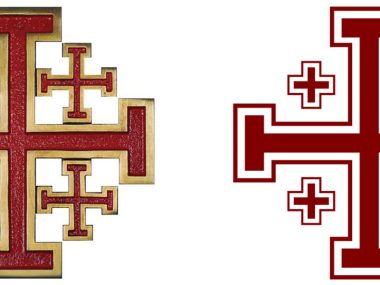
Seven centuries later, that story endures — a symbol of loyalty tested to destruction and a brotherhood the flames could not silence. Wearing the Templar cross is a quiet way to carry that memory: not a claim on their politics, but a nod to endurance, discipline, and faith under pressure. The red cross pattée still reads instantly, on a modern shirt as surely as on a medieval surcoat.
The fall of the Knights Templar was engineered by debt and ambition, not proven by evidence. From the loss of Acre in 1291 to the stake in 1314, the Order was dismantled through a mix of royal greed, coerced confessions, and papal weakness. Remembering how it truly ended is the surest antidote to the myths that later replaced the facts.
 Templar Uniform Editorial