The Jerusalem Cross — one large central cross flanked by four smaller crosses — carries a devotional meaning many people find striking: its five crosses are widely read as the Five Wounds of Christ, the wounds in both hands, both feet, and the pierced side. Also known as the Crusader’s Cross, the design was the emblem of the medieval Kingdom of Jerusalem and later of the Franciscan Custody of the Holy Land. In truth it is a Holy-Land and crusader symbol more than a strictly Templar one — the Templars’ own badge was the red cross pattée — so it pays to be precise. Here is what the cross means, where the Five Wounds reading comes from, and how the two connect.
What Is the Jerusalem Cross?
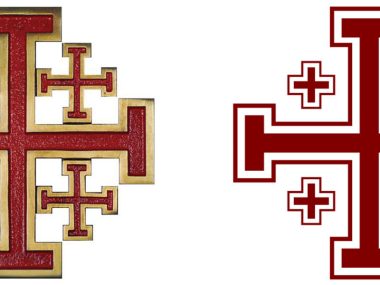
The Jerusalem Cross is a specific, recognizable design. At its center is a large cross potent, a cross whose four arms each end in a short crossbar (the “crutch,” or potent, shape). In each of the four quadrants around it sits a smaller Greek cross, with arms of equal length. Count them together and you get five crosses in one, which is the key to the symbolism.

Because it became the arms associated with the crusader Kingdom of Jerusalem, it is often simply called the Crusader’s Cross. For a fuller account of its origins and heraldry, this explainer on the meaning of the Jerusalem Cross is a good companion to what follows.
Heraldry enthusiasts will notice something unusual about the classic blazon: the crosses are gold set on a silver (white) field. Placing metal on metal breaks one of heraldry’s basic rules of contrast, and the Jerusalem arms are among the most famous exceptions to it. That deliberate breach was often explained as a mark of special dignity — a coat so exalted it stood outside the ordinary rules — which only deepened its association with the holy city.
The Five Wounds of Christ Interpretation
The most common devotional reading maps the five crosses onto the Five Wounds of Christ suffered in the crucifixion: the nail wounds in both hands, the nail wounds in both feet, and the wound in his side from the soldier’s lance. In this reading the four small crosses stand for the four extremities, and the central cross gathers them together as the wound of the side, or more broadly the body of Christ.
This was not an obscure idea. Devotion to the Five Wounds was widespread in medieval piety, expressed in prayers, hymns, and images, and it gave the cross an intensely personal meaning for pilgrims and crusaders who had traveled to the very places where the Passion was believed to have unfolded. To wear or carry the Jerusalem Cross was to keep the suffering of Christ literally before your eyes.
It is worth being clear that this is a devotional interpretation rather than a claim about the designer’s original intent. The cross was not necessarily invented to depict the wounds; rather, later Christian piety recognized the fitting parallel and embraced it. That is how much religious symbolism works — meaning accrues to a form over time, and the Five Wounds reading became the one most people carry in mind today.
Eagle and Symbol of Knights Templar
Wear the cross-and-eagle emblem as a bold statement of Christian and crusader heritage.
🇺🇸 Fast US shipping · 🇪🇺 Ships across the EU · 🔒 Secure checkout
An Alternate Reading: Christ and the Four Gospels
The Five Wounds are the most familiar interpretation, but not the only one. A second, equally old reading treats the central cross as Christ, or the Gospel itself, and the four smaller crosses as the four Gospels — the Christian faith spreading from Jerusalem to the four corners of the earth. On this view the design is a small map of mission: the message goes out from the holy city in every direction.
Both readings can be held at once, which is part of the cross’s appeal. One looks inward, to the Passion and the wounded body of Christ; the other looks outward, to the spread of the Gospel. Neither cancels the other, and medieval Christians were comfortable letting a single symbol carry layered meaning.
Templar or Crusader? Setting the Record Straight
It is common to see the Jerusalem Cross labeled a “Templar cross,” and here a careful correction helps. Historically these are the arms of the Kingdom of Jerusalem, traditionally linked to Godfrey of Bouillon, the leader who famously declined the title of king in the newly taken city; the design was later carried strongly by the Franciscan Custody of the Holy Land, which still uses it today.
The Knights Templar, by contrast, were identified by the red cross pattée granted in 1147, not by the Jerusalem Cross. So it is fairest to call the Jerusalem Cross a crusader and Holy-Land emblem that the Templars would have known and honored, rather than their own device. If you want to see how the order’s crosses differ from one another, this guide to the different Templar cross types lays them out clearly.
This matters for anyone who wants to wear the symbol truthfully. Calling it a crusader and Holy-Land cross rather than “the Templar cross” is not pedantry; it is the difference between honoring the actual history and repeating a tidy myth. The Templars belong to that crusading world, so the cross is very much in their orbit — it simply was not their badge.
The Five Wounds in Medieval Devotion
To understand why the Five Wounds reading stuck, it helps to see how central that devotion was. Medieval Christians meditated on the wounds as the price of salvation and the marks of Christ’s love; the wounds appeared in private prayer, in the visions of mystics, and in the art that surrounded worshippers. A cross that could be read as five wounds was, for that culture, an efficient and moving summary of the whole Passion.
The number itself carried weight. Alongside general meditation on the Passion, the later Middle Ages saw dedicated prayers and even a votive Mass of the Five Wounds, and the wounds appeared in art, on shields, and in the counting of devotions. A symbol that fixed the number at five spoke directly to a piety already organized around it.
The Jerusalem Cross gathered several of these threads — Passion devotion, the geography of the Holy Land, and the crusading impulse — into one compact emblem, and that density of meaning is why it has endured far beyond the Middle Ages. For a broader tour of how such emblems carry meaning, this overview of Templar symbols and their legacy sets the cross in wider context.
Wearing the Symbol Today
Worn now, the Jerusalem Cross remains a rich piece of Christian and crusader symbolism. Whether you read its five crosses as the Five Wounds of Christ or as the Gospel going out to the four corners of the earth, it carries a depth few designs match. On an eagle-and-cross tee, it becomes a bold, wearable statement of that heritage — meaning you can explain and stand behind.
Wear the emblem itself: the Jerusalem Cross Seal — ‘Non Nobis Domine’ Tee, printed on demand and shipped to the US and EU.
Understood accurately, the cross is more powerful, not less. It is a crusader emblem tied to Jerusalem, layered with the medieval devotion to Christ’s wounds, and worth wearing with knowledge of what it truly signifies. Choose it for its meaning, and you carry a genuine strand of medieval faith into the present.
 Templar Uniform Editorial