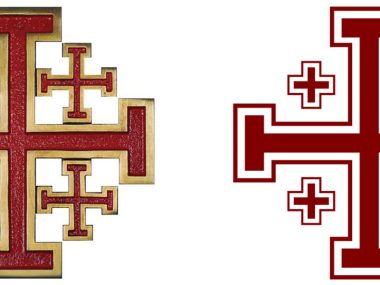
The Jerusalem Cross carries five crosses because each element adds a layer of Christian meaning built up during the Crusades. At its center stands one large cross potent — its arms ending in small crossbars, forming little T-shapes — surrounded by four smaller Greek crosses, one tucked into each quadrant. The most popular reading is that the five crosses represent the Five Holy Wounds of Christ: the nail wounds in both hands and both feet, plus the spear wound in his side. That is the interpretation you will hear most often, but it is not the only one. This guide walks through the main readings and the striking heraldry behind the design.
What the Jerusalem Cross Actually Looks Like
Before decoding the meaning, it helps to picture the emblem precisely. The Jerusalem Cross — also called the Crusader’s Cross or the five-fold cross — is a compound design, not a single shape. One large central cross dominates, and four identical smaller crosses sit in the corners it creates.

- The central cross is a cross potent: each of its four arms ends in a short horizontal bar (a “crutch” or potent in old heraldic language).
- The four corner crosses are plain Greek crosses, with arms of equal length, one set into each quarter.
That arrangement is what gives the symbol its balanced, unmistakable look. If you want a fuller primer on the design and its Crusader origins, our overview of the Jerusalem cross and the Crusader’s Cross meaning covers the background in more depth.
The Five Holy Wounds of Christ — the Most Popular Reading
Ask most people why the Jerusalem Cross has five crosses and you will get one answer: the Five Holy Wounds of Christ. In this reading, each cross marks a wound Christ received at the Crucifixion.
- The nail wound in the right hand.
- The nail wound in the left hand.
- The nail wound in the right foot.
- The nail wound in the left foot.
- The side wound, made by the soldier’s spear.
The devotion to the Five Wounds was widespread in medieval Christianity, expressed in prayers, hymns, and religious art, so it is easy to see why this reading attached itself to a cross made of exactly five parts. It is worth being honest, though: this is the best-known and most popular interpretation rather than a single documented “official” one. Medieval symbols often gathered meanings over time as different communities adopted them, and the Jerusalem Cross is a good example of a design that people have read in more than one faithful way without any single reading crowding out the rest.
Eagle and Symbol of Knights Templar
Carry the layered faith of the Crusader’s Cross into daily life with a bold eagle-and-cross design built for all-day comfort and quiet conviction.
🇺🇸 Fast US shipping · 🇪🇺 Ships across the EU · 🔒 Secure checkout
Beyond the Wounds: Evangelists and the Four Corners
The Five Wounds reading is the crowd favorite, but two other interpretations are just as well established and arguably more logical when you look at how the crosses are arranged.
In the first, the central cross stands for Christ himself — or, closely related, for the Gospel — while the four smaller crosses represent the Four Evangelists: Matthew, Mark, Luke, and John. The design becomes a compact picture of the Gospels radiating from Christ at the center.
In the second, the same layout is read geographically. The central cross marks Jerusalem and the spread of the Christian message, and the four corner crosses stand for the four corners of the earth to which that message travelled. Both readings turn the emblem into a small map of faith going out into the world. None of these interpretations cancels the others; a medieval viewer could hold several at once, which is part of the symbol’s enduring appeal.
Gold on Silver: The Arms of the Kingdom of Jerusalem
The Jerusalem Cross is not only a devotional symbol — it was also a coat of arms. It became the arms of the Latin Kingdom of Jerusalem, the Crusader state established after the First Crusade, and the way those arms are colored is genuinely unusual.
The blazon places gold (or) crosses on a silver (argent) field. In classical heraldry this breaks the so-called rule of tincture, which discourages placing metal on metal (gold on silver, or silver on gold) because it reduces contrast. The Jerusalem arms are one of the most famous deliberate exceptions, and the break was traditionally read as a mark of the kingdom’s uniquely sacred status — a holy city deserving a design that steps outside the ordinary rules.
The arms are often linked to Godfrey of Bouillon, the leader who declined the title of king in the newly captured city. That association is traditional and largely legendary rather than firmly documented, so it is best treated as part of the story that grew around the emblem rather than established fact. If you enjoy untangling designs like this, our guide to the Templar cross types compares the many crosses of the Crusading era side by side.
Not the Templar Cross — Clearing Up a Common Mix-Up
Because so many Crusader symbols look similar, the Jerusalem Cross is often confused with the emblem of the Knights Templar. They are not the same thing, and the distinction matters.
The Templar emblem proper is the red cross pattée (a cross with arms that flare outward) on a white mantle — a badge tied specifically to the Order and its members. The Jerusalem Cross, by contrast, is a broader Crusader and Kingdom-of-Jerusalem symbol. It was used widely across the Crusades and carried by pilgrims to the Holy Land, and it has never belonged to a single order.
Its life did not end with the medieval kingdom, either. The Jerusalem Cross survives today on the badge of the Franciscan Custody of the Holy Land and appears on numerous churches and Christian institutions around the world. For a wider tour of how these emblems developed and what they signal, see our breakdown of Templar symbols and their enduring meanings.
Wearing the Jerusalem Cross Today
Part of what makes this emblem rewarding to wear is exactly what this article has covered: it is not a flat logo but a design with layers. Whether you read the five crosses as the wounds of Christ, as Christ surrounded by the Evangelists, or as the Gospel reaching the four corners of the earth, the symbol invites conversation and reflection rather than just decoration.
Carry the cross this piece is about — the Jerusalem Cross — Bold Crusader Tee, printed on demand and shipped to the US and EU.
That depth translates well onto a shirt or tee. A clean, well-made piece lets the geometry of the cross speak for itself, so the meaning travels with you whether the color (or colour) scheme reads as classic gold, silver, or a modern monochrome. Because the emblem is tied to pilgrims and the wider Crusading story rather than to any one order, it also sits comfortably alongside other Templar-era imagery without clashing. It is a quiet way to carry centuries of Crusader and Christian history without saying a word.
So the short answer to why the Jerusalem Cross has five crosses is that five parts hold several meanings at once, with the Five Holy Wounds of Christ as the most popular. Add the Evangelists, the four corners of the earth, and the rare gold-on-silver heraldry of the Kingdom of Jerusalem, and you have one of the most layered emblems the Crusading age produced. Wear it knowing the full story, and the design carries far more than its simple outline suggests.
 Templar Uniform Editorial