
Picture the scene: a sun-scorched field in the Holy Land. Dust and the cries of battle fill the air. At the heart of the fray stands a Knight Templar, a bastion of faith and martial prowess. His great helm is an iconic silhouette, but beneath it lies a piece of equipment just as vital to his survival: the coif. Too often dismissed as a simple chainmail hood, the coif was, in reality, a sophisticated, multi-layered system engineered for a perfect balance of protection and agility. It was not merely worn; it was tailored. The difference between a well-fitted coif and a poor one could be the difference between a swift, decisive sword stroke and a fatal, cumbersome turn. This was where the legend was truly forged, not just in the heat of the crucible, but in the meticulous stitches and links of a knight’s attire. In this deep dive, we will unveil how the Templar coif was expertly tailored for the brutal ballet of medieval combat, proving that true strength lies in the freedom of movement.
The foundation of defense: the padded arming coif
Before a single link of mail touched a knight’s head, the first and most critical layer was put in place: the padded arming coif. To the untrained eye, it might look like a simple quilted hood, but this humble textile garment was the unsung hero of a knight’s head protection. Its role was multifaceted, serving as the crucial interface between the warrior’s body and the harsh, unyielding steel worn over it. Without a properly constructed arming coif, even the finest mail would be uncomfortable, less effective, and a significant hindrance to mobility.


Crafted typically from durable linen or wool, the arming coif was a substantial piece of equipment. It was filled with a variety of padding materials, such as raw cotton, wool fleece, or even horsehair, which were packed between the fabric layers. This filling was then secured with intricate patterns of stitching, often in vertical lines or a diamond-shaped grid. This quilting was not for decoration; it served a vital engineering purpose. It kept the padding evenly distributed, preventing it from bunching up in one area and leaving another vulnerable. This structure provided a cushioned, shock-absorbent barrier. When a mace or sword struck the helmet, the force would travel through the metal and the mail. The padded coif was the final line of defense, absorbing and dissipating a significant portion of that concussive energy, potentially preventing a knockout blow or a skull fracture.
However, its role in mobility was just as important. A knight’s life depended on their ability to survey the battlefield, to twist and see an enemy flanking them, and to duck under a swinging axe. A poorly tailored arming coif could spell doom. If it was too loose, it would shift under the weight of the mail and helmet, potentially slipping and obscuring the knight’s vision at a critical moment. If it was too tight, it would constrict the neck, choking the wearer and severely limiting their ability to turn their head. The art of tailoring this foundational piece was therefore paramount. The fit around the neck and shoulders had to be precise—snug enough to stay in place, yet with enough give to allow for a full range of motion. The cut around the face was equally important, framing it without impeding peripheral vision. This garment was the bedrock upon which the rest of the head and neck armor was built, and its careful construction was the first step in ensuring a knight was a mobile, and therefore effective, warrior.
A chain of ingenuity: the mail coif and its construction
With the padded arming coif providing a stable and cushioned base, the next layer was the iconic mail coif itself. This glittering hood of interlinked steel rings is what most people imagine when they think of a knight’s headwear, but its construction was far more nuanced than a simple sack of metal. The mail coif was a testament to the armorer’s skill, a piece of flexible, form-fitting armor tailored to move as an extension of the warrior’s own body. Its genius lay in its very composition: thousands of individual rings, each one connected to four others in the classic ‘four-in-one’ pattern, creating a fabric of steel.
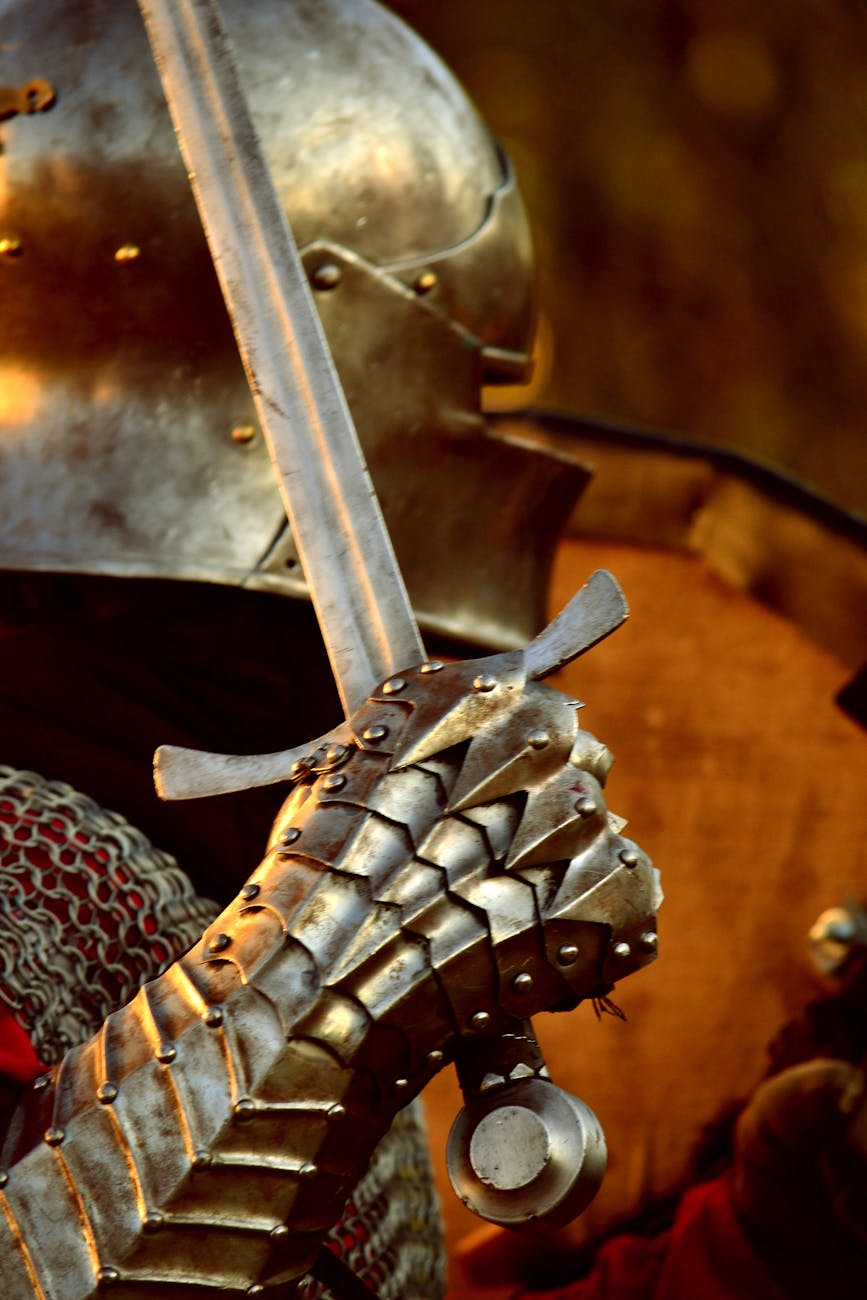
The quality of this ‘fabric’ varied. The most effective and historically accurate mail for a Knight Templar would have been riveted. Each tiny ring was flattened at the ends, overlapped, and secured with a minuscule rivet. This laborious process created an incredibly strong and durable defense, capable of turning aside a sword cut or a spear thrust. Cheaper, ‘butted’ mail, where the rings were simply bent closed, offered far less protection and could be burst open by a powerful blow. For an elite fighting force like the Templars, riveted mail was the standard.
The true art of the mail coif, however, was in its tailoring. An armorer didn’t just create a flat sheet of mail and drape it over a knight’s head. The coif was carefully shaped and contoured. It was constructed to be wider at the shoulders, forming a ‘mantle’ that draped over the upper chest and back, integrating with the hauberk, or mail shirt. This mantle was crucial for mobility. It had to be broad enough to allow the knight to raise and swing their arms without the coif pulling taut and restricting head movement. Armorers would sometimes use subtle techniques, such as adding triangular sections of mail called gores or using different linking patterns in high-stress areas, to build more room and flexibility into the garment.
Furthermore, many mail coifs featured a ‘ventail.’ This was a square or rectangular flap of mail that protected the lower face, mouth, and jaw. The ventail was not permanently fixed; it was designed to be versatile. It could be tied up to the side of the head with a leather lace when not in combat, allowing for better ventilation and communication. In the heat of battle, it could be quickly drawn across the face and secured, providing near-complete protection. This adaptability was a key feature for battlefield mobility, allowing the knight to adjust their level of protection based on the immediate threat without removing their entire head defense. The mail coif was not a rigid cage; it was a dynamic, tailored shield of steel.
The sum of its parts: integrating the coif for maximum mobility
Neither the padded coif nor the mail coif was designed to work in isolation. Their true brilliance was revealed when they were combined, forming a cohesive system that was greater than the sum of its parts. This integration, often completed with the addition of a helmet, was the final and most crucial step in tailoring for battlefield mobility. A knight’s survival depended on every single piece working in perfect harmony, and a master armorer understood that the fit and function of the coif system was as critical as the sharpness of a knight’s sword.
The synergy between the two layers was fundamental. The padded arming coif provided the necessary structure for the mail. It filled the space between the head and the steel rings, ensuring the mail didn’t sag or hang awkwardly. This prevented the mail from concentrating its considerable weight on a few pressure points, instead distributing it more evenly across the head and shoulders, which dramatically reduced fatigue over long hours of battle. More importantly for mobility, the padded layer held the mail in the correct position, ensuring the eye openings in the mail coif aligned perfectly with the knight’s eyes, providing a clear and unobstructed field of view. A slight misalignment could create a dangerous blind spot.
Furthermore, the entire coif system was tailored with the final piece of the puzzle in mind: the helmet. Whether it was an open-faced nasal helm or the imposing, all-encompassing great helm that became synonymous with the Crusades, its fit was dictated by the layers beneath. The coif system provided the necessary padding to make the helmet wearable and to help it absorb impact. A well-tailored coif ensured the helmet sat at the correct height, not too low to obscure vision and not too high to expose the neck. The mantle of the coif draped over the shoulders and under the rim of the great helm, closing the gap and preventing a lucky spear thrust from finding its way into the vulnerable neck area.
This is where custom tailoring became non-negotiable for an elite warrior. An ‘off-the-rack’ coif would be a dangerous liability. A Templar’s coif was likely made for him, or at the very least, adjusted to his specific measurements. The armorer would consider the circumference of his head, the width of his shoulders, and the length of his neck. They would ensure the drape of the mail mantle allowed for the full rotation of the torso and the lifting of a shield without binding or pulling. The weight, the fit, the integration with the final helmet—every element was a calculated decision. The Templar coif, in its complete form, was not just armor. It was a second skin, a piece of high-performance military equipment born from centuries of battlefield experience and the painstaking skill of master craftsmen, designed to allow the warrior within to move, to see, and to fight with deadly efficiency.

 Templar Uniform Editorial


