
Choosing your champion: selecting a templar helm with a soul
The journey of creating a powerful historical display begins not with the stand or the lighting, but with the helm itself. To the uninitiated, a Knights Templar helmet might seem like a singular, uniform design. However, the reality is a fascinating evolution of steel and strategy, and choosing the right replica is the first step in telling a specific story. Your helm is the protagonist of this display; it must have character, history, and a soul forged in authenticity.

The most iconic silhouette associated with the Templars is the Great Helm. Emerging in the late 12th and early 13th centuries, this full-head enclosure was a revolutionary piece of protective equipment. Early versions, often called ‘pot helms’ or ‘barrel helms’, featured a flat top. A replica of this style tells a story of the Crusades at their zenith, of knights like those at the Siege of Acre. The flat top, however, was a significant vulnerability, prone to catching the full force of a downward blow from a mace or sword. When selecting a flat-topped Great Helm replica, look for heavy-gauge steel (16 or 14 gauge is ideal for an authentic feel), solid riveting, and brass cross detailing that is securely affixed, not glued. The very design speaks of a brutal, direct form of warfare.

As the 13th century progressed, armorers learned from the battlefield. The Great Helm evolved into the ‘Sugarloaf’ helm. Its defining feature was a conical or rounded top, a brilliant innovation designed to deflect blows away from the skull. A Sugarloaf replica speaks to a later period of the Templar Order, a time of refined armor and hard-won experience. It tells a story of adaptation and survival. When examining a Sugarloaf replica, pay attention to the curvature. Is it a smooth, well-formed cone? The eye slits, or ‘occularia’, should be narrow for protection but still allow for a reasonable field of vision. Many high-quality replicas will also feature drilled ‘breaths’ or ventilation holes, not just for the wearer’s comfort but as a key element of historical accuracy.
Beyond the type, consider the finish. Do you want a story of a knight on parade or one returning from a long campaign? A highly polished, gleaming helm has a magnificent, ceremonial feel. It represents the ideal of the chivalric knight, the noble defender of the faith. Conversely, an ‘aged’ or ‘antiqued’ finish, with subtle patinas and simulated wear, tells a tale of grit and reality. It speaks of dusty roads in the Holy Land, of skirmishes and the harshness of a soldier’s life. Neither is better than the other; they simply tell different stories. The choice depends on the narrative you wish to craft. A quality replica, whether polished or aged, will feel substantial in your hands. It is more than a costume piece; it is a weighty echo of the past, and selecting the right one is the first, most crucial chapter.
Forging the narrative: creative displays that breathe life into steel
Once you have your champion, the helm that speaks to you, the next stage is to build its world. Placing a magnificent replica on a random bookshelf is like imprisoning a king in a common cell. It diminishes its power. A thoughtful display elevates the object from a mere possession to a true centerpiece, a portal to another time. The goal is to create a context, a narrative that the helm can inhabit.

The foundation of any great display is the stand. Avoid flimsy, generic options. The stand is the pedestal for your piece of history, and its material matters. A dark, rustic wooden stand, perhaps made of oak or walnut with a rough-hewn finish, evokes a sense of the medieval world. It might suggest the armory of a commandery or a field tent during a campaign. A sleek, black metal stand, by contrast, creates a more modern, museum-like aesthetic. It isolates the helm, presenting it as a piece of sculptural art and drawing the eye to its form and craftsmanship. For a truly immersive display, consider a helmet stand with an integrated chainmail coif or a padded arming cap peeking out from underneath. This small detail adds a layer of realism and suggests the knight has only just removed it.
But a stand is just the beginning. The most compelling displays create a vignette—a small, curated scene. Place your helm on a sturdy wooden table or in a display cabinet and surround it with complementary artifacts. A replica Templar sword leaning nearby immediately establishes a martial context. A large, leather-bound book or a rolled piece of parchment with calligraphy (perhaps a Templar rule or a Latin motto like *Non nobis, Domine, non nobis, sed Nomini tuo da gloriam*) can add a scholarly or spiritual dimension. Consider draping a Templar banner or surcoat, with its iconic red cross, as a backdrop. The texture and color will make the entire display pop. The key is to choose two or three supporting items that enhance the story without cluttering the scene. Each element should feel intentional.
Finally, do not underestimate the power of lighting. A room’s ambient light is rarely enough to do a helm justice. Strategic lighting is what transforms a good display into a breathtaking one. A single, focused spotlight from above, often called a ‘top-down’ light, can create dramatic shadows that pour out of the eye slits, giving the helm a brooding, mysterious presence. This is perfect for creating a sense of gravitas and intimidation. Alternatively, lighting it from a low angle can highlight the texture of the steel and the details of the brasswork. Experiment with warm versus cool light to see which best suits the mood you want to create. Proper lighting ensures that your helm is not just seen, but experienced.
The sentinel’s vigil: preserving the legacy of your helm
Your Templar helm replica is a connection to a formidable legacy, and with that connection comes a duty of care. These exquisite finds are not inert objects; they are often crafted from high-carbon steel, the same material used historically, which is susceptible to the ravages of time and environment. Proper maintenance is not a chore; it is a modern squire’s vigil, ensuring your piece of history remains a source of pride for years to come. Neglecting this duty can turn a gleaming sentinel into a rusty relic.
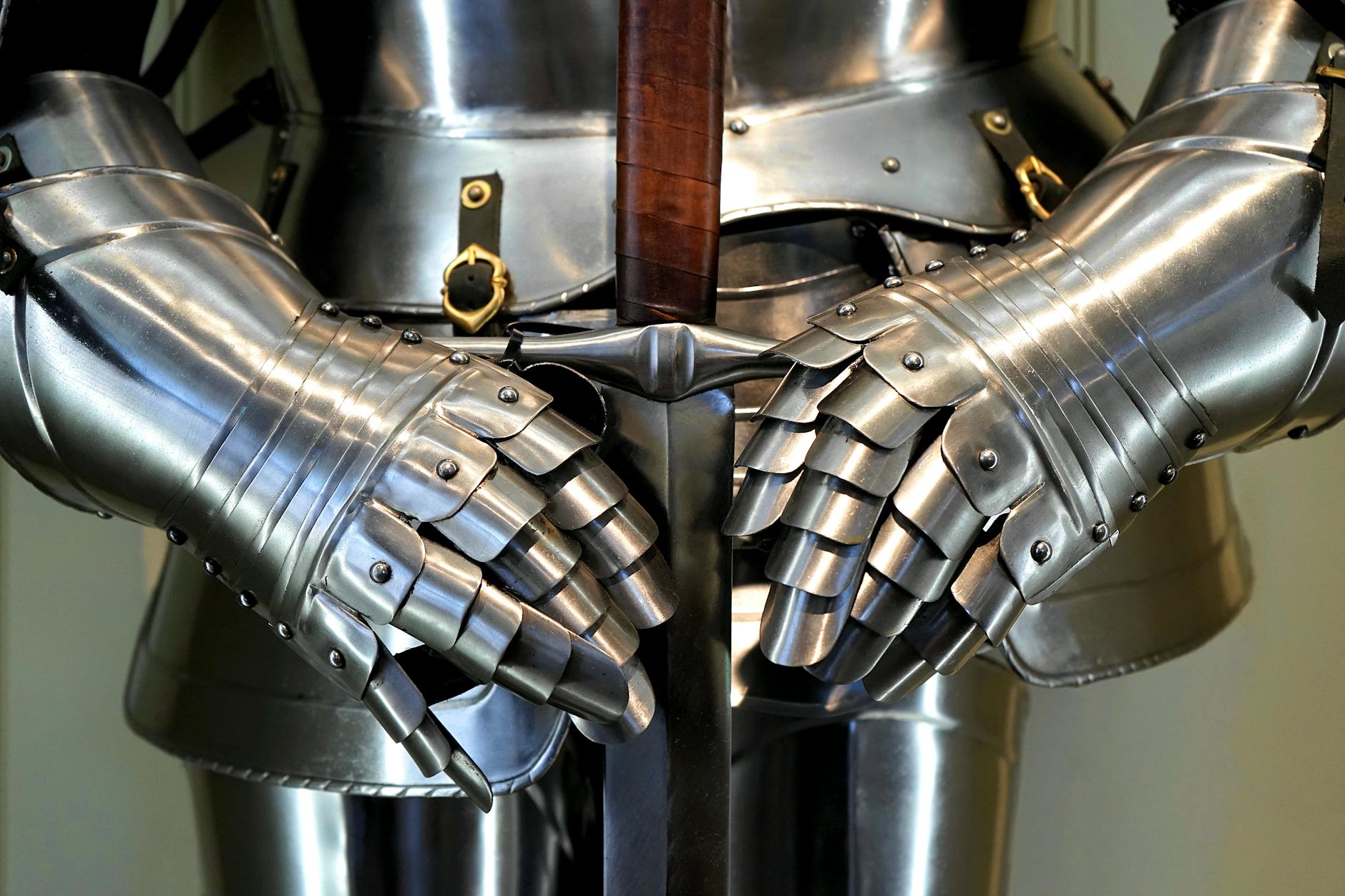
The primary enemy of any steel replica is rust. The moisture and oils from a single fingerprint can be enough to start the oxidation process. The first rule of care is to handle the helm as little as possible with bare hands. When you must move or adjust it, use clean cotton or microfiber cloths. For long-term protection, a thin, invisible barrier between the steel and the air is essential. A light coating of mineral oil, applied with a soft cloth, is a simple and effective solution. Wipe it on, then use a clean section of the cloth to wipe off any excess, leaving only a microscopic protective film. For a more durable, museum-grade solution, consider applying a thin layer of Renaissance Wax. This hard, micro-crystalline wax is used by conservators worldwide to protect everything from metal and wood to leather.
Many Templar helms feature beautiful brass crosses or decorative trim. Brass will naturally tarnish over time, developing a dull patina. Some collectors prefer this aged look as it adds to the historical feel. However, if you prefer the brilliant shine, it can be easily restored. Use a quality brass polish, like Brasso, applied sparingly to a soft cloth. Be meticulous and careful, ensuring you don’t get the polish on the surrounding steel. Use cotton swabs to get into the intricate corners of the cross. After polishing, wipe away all residue with a fresh, clean cloth to reveal the gleaming gold finish.
Where you choose to display your helm also plays a crucial role in its preservation. Avoid areas with high humidity, such as basements, or locations with drastic temperature fluctuations. Keep it away from direct sunlight, which can heat the metal and potentially affect any leather liners or straps. Regularly dust the helm with a soft, dry cloth or a can of compressed air to prevent grime from accumulating. This ongoing care is part of the story. It is a ritual that connects you to the piece, a respectful acknowledgment that you are not merely an owner, but a custodian of the legend it represents.
By selecting a helm with a soul, crafting a narrative with its display, and committing to its preservation, you do more than decorate a room. You create a focal point for history, a testament to the enduring legacy of the Knights Templar. Your helm ceases to be a replica; it becomes a storyteller, and you, its keeper.

 Templar Uniform Editorial


