
The red cross on a white background is one of the most instantly recognizable badges of the medieval world, and its meaning is refreshingly clear once you know the history. In short, the white stood for purity and chastity, while the red cross stood for blood and martyrdom — a knight’s readiness to die for his faith. The Knights Templar did not adopt both elements at once, though. The plain white mantle came first, around 1129, and the red cross was added nearly two decades later. Here is what each part of the emblem signified, how the two came together, and why the pairing has outlived the Order that wore it.
White first: the mantle of purity (1129)
When the Templars were formally recognized at the Council of Troyes in 1129, the Order received a distinctive white mantle, or habit. At that stage it was plain — simply white wool, with no cross on it at all. The colour itself was the message. White signalled purity and chastity: the professed knight had renounced worldly pleasures and bound himself to a disciplined life under monastic vows, in the service of God.

This drew on the wider religious world of the twelfth century, and especially the Cistercian movement, whose undyed pale habits carried the same idea. Bernard of Clairvaux, the Cistercian abbot who championed the fledgling Order, framed the Templars as a “new knighthood” that fused the monk and the soldier. A bright, unadorned cloak suited that vision perfectly: it told the world that the man beneath it had turned away from vanity and toward vocation. For roughly eighteen years, that plain white was the whole emblem.
The red cross: blood and martyrdom (1147)
The famous red cross arrived later. Sources credit Pope Eugenius III, around 1147, with granting the Templars the right to wear a red cross on the mantle. It was placed over the left shoulder, near the heart, so the brother literally carried the sign of Christ’s Passion close to the seat of his courage. The addition marked the Order out as soldiers of the Church in a way that plain white never could.
The colour choice was understood as deliberate and sober. Red stood for blood and martyrdom — the willingness to shed one’s own blood, and if necessary to die, for the faith. For a military order whose members might fall against overwhelming odds, this was not abstract theology but a daily possibility sewn onto their clothing. The cross declared whose army they served, and the red declared the price they had already accepted for serving in it.
Eagle and Symbol of Knights Templar
Carry the red-cross-on-white meaning as a modern statement piece — purity and courage, rendered in a bold eagle-and-cross design.
🇺🇸 Fast US shipping · 🇪🇺 Ships across the EU · 🔒 Secure checkout
Putting it together: what red-on-white actually means
Combine the two elements and the emblem reads as a single, coherent statement. The full meaning of the red cross on a white background comes down to a deliberate pairing of two ideas:
- White — purity, chastity, the monastic vow, and a life turned away from worldly pleasure.
- Red — blood, martyrdom, and a knight’s readiness to die for the faith.
Together they express the paradox at the heart of the Order: men who lived like monks yet fought like soldiers. The white declared what they had renounced; the red declared what they were prepared to give. That is why the combination has outlived the Order itself by seven centuries and still reads as unmistakably “Templar” today. If you enjoy tracing how such signs carried layered meaning, our wider look at decoding the enduring meanings of Templar symbols puts this emblem in fuller context.
The Beauséant: the Order’s black-and-white banner
The red cross was not the Templars’ only emblem of colour. Into battle the Order carried a distinctive war banner known as the Beauséant (also spelled Baucent), and it was not red and white at all but black and white. Contemporary descriptions differ on the exact arrangement — it is most often given as black above white — but all agree on the stark two-tone division. The name itself points to a piebald or parti-coloured horse. Later writers offered a tidy moral reading of the contrast, saying the Order was fair and gracious to friends but black and terrible to its enemies; that gloss is best treated as a later tradition rather than a documented statement from the knights themselves.
What is well attested is the banner’s role in discipline. The Order’s statutes made the raised standard the anchor of the battle line: a brother was not to leave the field while the Beauséant still flew, and losing the banner was a grave matter. Colour, in other words, did real work for the Templars — on the mantle as a statement of vocation, and on the standard as a rallying point in the chaos of a charge.
Which cross? The many forms of the emblem
Here is where careful history matters. Popular culture tends to fix on one shape — the cross pattée, with arms that flare outward at the ends — and it is indeed the form most associated with the Templars. But the Order did not use a single, legally fixed design across its roughly two centuries of existence. Surviving seals, coins, carvings and manuscripts show several cross shapes, including plainer equal-armed forms.
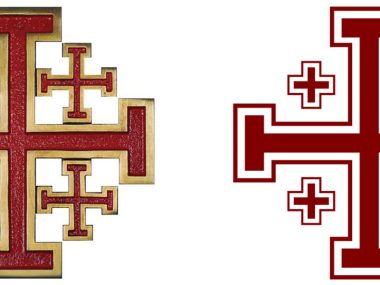
It is more honest, then, to speak of “a red cross” rather than one precise geometry. There was no rigid, unchanging blueprint that every brother reproduced exactly. If you want to see the range, our guide to the different types of Templar cross lays them out, and the closely related Jerusalem or crusader cross shows how crusading imagery branched into distinct designs. The meaning — blood upon purity — stayed constant even as the drawing varied from place to place.
A crusader’s cross, and its cousins
The very act of joining a crusade was called “taking the cross,” and from the First Crusade onward pilgrims and soldiers sewed a cloth cross onto their garments as a public vow. The Templars did not invent the crusader cross so much as adopt and standardize one version of a far wider practice. The rival military orders that shared the crusader states each took their own colour scheme, which makes them easy to tell apart:
- Knights Templar — a red cross on white, worn by the knights.
- Knights Hospitaller — a white cross, famously on a dark ground.
- Teutonic Knights — a black cross on white.
One further point often causes confusion. A red cross on a white field was not unique to the Templars: the same combination became the cross of Saint George, later carried by England and by the city of Genoa, among others. The Templars drew on a shared Christian vocabulary of colour, which is exactly why the badge still feels familiar far beyond the Order’s own story.
A last nuance is easy to miss. Within the Templars themselves, the white mantle was reserved for professed knights; sergeants and serving brothers wore black or brown mantles — and yet they too bore the same red cross. So the red cross, not the colour of the cloth, was the Order’s true unifying mark across every rank. A sergeant on a brown mantle and a knight on a white one were still visibly brothers of the same house.
Wearing the emblem today
You do not have to take monastic vows to appreciate what this emblem says. Worn today, a red cross on white is a compact piece of storytelling: it carries centuries of meaning about discipline, conviction and courage in a single glance. That is exactly the spirit behind our Eagle and Symbol of Knights Templar shirt, which pairs the cross with the eagle motif so the whole design reads as a wearable statement of the values the colours once encoded — not costume, but a symbol worn with understanding.
The takeaway is simple and grounded in real history. White for purity, red for the blood a knight was ready to shed: two colours, one clear meaning, granted eighteen years apart and fused into the most famous badge of the crusading age. Whether you are studying the Order or simply drawn to its imagery, knowing that story is what turns a striking design into something you can actually stand behind.
 knighttemplar


