A Templar cross necklace carries more weight than most modern pendants. At its heart sits the cross pattée — a cross whose arms flare, or splay, outward toward the ends — the emblem most closely associated with the medieval Knights Templar. Worn in red on a white mantle, it once signalled faith, courage, and a readiness to die for one’s beliefs. Today the same design lives on as jewelry rather than battlefield insignia. This guide explains what the symbol traditionally meant, how it differs from other crusader crosses that people often confuse it with, and practical, respectful ways to wear one with confidence.
What a Templar Cross Necklace Really Means
The meaning of a Templar cross pendant comes from two elements working together: the colour red and the cross itself. For the medieval Order, red was read as the blood of martyrdom — a visible reminder that a brother should be willing to die for Christ. The cross stood for the Passion and marked the wearer’s identity as a soldier of Christ rather than an ordinary fighting man.

There is a third layer many people miss. Because the red cross was displayed against the Order’s white mantle, the pairing carried a double message: red for the sacrifice of martyrdom, white for purity and chastity. Together they summed up the vows a Templar took.
When people search for the meaning of a Templar cross necklace today, they are usually reaching for that same shorthand:
- Faith — devotion held above personal comfort or safety.
- Courage — the resolve the red cross was meant to represent.
- Discipline — the vowed, ordered life behind the white mantle.
It helps to remember that, for the brothers, the cross was never merely decorative. It was closer to a uniform and an oath made visible — a mark that told friend and foe alike who the wearer was and what he had promised. A modern pendant obviously cannot carry that vowed weight, but it can borrow the same vocabulary of commitment. Worn thoughtfully, it nods to that heritage rather than claiming any literal link to the medieval Order.
The Red Cross Pattée: A Short History
The Knights Templar were founded around 1119 under Hugues de Payens, and their way of life was shaped by a Rule associated with St Bernard of Clairvaux. In their earliest years the brothers did not yet wear the famous red cross. That grant came later.
The right to wear the red cross is traditionally attributed to Pope Eugenius III around 1147 — some sources place it in the mid-1140s. It is fair to present this as the traditional account rather than a precisely documented event, because the surviving evidence is not exact. What is clear from the sources is that the Templars became known for a red cross displayed on the left shoulder or breast of the white mantle, over the heart.
Positioning mattered. Placing the cross over the heart, on the mantle worn into battle and daily religious life alike, tied the symbol directly to the vow of martyrdom it was meant to express. Over time the red cross became one of the most recognisable marks in Christendom, so bound up with the Order that it still stands in for the Templars in popular imagination today.
The specific form linked to the Order is the cross pattée, with those distinctive flaring arms. If you want to go deeper into the variations the Order and its contemporaries used, this guide to the Templar cross types is a useful next read.
Eagle and Symbol of Knights Templar
Carry the red cross pattée into daily life on a tee built to let a pendant rest right where the knights once wore it — over the heart.
🇺🇸 Fast US shipping · 🇪🇺 Ships across the EU · 🔒 Secure checkout
Cross Pattée vs. Jerusalem, Maltese, and Latin Crosses
Part of choosing a Templar cross necklace is knowing that several very different crosses get lumped together under the word “crusader.” Telling them apart helps you buy the design you actually want.
- Cross pattée — arms narrow at the centre and flare outward at the ends. This is the form most associated with the Templars, and it is what a “Templar cross necklace” usually renders.
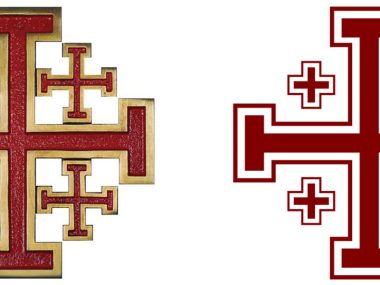
- Jerusalem cross (or crusader cross) — a large central cross with four smaller crosses in the quarters, five in all. It is tied to the arms of the Kingdom of Jerusalem, not specifically to the Templars.
- Maltese cross — an eight-pointed cross linked to the Hospitallers, later the Knights of Malta. It is a different order and a different emblem.
- Latin cross — the plain upright cross, longer below than above, with no flaring or extra elements.
If a pendant shows five crosses, you are looking at the Jerusalem design; our explainer on the Jerusalem cross meaning covers why. If the arms simply splay out from a single cross, that is the pattée — the classic Templar look.
How to Wear a Templar Cross Necklace Today
A modern Templar pendant is a piece of jewellery, not a medieval artifact, so treat it as a wearable heritage symbol of faith, courage, and discipline. A few practical notes make it look intentional rather than costume-like:
- Pendant size. A pendant of roughly 25–40 mm reads clearly without overwhelming a collar. Smaller suits everyday layering; larger works as a single statement piece.
- Chain metal. Stainless steel is hard-wearing and low-maintenance; sterling silver gives a softer, more traditional shine. Match the chain metal to the pendant so nothing clashes.
- Chain length. Around 50–55 cm (20–22 in) lets the cross sit near the sternum, close to where the knights wore it over the heart. Shorter sits higher at the collar.
- Layering. If you stack chains, give the cross room — one plainer chain beside it, not three competing pendants.
- Let it stand out. Wear it against a plain shirt so the cross reads cleanly instead of disappearing into a busy print.
- Wear it informed. Know what the symbol means and its history, and wear it respectfully. That knowledge is what turns a pendant into something you can speak to.
The same “know what you wear” principle applies across Templar-inspired jewelry — the idea of carrying a code close to the body is exactly what our piece on wearing Templar mottos on modern dog-tag necklaces explores.
Pairing the Pendant With Your Templar Tee
The most natural way to wear a cross pattée is where the knights themselves placed it: over the heart. A plain, well-fitted tee gives the pendant a clean field to sit against, and a crew or slightly open neckline frames the cross rather than hiding it. Keep the shirt simple in tone so the metal draws the eye.
Wear the cross itself — the Templar Cross — Distressed Crusader Tee, printed on demand and shipped to the US and EU.
If your tee already carries the cross pattée as a printed emblem, let the pendant echo it quietly rather than compete — one bold cross, one subtle one. That pairing of a shirt and a matching pendant is a low-effort way to build a coherent, heritage-minded look you can wear every day.
A Templar cross necklace is at its best when it is understood, not just worn. Choose the pattée if you want the emblem tied to the Order, keep the styling simple, and remember the piece is a modern tribute rather than a relic. Worn that way — informed, respectful, and paired with the right tee — it becomes a small daily reminder of faith, courage, and discipline.
 Templar Uniform Editorial