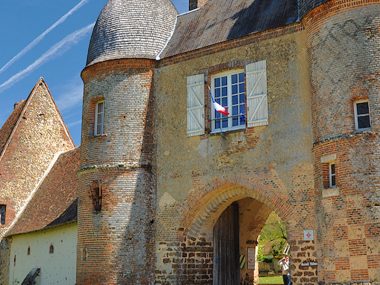
The first line of defense: walls, gates, and water
When you picture a medieval castle, the first image that likely comes to mind is its massive, imposing outer shell. This was no accident. The outer defenses were a castle’s handshake with the outside world—a firm, unyielding grip designed to crush an enemy’s spirit before the first arrow was even loosed. For orders like the Knights Templar, whose very existence depended on holding strategic locations in hostile lands, mastering this outer shell was the key to survival.
The primary feature was the curtain wall. These weren’t the simple wooden palisades of earlier fortifications. By the high middle ages, they were towering structures of stone, often many feet thick. The top of the wall was a carefully engineered platform for defenders. It featured crenellations—the classic sawtooth pattern—which provided archers with cover (the merlons) and openings to shoot through (the crenels). Narrow vertical openings known as arrowslits, or loopholes, allowed defenders to fire on attackers with minimal exposure. The design of these slits evolved over time, with the introduction of the cross shape allowing for a much wider field of fire for crossbowmen.

However, a wall is only as strong as its weakest point: the entrance. This led to the development of one of the most sophisticated pieces of medieval military architecture: the gatehouse. A simple gate became a formidable fortress in its own right. It was often flanked by two strong towers and featured a gauntlet of defensive measures. Attackers first had to cross a drawbridge, often over a deep moat. If they breached the outer gate, they would be met by a heavy iron or wooden portcullis, which could be dropped to trap them in a narrow passage. This passage, often called the “killing ground,” was riddled with “murder holes” in the ceiling, through which defenders could drop rocks, boiling oil, or quicklime onto the trapped enemy. A second portcullis and another heavy door often stood behind the first, creating a layered, deadly trap.
Surrounding it all was the moat. While we often think of moats as being filled with water, many were dry ditches. A wet moat was excellent for preventing attackers from tunneling under the walls and made it nearly impossible to move heavy siege towers into place. A dry moat, on the other hand, could be a deep, steep-sided obstacle, often lined with sharpened stakes, forcing attackers into a vulnerable position at the base of the walls where they could be easily targeted by archers above. For the Knights Templar, who built some of the most advanced castles of the era like Krak des Chevaliers in Syria, these principles were elevated to an art form, often employing concentric rings of walls, creating a fortress that was as psychologically intimidating as it was physically impenetrable.
The heart of the fortress: the bailey and the keep
If you managed to breach the formidable outer defenses, you wouldn’t find yourself at the lord’s doorstep. Instead, you would enter the bailey. The bailey was the sprawling, enclosed courtyard that served as the bustling heart of the castle. It was a self-contained community, a microcosm of the medieval world, protected by the curtain walls. Here, life hummed with activity. You would find barracks for the soldiers, stables for the horses, workshops for blacksmiths and carpenters, kitchens, a brewhouse, and perhaps a small chapel.
In larger castles, there could be multiple baileys (an outer and an inner bailey), separating the more industrial and military functions from the lord’s private residence. This space was vital during a siege. It could house local villagers and their livestock, ensuring that the castle’s defenders had a ready supply of food and resources to withstand a prolonged assault. The well, often the most protected feature within the bailey, was the castle’s lifeline, providing the fresh water necessary for survival.
At the center of it all, or in the most secure position, stood the keep, also known as the donjon. This was the castle’s nucleus—the ultimate stronghold and the final point of defense. If the outer walls fell and the bailey was overrun, the defenders would retreat into the keep to make their last stand. As such, it was built to be a self-sufficient fortress-within-a-fortress. Its walls were the thickest, its entrance was heavily fortified, and it often had its own well and storerooms.
The keep also served as the lord’s residence, a symbol of his power and status. Inside, you would find the great hall, the administrative and social center of the castle where feasts were held and justice was dispensed. Private chambers for the lord and his family, a private chapel, and often a grim dungeon in the lower levels completed the structure. Early Norman keeps were typically square, which were strong but had a critical flaw: the corners were vulnerable to siege engines and created blind spots for defenders. Military orders like the Templars learned from this, and later keeps were often circular or had rounded edges. These ‘shell keeps’ provided better lines of sight and were more effective at deflecting projectiles from catapults and trebuchets, showcasing the constant evolution of defensive architecture in response to offensive technology.
The silent language of attack and defense
Every stone in a medieval castle was placed with purpose, a direct response to the brutal realities of siege warfare. The entire structure was a masterclass in physics and psychology, designed to exhaust, demoralize, and ultimately defeat an attacking army. Understanding this silent language of design reveals the true genius behind these medieval marvels.
Consider the subtle but brilliant features built into the walls themselves. As siege ladders became taller and more common, defenders needed a way to engage attackers directly at the base of the wall. This led to the development of hoardings—covered wooden galleries that were temporarily built out from the top of the walls. These gave defenders a protected platform from which to drop projectiles. Later, this wooden feature was replicated in stone, creating what we know as machicolations. These were openings in the floor of a projecting parapet, allowing defenders to see and attack the base of the wall without exposing themselves.
Even the staircases were designed with defense in mind. Most spiral staircases in castles were built to ascend in a clockwise direction. Why? Because this design favored a right-handed swordsman defending the stairs. As he came down the spiral, his sword arm would have a wide, open arc to swing, while the attacker climbing up would find his own right arm hampered by the central pillar of the staircase. It was a simple, yet incredibly effective, tactical advantage built right into the architecture.
The castle’s overall layout was also a key defensive weapon. The Knights Templar became masters of the concentric castle design, a concept they perfected in the Crusader states. This design featured two or more rings of curtain walls, one inside the other. The inner wall was always built higher than the outer wall. This meant that archers on the inner wall could fire over the heads of the defenders on the outer wall, effectively doubling the amount of firepower that could be brought to bear on an advancing enemy. If the attackers managed to breach the outer wall, they would find themselves trapped in a narrow killing ground between the two walls, exposed to attack from all sides. Castles like Belvoir and the aforementioned Krak des Chevaliers are prime examples of this deadly and effective design, a testament to the Templars’ unparalleled skill in military engineering and their deep understanding of the brutal art of the siege.

 Templar Uniform Editorial