The ancient origins of the moving fortress.
Before the iconic stone castles of the medieval era dominated the landscape, empires rose and fell on their ability to conquer fortified cities. The concept of simply going over an enemy’s wall, rather than through it, is an ancient one, and it gave birth to one of warfare’s most imposing and terrifying inventions: the siege tower. Our journey begins not in the shadow of a European keep, but in the dusty plains of Mesopotamia, nearly three thousand years ago.

The masters of this early, brutal form of warfare were the Neo-Assyrians, an empire that flourished from the 10th to the 7th centuries BCE. Their military was a well-oiled machine of conquest, and their siegecraft was second to none. Carved reliefs from ancient Nineveh depict their armies assaulting walled cities with monstrous, wheeled towers. These were not the complex, multi-storied structures of later eras, but they were ruthlessly effective. Built with a timber frame and often covered in wet leather hides to protect against flaming arrows, these proto-towers served a dual purpose. They were mobile firing platforms, allowing archers to rain down arrows on the defenders from an elevated position, and they were assault vehicles, often equipped with a battering ram at their base and a ramp to deliver soldiers directly onto the battlements.

The idea was too effective to remain an Assyrian secret. As empires clashed, military technology spread. The ancient Greeks, renowned for their philosophy and art, were also innovators in the art of war. During the legendary siege of Rhodes in 305 BCE, the Greek general Demetrius I Poliorcetes commissioned the creation of a truly colossal siege engine named Helepolis, meaning “Taker of Cities.” This iron-plated behemoth stood an estimated 130 feet tall, resting on eight massive wheels. It housed multiple levels for catapults and soldiers, a testament to the sheer scale of ancient engineering. While the Helepolis ultimately failed to take Rhodes, its legend echoed through the annals of military history.
It was the Romans, however, with their penchant for systematic engineering and relentless warfare, who standardized the siege tower. Known as the turris ambulatoria, the Roman siege tower was a common sight at the edge of any legionary encampment laying siege to a stubborn enemy. During the famous siege of Masada in 73 CE, Roman legions constructed a massive earthen ramp to move their tower against the near-impregnable fortress. Once in place, the tower, equipped with a battering ram and a gangway, allowed the legionaries to finally breach the defenses. For these ancient civilizations, the siege tower was more than a weapon; it was a symbol of overwhelming power and the inevitability of conquest. It was the mountain that came to the fortress.
The golden age of the medieval belfry.
When we picture a knight in shining armor, we invariably picture him defending or assaulting a castle. The High Middle Ages (roughly 1000-1300 CE) was the golden age of castle building, and with every new defensive innovation came a new offensive solution. This arms race between stonemason and engineer led to the perfection of the siege tower, which became known in medieval Europe by a curious name: the belfry.
The term “belfry” had nothing to do with bells. It is believed to have derived from Old French and Germanic roots meaning, essentially, a “protective shelter.” Over time, this term came to be associated specifically with these mobile assault towers. A medieval belfry was a masterpiece of battlefield engineering, often constructed on-site using green timber from a nearby forest. The unseasoned wood was less prone to catching fire, a constant and terrifying threat. The entire structure was built on a large, square base with wheels, which were often located inside the frame to protect them from enemy fire. Moving the colossal structure was a feat in itself, requiring the brute force of dozens of men or teams of oxen, all pushing from within the tower’s protected lower level.
The design was a marvel of deadly function. A typical belfry would have several floors connected by internal ladders. The lowest level provided shelter for the men pushing the tower and sometimes housed a battering ram. The middle levels were filled with soldiers, often crossbowmen, who would use narrow slits, or crenels, to fire upon the defenders as the tower crept ever closer. The top floor was the prize. It was an open platform, level with the castle’s ramparts, and packed with the best soldiers—men like the Knights Templar. At the front was a large, hinged drawbridge. The moment the belfry crunched against the stone wall, the drawbridge would be dropped, creating a direct path for a flood of elite warriors to pour onto the battlements and open the fight for the castle from within.
For orders like the Knights Templar, these sieges were a brutal reality of their campaigns in the Holy Land. During the First Crusade, the successful Siege of Jerusalem in 1099 was decided by the effective use of two massive siege towers. The Templars, and other crusading knights, would have been the first men across that perilous drawbridge, their shields locked and swords drawn, charging into the heart of the enemy’s defense. They understood that the belfry was their key to unlocking the most formidable fortresses. But defending against one was a nightmare. Defenders would desperately try to set the tower ablaze with flaming arrows or pots of Greek fire, while engineers frantically worked to heighten their own walls or dig ditches to trap the slowly advancing monster.
The thunder of cannons and the end of an era.
For centuries, the tug-of-war between the stone wall and the wooden tower defined siege warfare. The belfry was the ultimate expression of mechanical, muscle-powered assault. But its reign, like that of the knights and castles it was built to conquer, was destined to come to a thunderous end. The agent of its demise was a new technology that arrived from the East: gunpowder.
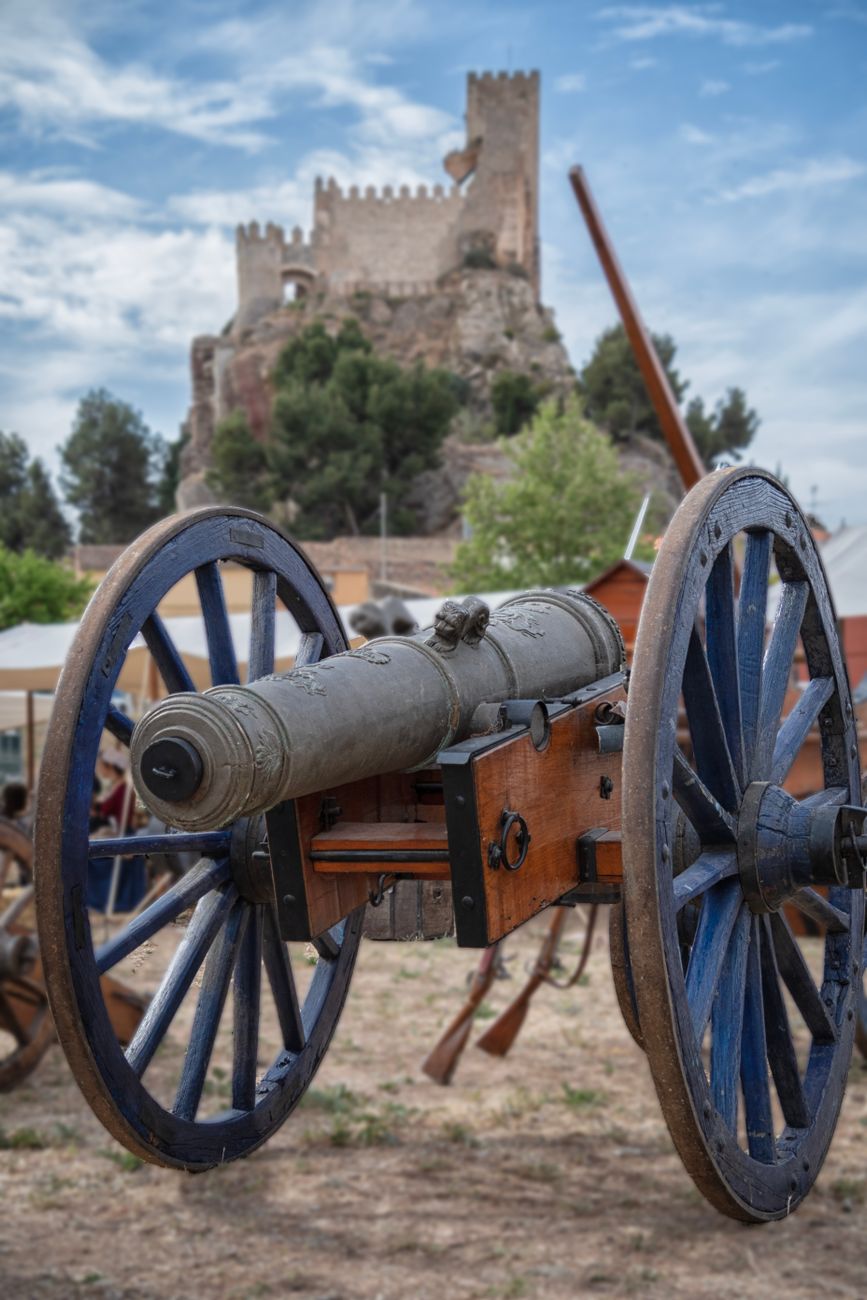
The introduction of cannons to European warfare in the 14th century was a slow burn, but by the 15th century, artillery had become the undisputed king of the battlefield. The very nature of a siege began to change. The goal was no longer to meticulously maneuver a tower to go over a wall; it was to stand back and pulverize that wall into rubble. The siege tower, once a symbol of immense power, suddenly became a liability. Its key characteristics—its large size, slow speed, and wooden construction—made it the perfect target for cannon fire. A single well-aimed cannonball could splinter its main supports, shatter its wheels, or blast a hole in its protective cladding, rendering the entire, labor-intensive structure useless.
The Fall of Constantinople in 1453 to the Ottoman Sultan Mehmed II is often seen as the final, deafening death knell for the age of traditional siege warfare. Mehmed’s army brought with it enormous cannons, including the legendary Great Turkish Bombard, which relentlessly pounded the ancient Theodosian Walls. Against such explosive force, even the most formidable medieval fortifications were revealed to be fragile. The great siege towers of old were nowhere to be seen; they would have been obliterated before they even reached the city’s moat.
As castle design evolved to counter this new threat—with lower, thicker, star-shaped walls (the trace italienne) designed to deflect cannonballs—the belfry faded from a battlefield reality into a historical relic. The age of assault was over, and the age of bombardment had begun. The ingenuity that once went into crafting these towering wooden giants was now poured into metallurgy and ballistics.
Yet, the legacy of the siege tower endures. It remains one of the most potent symbols of medieval warfare, immortalized in film, literature, and our collective imagination. It represents a time of incredible ambition and engineering, a physical manifestation of the will to conquer. From the ancient Assyrian plains to the Crusader battles of the Holy Land, the siege tower was the ultimate castle breaker—a moving fortress that, for thousands of years, brought the battle directly to the enemy’s doorstep.
 knighttemplar