
The simple cloth that defined an order
Picture a Knight Templar. What comes to mind? A fearsome warrior clad in gleaming mail, a great helm obscuring his features, and a sword ready for battle. Central to this iconic image is the stark white mantle or surcoat, emblazoned with a bold, red cross. This garment, known colloquially as a tabard, is more than just a piece of clothing; it’s a symbol of faith, a tool of war, and a uniform that struck fear into the hearts of enemies and inspired awe in allies. But the version we see in movies and video games is often a romanticized fantasy, a far cry from the practical, functional garment worn by the historical knights. Here at Knight Templar Uniform Blogs, we believe in unveiling the legend in every stitch, and that means peeling back the layers of myth to reveal the historical truth. The Templar tabard, or more accurately, the surcoat, was not a product of high fashion. It was born from the harsh realities of the Crusades, designed for identification, protection, and as a powerful declaration of purpose. In this article, we will delve into the historical records and archaeological evidence to reconstruct this legendary piece of attire, reinforcing our understanding with historical accuracy. Forget the velvet and gold trim; let’s explore the humble wool and unwavering symbolism of the real Templar surcoat.
Function over fashion: the practical purpose of the Templar surcoat
Before it was a legendary symbol, the Templar surcoat was a profoundly practical piece of military equipment. Its adoption during the 12th century wasn’t an aesthetic choice; it was a solution to several pressing problems faced by Crusader knights in the Holy Land. The most immediate purpose was identification. In the chaotic swirl of a medieval battlefield, with helmets concealing faces, distinguishing friend from foe was a matter of life and death. The simple, uniform design—a white surcoat for the knights and a black or brown one for the sergeants—allowed Templar brethren to instantly recognize each other amidst the dust and din of combat. This visual cohesion was crucial for maintaining battle lines and executing coordinated maneuvers. The stark white, emblazoned with the red cross, became the Order’s banner, worn by every knightly brother. It declared their presence on the field and unified them as a single, formidable fighting force.


Beyond identification, the surcoat served as a critical layer of protection against the elements. The primary defense for a Templar was his hauberk, a full-length coat of mail. While effective against blades, chainmail was essentially a metal shirt, making it incredibly susceptible to the scorching Middle Eastern sun. An un-covered hauberk would quickly become dangerously hot, risking heatstroke and exhaustion for the warrior within. A simple, loose-fitting surcoat made of a light-colored fabric like wool or linen acted as a crucial barrier. It reflected sunlight, keeping the mail and the knight beneath it significantly cooler. The opposite was true in wet or cold conditions. The surcoat helped shield the mail from rain, which could not only add to the chilling effect but also promote the ever-present threat of rust. Rust was the bane of mail armor, weakening the links and requiring constant, laborious maintenance. By providing a protective outer layer, the surcoat preserved the knight’s most expensive and vital piece of equipment, ensuring he was always battle-ready. The garment’s simple, poncho-like construction, often with splits in the front and back, also ensured it didn’t hinder movement, especially when mounted on a warhorse. It was a masterpiece of simple, functional design, born from necessity and honed by experience on the battlefield.
Decoding the croix patée: the symbol on the surcoat
While the surcoat’s function was practical, its symbolism was its soul. The defining feature, the one that elevated the garment from a mere piece of cloth to a sacred vestment, was the red cross. This was not just any cross; it was a powerful statement of the Templar’s dual role as both a monk and a warrior. The right to wear this symbol was granted to the Order by Pope Eugenius III around 1147, just before the Second Crusade. The Papal Bull *Omne Datum Optimum* had already placed the Templars under the direct protection of the papacy, and the addition of the cross further cemented their status as soldiers of the Church. The cross was to be worn on their mantles and surcoats, typically over the heart—a placement heavy with meaning, signifying that their actions and their very lives were dedicated to Christ.

The color red was deliberately chosen for its potent symbolism. It represented the blood of Christ and the concept of martyrdom. By wearing the red cross, a Templar was publicly declaring his willingness to shed his own blood in defense of the Holy Land and the Christian faith. It was a vow made visible, a constant reminder of the ultimate sacrifice he was prepared to make. The specific style of the cross most associated with the Templars is the *croix patée* (cross pattée), which features arms that are narrow at the center and flare out towards the ends. However, it’s a common misconception to assume this was a rigidly standardized design from the outset. Over the nearly two centuries of the Order’s existence, and across different geographical regions, variations in the cross’s shape and proportions were almost certain. The perfectly symmetrical, sharp-edged version popular today is more of a modern interpretation. Historical depictions suggest simpler, sometimes cruder forms, likely cut from red wool or felt and appliquéd onto the surcoat. For the average Templar brother, the symbol’s presence and meaning were far more important than its precise geometry. It was this cross that transformed him from a secular knight into a warrior monk, a member of the elite *Pauperes commilitones Christi Templique Salomonici*—the Poor Fellow-Soldiers of Christ and of the Temple of Solomon.
Recreating the authentic tabard: a guide for reenactors
For modern historians, reenactors, and enthusiasts, recreating a Templar surcoat with historical accuracy is a rewarding challenge. The key is to resist the allure of fantasy and focus on the materials and construction methods of the 12th and 13th centuries. The first and most important choice is the fabric. The overwhelming choice for a knight’s surcoat would have been wool. Wool is a remarkably versatile material; it breathes well, insulates even when damp, and is incredibly durable. A mid-weight, off-white or natural white wool is the ideal starting point. Avoid pure, bleached-white synthetic fabrics like polyester, as they look and behave in a way that is jarringly modern. Linen is a possible alternative, especially for a lighter garment intended for a warmer climate, but wool was the workhorse fabric of the medieval period.
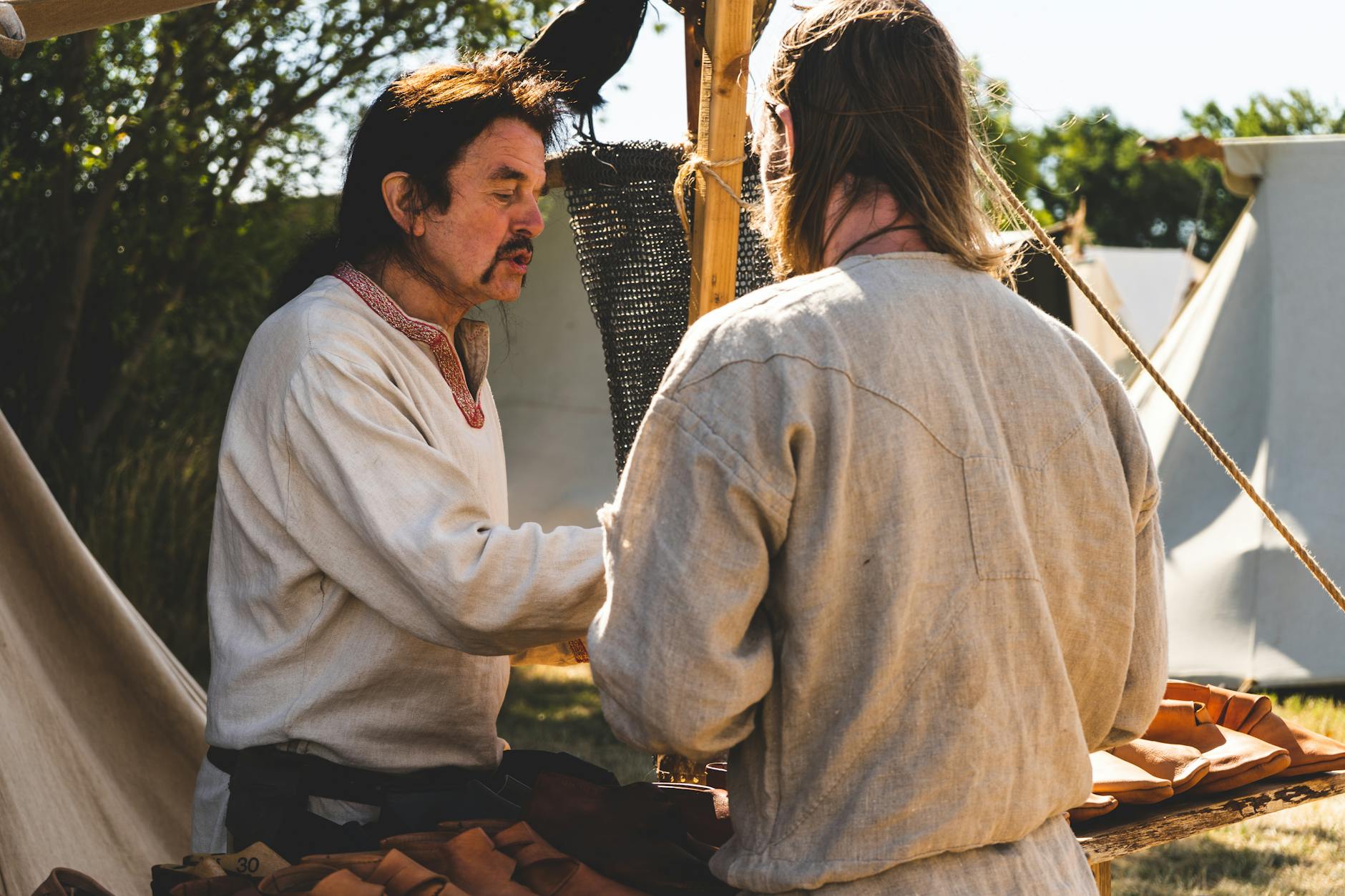
The cut of the surcoat should be simple and functional. Think of a large rectangle of fabric folded in half at the shoulders with a hole cut for the head. The sides could be sewn up from the waist down, left open, or partially sewn to create a T-shape. Most importantly, it should be loose and flowing, designed to be worn over a bulky mail hauberk and padded gambeson. It was not a tailored, form-fitting garment. For a mounted knight, deep splits in the front and back were essential to allow the garment to drape over the horse without bunching up. The construction should also reflect the period. Hand-stitching, particularly with visible seams, adds a layer of authenticity that a machine-sewn garment lacks. Next, consider the cross. As mentioned, this was likely an appliqué. A piece of red wool or felt, cut into the shape of a cross pattée, would be sewn onto the chest. Avoid printed, ironed-on, or intricately embroidered crosses for a standard knight’s impression, as these methods are either anachronistic or would have been reserved for the highest echelons of the Order, if used at all. Finally, don’t be afraid of a little wear and tear. A Templar’s surcoat was field equipment. It would have been stained with sweat and dust, faded by the sun, and likely patched and repaired multiple times. A pristine, perfectly clean surcoat looks like a costume. A realistically weathered one looks like a piece of history, embodying the grit and determination of the warrior who wore it and truly bringing the legend to life.

 Templar Uniform Editorial


