
The cross pattée is the emblem most people picture when they imagine the Knights Templar: a bold red cross on a white field, its four arms pinched narrow at the center and flaring outward into broad, straight-edged tips. Stitched onto the mantle and surcoat of the Order’s knights, it became one of the most recognizable badges of the medieval world. Yet it was not there from the beginning. For roughly thirty years the Templars wore a plain white habit with no cross at all — the red cross pattée arrived in 1147 as a gift from the papacy, and that timeline is the key to reading the symbol honestly. This guide covers what the cross is, where it came from, what it was believed to mean, how it differs from its cousins, and why it still turns heads today.
What Exactly Is a Cross Pattée?
A cross pattée (also written cross patté, and closely related to the cross formée) is defined by its silhouette rather than by any single fixed measurement. Each of the four arms starts slender where they meet at the center, then spreads or “splays” outward so the ends are far wider than the middle. The name comes from the French patté, roughly “having feet or paws” — a nod to the way the broad arm-ends plant themselves like feet at the edges of the cross.

Medieval artists were not working from a modern style sheet, so the exact geometry varies from seal to seal and wall to wall:
- Edges: some versions have perfectly straight, angled sides; others curve gently inward (concave) before the flare.
- Proportion: the ratio of the narrow waist to the wide tips shifts from one depiction to the next.
- Ends: the outer edge is usually flat and straight, not notched or forked — that plainness sets it apart from fancier heraldic crosses.
The takeaway is that the cross pattée is really a family of shapes with a shared logic — a narrow heart, broad extremities — rather than one trademarked design. Heraldry names dozens of cross variants, and the pattée is easy to confuse with its neighbours, but that adaptable outline is exactly why it moved so easily from cloth to stone to seals and, centuries later, to printed apparel.
Red on White: The Cross Granted in 1147
The single most important fact about the Templar cross is that the knights did not always wear it. When the Order won formal Church recognition at the Council of Troyes in 1129 — with the influential abbot Bernard of Clairvaux championing their cause — the brothers adopted a plain white mantle as a sign of purity and their monastic vows. There was no cross on it yet.
That changed in 1147, when Pope Eugenius III granted the Templars the right to wear a red cross on the white mantle, over the heart. Tradition holds the red was chosen as a symbol of martyrdom — a visible sign that these warrior-monks were prepared to shed their own blood in defense of the faith and of Christian pilgrims. Set against the white of chastity and purity, the pairing gave the Order the stark red-on-white identity we still recognize instantly.
It is worth stressing how deliberate this was. The Rule of the Order regulated dress tightly and banned personal decoration, gold and finery; the cross was not an ornament but a mark of consecration granted from the highest authority in the Church. Before 1147 the habit spoke of poverty and purity alone; after it, the same white cloth carried a badge of holy war — a distinction that would have been obvious to anyone who saw a column of Templar knights ride past.
Eagle and Symbol of Knights Templar
From the flaring red cross to the Order’s proud eagle, this design gathers the symbols the Templars actually bore into one clean piece you can wear anywhere.
🇺🇸 Fast US shipping · 🇪🇺 Ships across the EU · 🔒 Secure checkout
What the Cross Was Believed to Mean
Any honest discussion of symbolism has to separate documented fact from later interpretation. What we can say plainly is that the red cross marked a brother as a professed member of a religious military order, worn over the heart on a white habit. Everything beyond that belongs to tradition rather than to some surviving Templar “decoder.”
Traditionally, the reading runs like this:
- Red: the blood of Christ and of the martyrs, and the knight’s readiness to die for his faith.
- White: purity, chastity and the monastic ideal the brothers had sworn to uphold.
- The four arms: often linked to the four corners of the earth or the four evangelists, echoing older Christian cross symbolism.
These meanings are long-standing and resonant, but they are interpretive. No medieval Templar left a definitive gloss explaining precisely why the pattée shape was chosen over another, so it is only fair to treat the finer symbolic claims as tradition rather than verified doctrine. Even the placement carried weight, though: worn over the heart, it framed the cross as the center of a brother’s devotion rather than mere decoration. The honest version of the story is more interesting than a tidy myth anyway.
How It Differs From Other Crusader Crosses
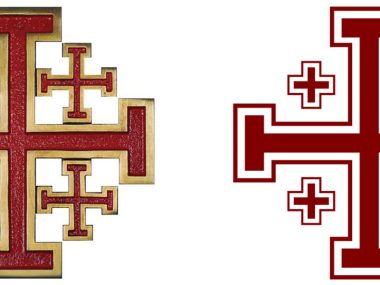
The medieval crusading world was full of crosses, and lumping them together is a common mistake. The cross pattée is a single, self-contained cross — one shape, four flaring arms. Compare that with the Jerusalem cross, a large central cross (usually a cross potent, with T-shaped ends) surrounded by four smaller crosslets, making five crosses in total; it is generally read as the five wounds of Christ, or the spread of the gospel to the four corners of the earth. If you want the full contrast, this explainer on the five-fold crusader’s cross of Jerusalem lays the differences out clearly.
Other orders carried their own marks — the Hospitallers are tied to the eight-pointed cross that later became the “Maltese” cross, while a plain Latin cross was common across Christendom. Because the terminology overlaps so much, it helps to read a fuller guide to the Order’s different cross types before assuming every red cross is “the” Templar cross. The pattée stands out precisely because of that narrow-waisted, wide-armed profile — once you can spot it, you will notice how often it is mislabelled online.
The Cross Pattée Today
Few medieval symbols have travelled as far. The flaring-armed cross influenced later heraldry and military decorations across Europe: the German Iron Cross, various Christian chivalric orders and any number of regimental badges borrow the pattée outline, which is partly why the shape still feels martial and ceremonial to modern eyes — long after the Order itself was suppressed in 1312. Today the cross pattée turns up in church iconography, heritage crests, historical reenactment and, inevitably, on apparel and accessories for people who feel a pull toward the Templar story. It sits inside a wider visual language you can explore through the broader vocabulary of Templar symbols and their enduring legacy.
Because it began as a Christian and heraldic emblem, most wearers treat it as a mark of faith, courage or heritage rather than a costume prop. If you want to carry it yourself, look for designs that respect the real proportions — a clean red cross pattée on a white or neutral ground says far more than a cluttered graphic. That restraint is what turns a shirt into a piece of wearable history rather than a gimmick.
The cross pattée earned its fame the slow way: adopted in 1147, worn over the heart of men sworn to poverty and faith, and remembered for centuries after the Order was gone. Knowing that it postdates the founding, and that its deeper meanings are tradition rather than proven doctrine, only makes it more rewarding to wear. Understood properly, it is not just a shape — it is a compact history lesson stitched in red and white.
 knighttemplar


1 comment