
When we picture a Knight Templar, a powerful image comes to mind: a stoic warrior clad in a shimmering coat of mail, the bold red cross emblazoned upon a white surcoat. This vision, while iconic, only scratches the surface of a far more complex and sophisticated reality. The true defensive genius of a Templar knight wasn’t found in a single piece of armor, but in a meticulously engineered system of layers. It was a symphony of steel, padding, and fabric, each element playing a crucial role in transforming a man into a walking fortress on the battlefields of the Holy Land. To truly understand their legendary prowess, we must look past the mail and appreciate the forgotten art of layering for survival.
The common misconception is that chainmail alone was the ultimate defense. While it was brilliant at stopping the slicing cut of a sword, it offered little protection against the crushing, bone-shattering force of a mace or the concussive impact of a warhammer. A direct blow could still incapacitate or kill a warrior, even if the mail remained unbroken. The Templars, pragmatic and battle-hardened, knew this well. Their armor was an integrated system, a testament to medieval ingenuity where the whole was far greater than the sum of its parts. Let’s peel back these historical layers to reveal the science and art behind a Templar’s formidable protection.

The unsung hero: The padded gambeson foundation
Before a single ring of steel was donned, the knight’s defense began with a thick, padded garment known as the gambeson, or aketon. This was arguably one of the most critical and underappreciated pieces of medieval armor. To dismiss it as mere underwear would be a grave mistake; the gambeson was the unsung hero of the entire defensive system, providing the essential foundation upon which all other layers were built. Without it, the finest chainmail in Christendom was significantly less effective.

Constructed from multiple layers of durable fabric like linen or canvas, the gambeson was quilted into vertical or diamond-shaped channels. These channels were then stuffed with shock-absorbing materials such as raw wool, scrap cloth, or even horsehair. The result was a surprisingly resilient garment, thick and dense, that served several vital purposes. Its primary function was shock absorption. When a blow from a blunt weapon landed on the chainmail, the force would be distributed across the surface of the mail. However, it was the gambeson beneath that cushioned this impact, absorbing the kinetic energy and preventing broken bones, deep bruising, and internal injuries. It was the difference between walking away from a mace strike and being carried from the field.
Beyond its protective qualities, the gambeson provided comfort and support. A full mail hauberk could weigh upwards of 30 pounds (or about 13 kg), and its weight rested heavily on the shoulders. The padded gambeson distributed this load more evenly across the torso, making it more bearable during long marches or extended battles under the scorching Levantine sun. It also prevented the coarse, riveted steel rings from chafing and pinching the skin, a practical consideration that cannot be overstated. In many instances, particularly for archers or less affluent men-at-arms, a well-made gambeson was their primary and only form of torso armor. Its ability to stop cuts and absorb impacts made it a formidable defense in its own right.
Historical evidence confirms that these garments were standard-issue for crusading knights. The Rule of the Templars, the code that governed the order, meticulously listed the equipment each knight was entitled to, and padded armor was a fundamental component. Styles varied, with some being simple sleeveless vests while others featured full-length sleeves and high collars to protect the neck. Many later versions incorporated “arming points”—sturdy laces tied to the garment—which allowed a knight to securely attach pieces of plate armor, such as elbow and knee cops, directly to his padded foundation. This illustrates the gambeson’s role as the central interface for the entire armor system, a padded chassis upon which the knight’s steel shell was mounted.
The heart of the matter: The riveted mail hauberk
With the padded foundation in place, the knight would then don the centerpiece of his protection: the mail hauberk. This was the iconic coat of “ten thousand rings” that defined the silhouette of the High Middle Ages warrior. For the Templars, mail was the standard for heavy cavalry, offering an excellent balance of protection and flexibility that was unmatched by other armors of the period. But not all mail was created equal, and the type used by a Templar knight was a testament to painstaking craftsmanship.
True historical mail was almost always “riveted.” Each tiny ring was formed from iron wire, its ends flattened and overlapped. A tiny hole was then punched through the overlap, and a minuscule rivet was hammered into place, creating a strong, closed loop. These rings were then woven together in a dense, interlocking pattern, typically a “four-in-one” matrix where each ring passed through four of its neighbors. This process was incredibly labor-intensive, requiring hundreds of hours of skilled work to produce a single hauberk. The alternative, “butted” mail, where rings are simply bent closed, was far weaker and would burst open upon impact. For a military order like the Templars, who demanded the most reliable equipment, only riveted mail would suffice.
The main garment was the hauberk, a long-sleeved shirt of mail that often extended to the knees. It was heavy and cumbersome, but its weight was a small price to pay for the life-saving protection it afforded. A split in the front and back of the skirt allowed a knight to sit comfortably on his warhorse, a crucial feature for a cavalry-focused order. Covering the legs were chausses, which were essentially mail leggings, protecting a knight from disabling blows to the lower body. Protecting the head and neck was the mail coif, a hood that could be separate or integrated into the hauberk itself. Worn over a padded arming cap, the coif provided a flexible defense for one of the body’s most vulnerable areas. It moved with the wearer, allowing for a far greater range of vision and movement than the later, more restrictive plate helmets.
The genius of mail lay in its flexibility. Unlike the rigid plate armor that would come to dominate the later Middle Ages, chainmail conformed to the wearer’s body like a heavy cloth. This allowed a knight a full range of motion for swinging a sword, couching a lance, or controlling his steed. It was breathable, which, while still hot, was a significant advantage in the arid climate of the Outremer. Its primary strength was against cutting weapons. A sword edge, no matter how sharp, would simply glance off the hardened iron rings, unable to purchase a bite. It was this quality that made knights seem almost invincible to infantry armed with conventional weapons, cementing their reputation as the dominant force on the medieval battlefield.
Identity and reinforcement: The surcoat and great helm
The final layers of a Templar’s attire were not just for protection; they were powerful statements of identity and crucial adaptations to the environment. Worn over the mail hauberk was the garment most associated with the order: the white surcoat, adorned with its stark red cross. This simple piece of fabric was far more than a uniform; it was a symbol of the knight’s dual role as both a monk and a soldier. The white field represented the purity of their monastic vows, while the red cross symbolized their willingness to shed their blood as martyrs for Christ. On a chaotic battlefield, these surcoats served as a vital form of identification, allowing Templars to distinguish friend from foe and rally to their banner.

Beyond its profound symbolism, the surcoat served a critical practical purpose. In the relentless sun of the Holy Land, bare metal armor would quickly heat up to unbearable temperatures, risking heatstroke and exhaustion. The loose-fitting, light-colored surcoat reflected the sun’s rays, keeping the knight underneath significantly cooler. It also protected the mail from rain and moisture, which could quickly lead to rust—the perennial enemy of iron armor. By shielding the mail from the elements, the surcoat extended the life of this expensive and vital equipment.
The final layer of defense for the head was the great helm. By the 13th century, this imposing piece of armor had become common. Worn over the mail coif and its underlying padded cap, the great helm was a flat-topped cylinder of steel that completely encased the head. It offered vastly superior protection against lances and heavy blows compared to the mail coif alone. While it severely restricted vision and ventilation, it was an indispensable piece of equipment for the cavalry charge, where protection against a couched lance was paramount. This layering of a padded cap, a mail coif, and a solid steel helm created a formidable defense for the head, demonstrating the layered approach in microcosm.
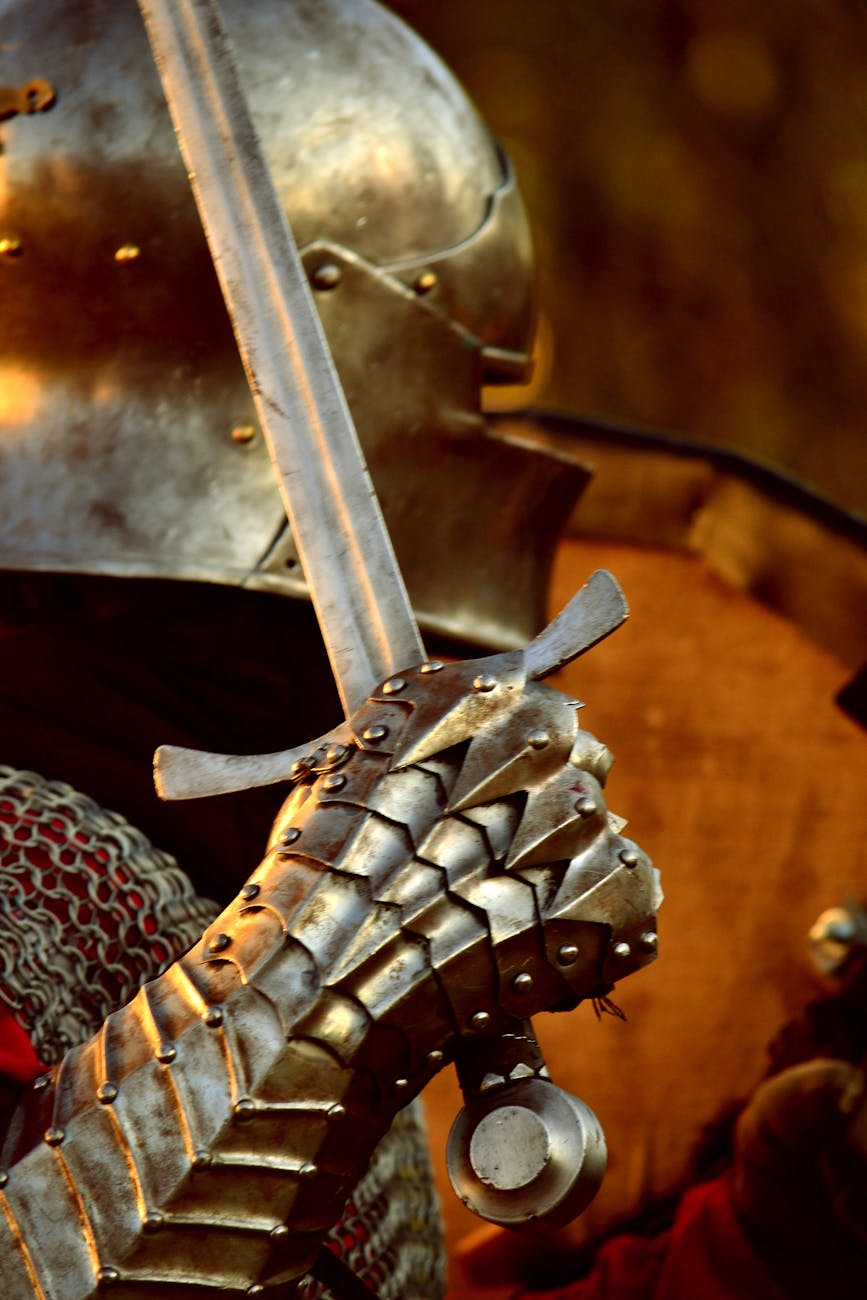
As the 13th century progressed, knights began adding further reinforcements over their mail. This marked the transitional period between the age of mail and the age of full plate. Small pieces of plate armor, such as “poleyns” to protect the knees and “couters” to guard the elbows, were strapped on over the mail chausses and hauberk. A “coat of plates,” a precursor to the breastplate, might be worn under the surcoat, consisting of steel plates riveted to the inside of a fabric or leather vest. These additions were targeted at shoring up the known weaknesses of mail, particularly against piercing attacks from lances and crossbows. A Templar knight of the late 13th century was a hybrid of mail and plate, a walking timeline of armor evolution. This constant adaptation shows that Templar armor was not a static uniform but a dynamic, ever-evolving system designed for one purpose: to ensure the soldier of Christ could fight, and win, on the battlefield.
From the padded gambeson that absorbed the shock to the iconic surcoat that declared their faith, the Knights Templar were masters of layered defense. Their attire was a carefully considered system where each element complemented the others, creating a level of protection that made them one of the most feared and respected fighting forces of their time. It is a powerful reminder that true strength often lies not in a single, shining piece of steel, but in the wisdom and artistry of the layers beneath.

 Templar Uniform Editorial


