
In the age of steel and stone, a knight’s identity was his most valuable asset on a chaotic battlefield. Encased in armor, his face hidden behind a grim visor, he was rendered anonymous. How, then, was friend distinguished from foe? The answer was emblazoned in vibrant color and bold design upon his shield and surcoat: his heraldry. This visual language of lineage, loyalty, and valor was more than decoration; it was a declaration. For the Knights Templar, their simple, stark red cross on a white mantle was a symbol of immense power, recognized and respected across Christendom. Today, in a world saturated with fleeting trends and mass-produced fashion, this ancient practice is experiencing a profound resurgence. We are once again learning to wear our stories, not on shields of steel, but in the very fabric of our modern lives, elevating chivalrous apparel with a uniquely personal and symbolic flair.
The language of symbols: a brief history of heraldry
To understand the modern appeal of heraldry, we must first journey back to its origins in the heart of the 12th century. Heraldry, or armory, was born of necessity. As armor evolved to cover the entire body, a system was needed to identify combatants. What began as simple patterns and colors painted on shields soon blossomed into a complex and regulated art form. This was not merely a collection of random pictures; it was a codified language, a visual shorthand for a person’s identity, achievements, and social standing. Each element on a coat of arms was chosen with deliberate intention and held a specific meaning, understood by allies and adversaries alike.

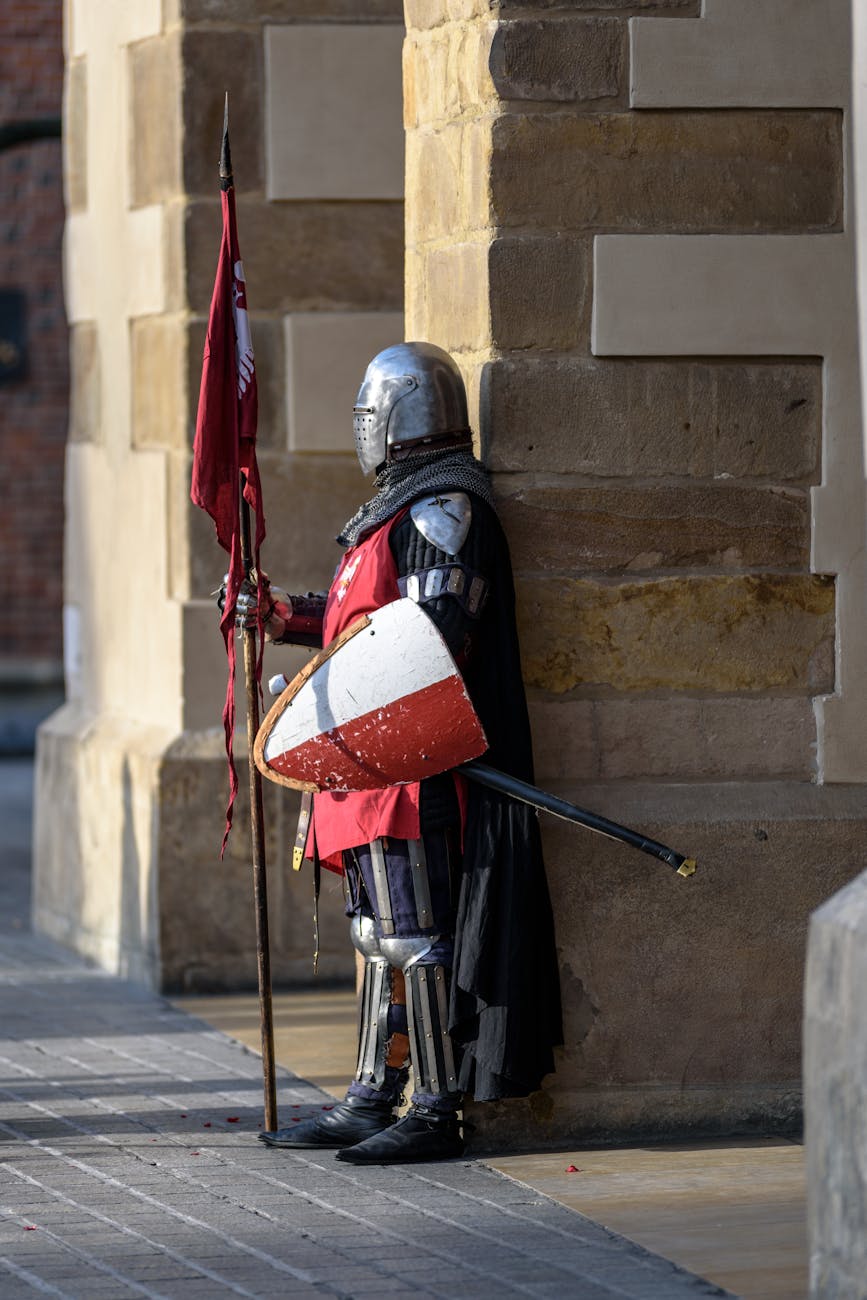
The core of any heraldic achievement is the shield, or escutcheon, which serves as the canvas. Upon this canvas, we find several key components. The colors, known as tinctures, are divided into metals (Or for gold/yellow, Argent for silver/white), colours (Gules for red, Azure for blue, Sable for black, Vert for green, and Purpure for purple), and furs (like Ermine). The meaning of these colors was deeply ingrained in the medieval mindset; red, for instance, often symbolized a warrior’s courage or martyrdom, while blue represented loyalty and truth. The geometric shapes and lines that divide the shield are called ordinaries, such as the ‘chief’ (a band across the top) or the ‘pale’ (a vertical band down the middle). Finally, the symbols placed upon the shield are known as charges. These could be anything from ferocious beasts like the lion (representing courage and royalty) and the eagle (signifying nobility and strength) to inanimate objects or religious symbols like the cross, which denoted faith and service.
The Knights Templar themselves were masters of this symbolic branding. Their famed banner, the Beauséant, was a simple black and white field, said to represent their ferocity to enemies and fairness to friends. Their personal seal, depicting two knights on a single horse, was a powerful symbol of their vow of poverty and brotherhood. And of course, the blood-red cross on their white mantle was their ultimate coat of arms—a stark, unambiguous symbol of their holy mission. It needed no complex charges or mottos; its power was in its purity and immediate recognition. This historical precedent demonstrates the enduring power of a well-designed symbol to convey a complex story in a single glance. It is this depth and historical gravity that modern wearers seek to capture.
The modern renaissance of the personal crest
Why, in the 21st century, are we so drawn to this medieval art form? The answer lies in our contemporary quest for authenticity and meaning. In an era dominated by fast fashion, where clothing is often disposable and logos represent corporate identities rather than personal ones, heraldry offers a potent antidote. It provides a tangible link to our heritage, a way to express our values, and an opportunity to create something truly unique and lasting. The modern renaissance of the personal crest is a quiet rebellion against the impersonal, a movement to reclaim our individuality through the timeless language of symbols.

For many, this journey begins with genealogy. The rising popularity of ancestry research has unearthed a treasure trove of family histories, and with them, ancestral coats of arms. To discover and adopt a family crest that has been passed down through generations is to connect with one’s roots in a profound way. It’s about understanding that you are part of a much larger story. Wearing this crest, whether on a signet ring or an embroidered blazer, becomes an act of honoring that legacy. It’s a statement that says, “I know where I come from.” This connection to the past provides a sense of grounding and identity that generic brand logos simply cannot offer.
But what if your family tree doesn’t yield a ready-made coat of arms? This is where the true creativity of modern heraldry shines. The tradition has always allowed for the creation of new arms for individuals of merit. Today, people are embracing this by designing their own personal crests. This is the ultimate form of personal branding, allowing you to distill your own life story, passions, and values into a single, powerful emblem. An engineer might incorporate a gear or a compass, a writer might choose a quill or an open book, and someone dedicated to family might use an oak tree to symbolize strength and continuity. By adhering to the traditional rules of heraldic design—the tinctures, divisions, and charges—one can create a symbol that is both deeply personal and historically legitimate. This new coat of arms becomes a modern heirloom, the beginning of a new tradition to be passed down to future generations.
Weaving heraldry into chivalrous apparel and accessories
Bringing the symbolic weight of heraldry into your daily life is an art of balance and intention. It’s not about donning a full suit of armor, but about integrating meaningful symbols into your wardrobe with purpose and style. The modern application of heraldry is versatile, allowing for expressions that range from the exceedingly subtle to the proudly bold. The key is to choose pieces that reflect your personality and the dignity of the symbol you bear. This is where chivalrous apparel moves beyond mere clothing and becomes a form of personal storytelling.

For a subtle approach, consider accessories that carry a personal mark. A classic gold or silver signet ring, engraved with your full coat of arms or just the crest, is perhaps the most timeless and personal expression of heraldry. It’s a piece you wear every day, a constant and private reminder of your heritage or personal code. Other understated options include custom cufflinks, a tie bar etched with a key symbol from your crest, or the quiet elegance of having your arms engraved on the back of a wristwatch. These small touches are for the wearer first and foremost. They are nods to your identity that don’t shout for attention but reward the keen observer.
For those who wish to make a more forthright statement, heraldry can be masterfully integrated into larger garments. An embroidered crest on the pocket of a navy blazer is a classic and distinguished look, instantly elevating the garment from a simple piece of clothing to a personal statement. High-quality embroidery, with its rich texture and color, does justice to the historical art form. For a more casual but equally impactful look, a tastefully designed coat of arms can be screen-printed on a quality t-shirt or hoodie. The craft is paramount; the quality of the material and the artistry of the application must honor the symbol itself. Beyond clothing, heraldry extends to the tools of modern life. A leather-bound journal, a wallet, or even a phone case, embossed with your personal arms, brings a touch of chivalrous tradition and bespoke elegance to everyday items. It’s about curating a cohesive personal identity system, much as a medieval knight would have, where your mark of honor is present on all that is yours.
Ultimately, incorporating heraldry is about embracing the principles of the Knights Templar in a modern context: wearing your beliefs and your identity with conviction. It is a powerful way to carry the legacy of the past into the future, transforming ordinary apparel into a meaningful connection to your personal story. Whether inherited or newly forged, your coat of arms is more than a design—it is a banner for your own chivalrous code in the modern world.

 Templar Uniform Editorial


