The sacred blueprint: origins of the circular design
In the heart of every great legend lies a powerful symbol, an origin point from which all stories flow. For the Knights Templar and their most iconic architectural legacy—the round church—that origin point is in Jerusalem. Before we can trace the timeline of these magnificent structures across Europe, we must journey back to the very source of their inspiration: the Church of the Holy Sepulchre.
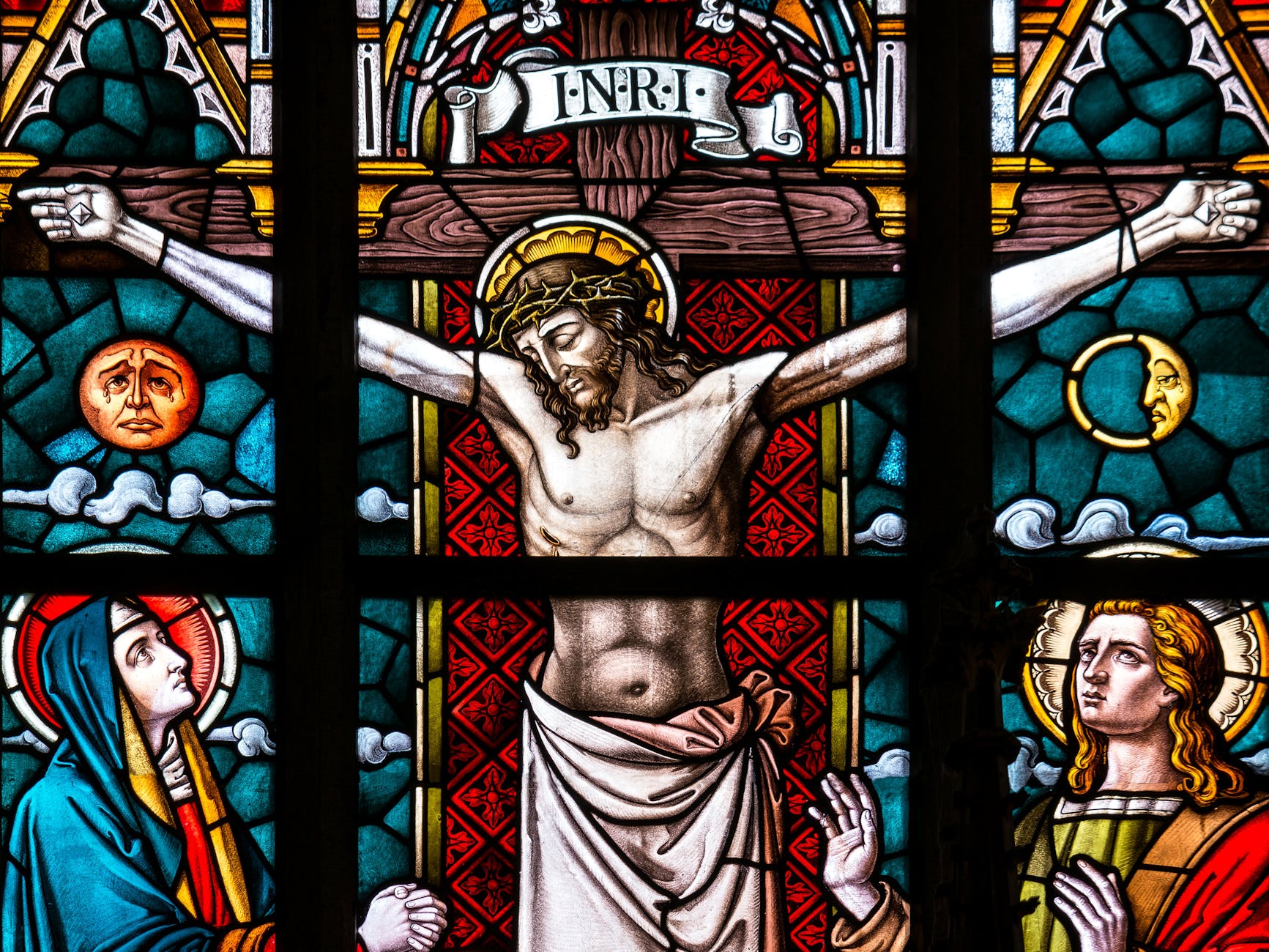
Commissioned in the 4th century by Emperor Constantine the Great, the Church of the Holy Sepulchre was built to sanctify the two most sacred sites in Christianity: the location of Christ’s crucifixion and the tomb (the sepulchre) from which he was resurrected. While the entire complex is a sprawling collection of chapels and shrines, it was the tomb’s housing, a circular rotunda known as the Anastasis (Greek for “Resurrection”), that captured the imagination of Christendom. This round structure, with the holy tomb at its center, became a symbol of eternity, rebirth, and Christ’s victory over death. The circle, a shape with no beginning and no end, was the perfect geometric representation of God’s infinite nature and the promise of everlasting life.

When the first crusaders arrived in Jerusalem in 1099, they were not just warriors; they were pilgrims. They stood in awe before the Anastasis Rotunda, a piece of living history and the ultimate goal of their perilous journey. For the men who would soon form the Poor Fellow-Soldiers of Christ and of the Temple of Solomon, this building was more than stone and mortar. It was a physical connection to the divine, the epicenter of their faith and the reason for their existence.
The timeline of this foundational idea begins long before the Templars themselves:
- c. 326-335 AD: Construction of the original Church of the Holy Sepulchre under Constantine. The Anastasis Rotunda is established as a key pilgrimage destination, its circular plan forever associated with the Resurrection.
- 614 AD: The church is damaged by a Sassanid invasion but is later restored. Its importance only grows over the centuries.
- 1009 AD: A devastating blow is struck when the church is systematically destroyed by the Fatimid Caliph al-Hakim bi-Amr Allah. This event sends shockwaves through the Christian world and is a major contributing factor to the eventual call for the Crusades.
- c. 1048 AD: The church is partially rebuilt by the Byzantine Emperor Constantine IX Monomachos, though not to its original grandeur. The rotunda, however, is restored, preserving its essential form.
- 1099 AD: The First Crusade captures Jerusalem. The crusaders take control of the Holy Sepulchre and begin their own extensive, century-long rebuilding and beautification project.
It was this crusader-era Church of the Holy Sepulchre that the first Templars knew. They were headquartered just steps away on the Temple Mount, and their daily lives were intertwined with this sacred space. When they began to establish a network of preceptories across Europe, it was only natural that they would choose to replicate the holiest site they knew. Building a round church in London, Paris, or Tomar was a powerful statement. It was a way of bringing a piece of Jerusalem home, a constant, physical reminder of their sacred duty to protect pilgrims and defend the Holy Land. It was their story, their purpose, and their uniform—the white mantle of purity and the red cross of martyrdom—rendered in stone.
The Templar trademark: building the order’s spiritual fortresses
With the divine blueprint of the Holy Sepulchre firmly embedded in their identity, the Knights Templar began one of the most ambitious and recognizable building campaigns of the Middle Ages. The 12th century was the order’s golden age, a period of explosive growth in wealth, influence, and membership. As donations of land and money poured in from across Europe, the Templars established thousands of commanderies, or preceptories. These were far more than simple monasteries; they were administrative hubs, training grounds, recruitment centers, and agricultural estates that funded the order’s military operations in the East. At the spiritual heart of every major preceptory stood the chapel, and for their most important sites, the Templars chose the powerful, symbolic circular design.
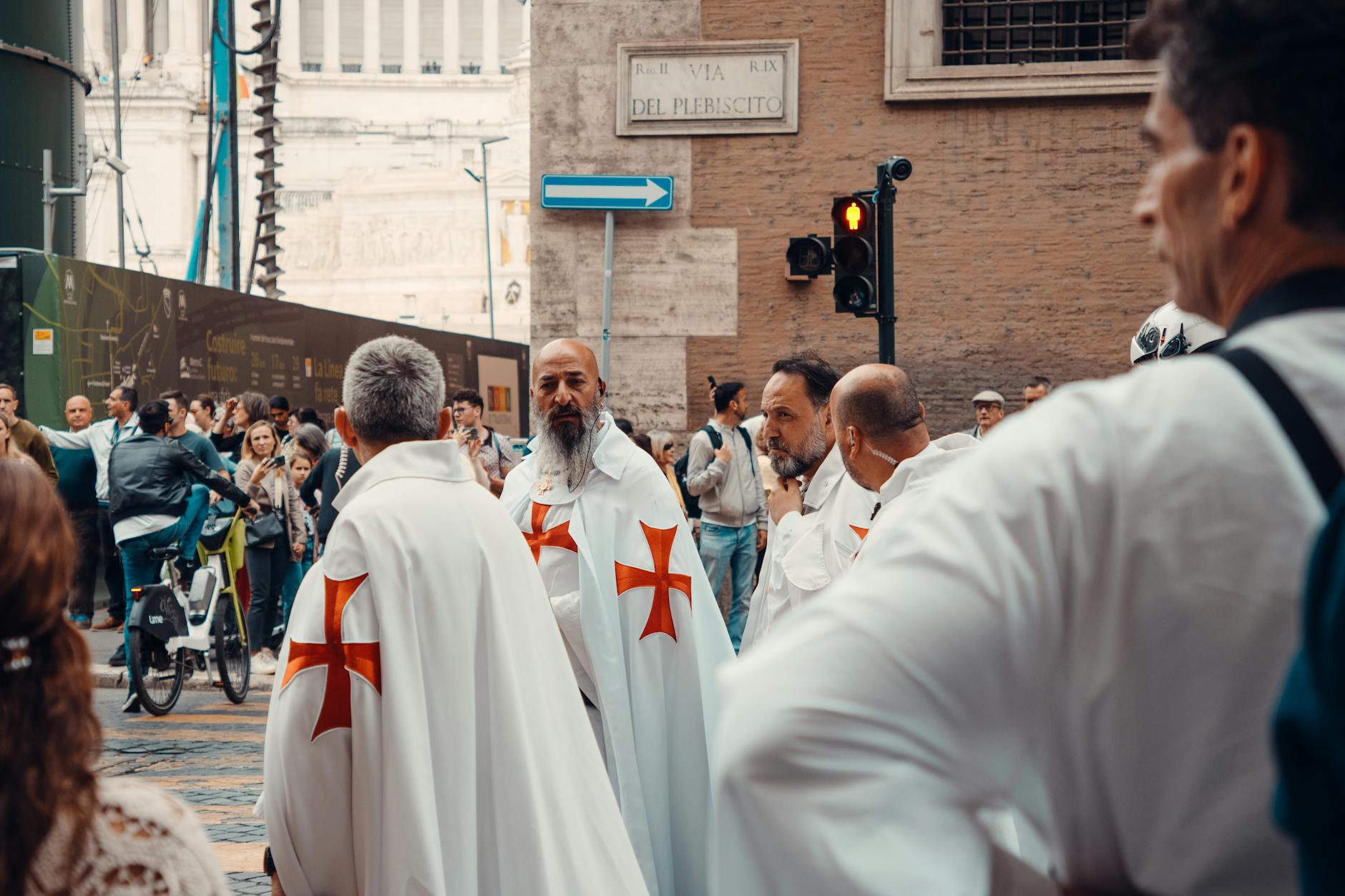
A Templar round church was a declaration. In a landscape dominated by the traditional Latin-cross layout of cathedrals and parish churches, the circular form was distinct and immediately identifiable with the order. It signaled their unique connection to Jerusalem and set them apart from other monastic or military institutions. These buildings were spiritual fortresses, designed to inspire the brother knights and project the order’s power and piety to the secular world.
The timeline of these iconic structures charts the rise of the Templars themselves:
- c. 1129: The Council of Troyes officially recognizes the Knights Templar. With papal sanction, the order begins its rapid expansion. The first, likely wooden, structures are built on donated lands.
- c. 1130s: The Templars begin construction on their European headquarters, the Paris Temple (Enclos du Temple). While the original round church was destroyed during the French Revolution, contemporary accounts describe it as a formidable structure, modeled on the Holy Sepulchre. It served as the order’s primary treasury and a testament to their growing influence.
- c. 1160: Construction begins on the Charola of the Convent of Christ in Tomar, Portugal. This is perhaps the most breathtaking and well-preserved example of a Templar round church. Built as part of a heavily fortified castle, the Charola is a 16-sided polygonal structure with a central octagonal oratory. Its design is explicitly military and spiritual, a reflection of the Templars’ dual role in the Reconquista—the centuries-long effort to retake the Iberian Peninsula from Moorish rule.
- 1185: The Temple Church in London is consecrated by Heraclius, the Patriarch of Jerusalem. The ceremony itself was a major event, underscoring the importance of the English preceptory. The round nave, with its Purbeck marble columns and expressive carved heads, was a direct architectural homage to the Anastasis Rotunda. It served as the order’s English headquarters, a royal treasury, and a residence for knights preparing to travel to the Holy Land.
The construction of these churches was a logistical feat. The Templars employed the finest masons and artisans of the day, utilizing sophisticated geometry to create the perfectly proportioned round naves. The design was not only symbolic but also practical. The circular layout was well-suited for the knights’ specific liturgical needs, allowing the brothers to gather around a central altar, reinforcing their unity and shared purpose. Just as their simple white mantle distinguished them on the battlefield, the pure geometry of their round churches distinguished them on the spiritual landscape of medieval Europe. Every stone was placed with intent, creating a network of sacred spaces that tethered the entire order back to its singular purpose in Jerusalem.
Beyond the Templars: the legacy and evolution of the round church
While the Knights Templar are the most famous proponents of the round church, it is crucial to recognize that they were not the only builders of such structures. The circular design, rooted in early Christian martyriums and Roman mausoleums, appeared in various forms across Europe, often independently of the Templars. Understanding this broader context helps to appreciate both the uniqueness of the Templar model and the enduring architectural appeal of the circular form.

In Scandinavia, particularly on the Danish island of Bornholm, four iconic round churches (rundkirker) were built in the 12th and 13th centuries. These structures, such as the famous Østerlars Church, had a distinct triple function: they were places of worship, defensive strongholds for the local populace against sea raiders, and storehouses for community valuables. Their thick walls, upper-level fighting galleries, and defensible designs speak to a different set of priorities, although the sacred symbolism of the circle remained potent.
The timeline of the round church continues, evolving and adapting even as the Templars faced their doom:
- Early 13th Century: The Templar building program continues. The London Temple Church, for example, has a rectangular chancel added to its round nave around 1240. This was a significant modification, reflecting a need to accommodate a larger congregation and more elaborate services, blending the unique Templar model with the more common parish church layout.
- 1307: On Friday, October 13th, King Philip IV of France orders the mass arrest of all Knights Templar in a swift and brutal dawn raid. The order’s immense power structure begins to crumble.
- 1312: Pope Clement V, under immense pressure from Philip IV, officially disbands the Knights Templar at the Council of Vienne. The fate of their vast properties, including their iconic churches, hangs in the balance.
- Post-1312: The majority of the Templar assets are transferred to their great rivals, the Knights Hospitaller. The round churches of London and Tomar (which became the headquarters of the newly formed Order of Christ in Portugal) were preserved, though often altered. Other, smaller Templar chapels fell into ruin or were absorbed into local parishes, their original identity slowly fading from memory.
The suppression of the Templars marked the end of an era, but it did not erase their architectural footprint. The round churches that survived became powerful relics, physical links to the legendary order. In the centuries that followed, especially during the Gothic Revival of the 19th century, a renewed romantic interest in the Templars brought their buildings back into the spotlight. Restorations, like the extensive work done on London’s Temple Church after it was bombed in World War II, were undertaken with a deep respect for the original Templar vision.
Today, these echoes in stone continue to captivate us. They are more than just architectural oddities. They are chronicles of the Crusades, monuments to a unique order of warrior-monks, and enduring symbols of a sacred mission that began in Jerusalem. From the hallowed Anastasis Rotunda to the fortified walls of Tomar and the elegant columns of London, the round church tells a story of faith, power, and legend—a story that, like the circle itself, truly has no end.
 Templar Uniform Editorial